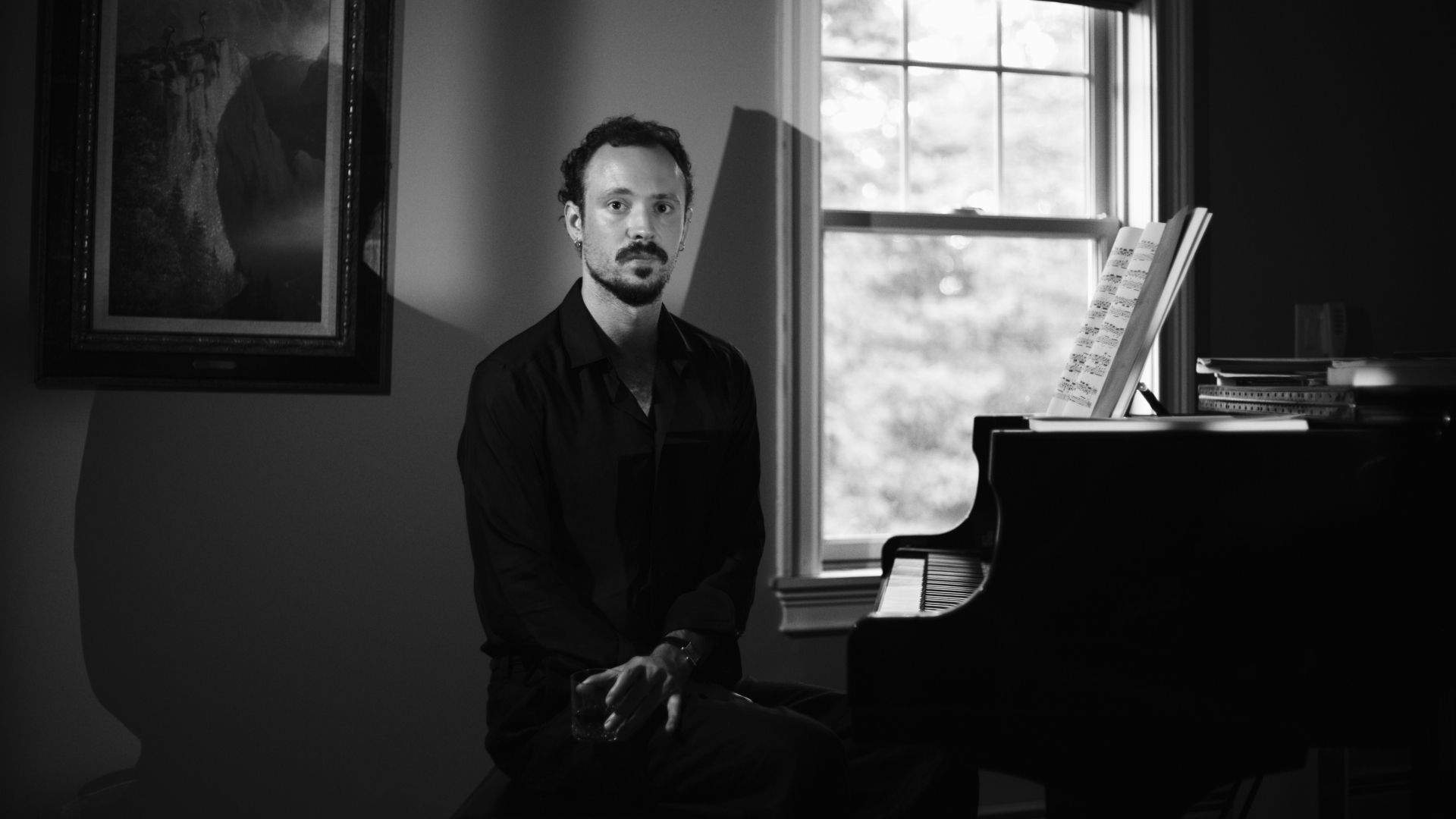
Eric Christian is a New York-based pianist and composer. Trained at Berklee and rooted in the classical tradition, his music prioritizes melody and emotional depth over production — he's sold over 100,000 scores to players in 200 countries who want to perform it themselves. We sat down with Eric to talk about his creative process, what it means to build out a full orchestral vision without a full orchestra, and why he's never been afraid to be early to something new.
You started playing piano at four and went on to study Film Scoring at Berklee College of Music. How did you find your way to the music you make now?
Honestly that’s probably the hardest question. For the longest time it seemed impossible to answer. Even my entire time at Berklee I had no idea what my voice as a composer was. I graduated with a degree in composition but felt as though I had never really written a piece of music. It wasn’t until sometime later after living in Paris and studying Satie, Saint-saens and Ravel that I really began to find out what I wanted to say as a composer.
How would you describe your music to someone who’s never heard it?
I would not try to describe it. I would let them listen and the music can speak for itself. I search for simple beautiful melodies that are universal. That is it.
“I often think if all the power went out in the world, what would be left? We would be back to where we started. I don’t trust electricity and I don’t trust technology, but a piece of paper, I trust that. ”
You've said that music is meant to be shared, not shown — and you've sold over 100,000 scores across 200 countries. What does writing music down mean to you that recording it doesn't?
Writing music down on paper is the foundation of all music. That is the language of music a recording is not. Remember most of the composers that inspire me never experienced recorded music in their lifetime. Recordings are just a bonus, something extra; the written language of music is the foundation. I often think if all the power went out in the world, what would be left? We would be back to where we started. I don’t trust electricity and I don’t trust technology, but a piece of paper, I trust that.
You’ve embraced what platforms like TikTok and Instagram can do to bring music to people – and now you're one of the first classical composers building seriously on Hooks. What draws you to new platforms before many people in your world are paying attention to them?
Andy Warhol said in the future everyone will be famous for 15 minutes. It's very true in today's modern age. It's very easy to be popular for a short time. But to stay relevant for a long time – that's what is difficult. I believe there is an audience for everything; you just have to find them. Every platform has a different audience, and the more you can diversify the better.
“Suno allows me the opportunity to hear the music as I truly intended in just a few seconds. Orchestral mockups used to take hours.”
Tell me how Suno fits into how you work. When does it come in, and what does it let you do?
Suno is my final check when I have something new. The way I work is writing these little loop melodies. Something that catches my ear and when it begins looping endlessly in my head – I know it’s a good one. They don’t come often. Although all of my music is for solo piano, that's not how I imagine it. I imagine it much bigger symphonically: how would this melody work and sound in a soundtrack? You take that melody and manipulate it many ways. Suno allows me the opportunity to hear the music as I truly intended in just a few seconds. Orchestral mockups used to take hours. When I’m really serious about a new melody, the final step is to put it into Suno and see if it really works. It's truly very exciting when it does.
Is there a piece you've made recently that you want to walk me through — how it started, how it came together?
Honestly they are all the same, really. Hemingway had a quote that said, “Just write one sentence, write the truest sentence you know,” in regards to writing a book. You just need one good, true line, and the rest is born from that. I think the same for music. I only need one good measure, everything else comes from that. Usually it's a random chance I sit down at the piano and my hands just go to it. I never hear melodies, it's my hands that find them. Which is another point – that I don’t really think of myself as creating them so much as I am discovering them.
When you enable remixes on a song, you're opening something you wrote to whoever wants to take it somewhere new. How do you feel about that?
Well, to be honest this has been happening for a long time for me already. I’ve sold thousands of copies of my scores; people have been doing things with my music for a long time. Recently, someone sent me a remix they did of my song “I Love You When I Drink Champagne,” and they hadn’t gotten a license to do so, but I was so pleasantly surprised with how it sounded I let them publish for free. I’m happy to inspire others to create. That’s the whole point of this.
What would you say to a classically trained musician who's been skeptical about tools like this?
You adapt or you die, it's as simple as this. It’s a tool and a brilliant one if you use it correctly. It’s opportunities like this that allow us to get ahead. Read Malcolm Gladwell's ‘Outliers.’ This is something new and unique we have right now that has never existed before – these are the things we take advantage of that let us rise above the rest.
You can find more of Eric Christian’s work on Suno, Instagram, TikTok, YouTube, X, and Spotify.