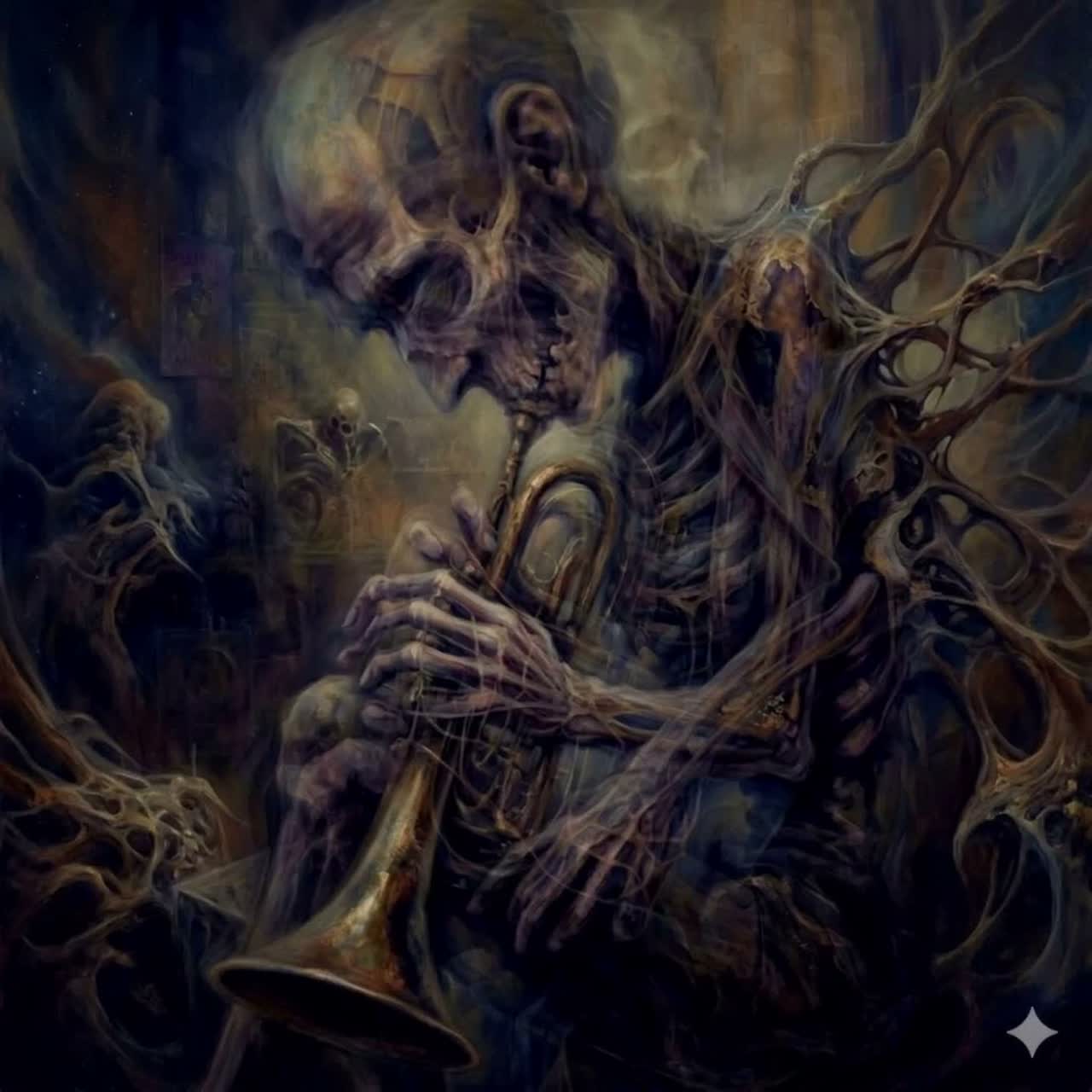
Horn for the Hollow Saint

There are distances beneath the earth for which no human faculty was designed. Not darkness. Darkness implies the possibility of light. This was older than that. The pilgrims who crossed the salt basins spoke often of the Horn, though never in its presence. The sound itself prohibited language. Men would begin a sentence only to forget midway through it what mouths were for. Entire caravans reportedly stood motionless for hours beneath the black obelisks, staring upward at carvings which seemed to rearrange themselves whenever directly observed. And always, from somewhere immeasurably far below the dunes, came that singular note. Not music. A pressure. A vast brazen exhalation rolling through the foundations of the world like the shifting of some planetary organ buried alive before history began. The sand trembled when it sounded. Ancient wells spat up warm air carrying the odor of rain striking hot metal. Animals bled from their nostrils and fled eastward into the dead territories. Yet the pilgrims continued toward it. There existed among them a belief that the Hollow Saint still wandered the subterranean cathedrals beneath the desert crust. Whether this entity had once been a god, a king, or merely the dream of some extinct species was impossible to determine. The oldest inscriptions depicted only an immense robed absence crowned with spiraled instruments resembling fossilized horns grafted directly into its torso. No face was ever shown. Only the cavity where one ought to have been. The Choir was heard three nights before arrival. At first the travelers mistook it for wind moving through ruined ventilation shafts buried beneath the dunes, but closer listening revealed structure within the sound: vast chords unfolding with impossible slowness, human voices bent into intervals no natural throat should sustain. There were harmonies which seemed to curve spatially around the listener, as though the air itself had acquired depth in directions previously unknown. Several pilgrims collapsed upon hearing them. One clawed out his own hearing organs with ceremonial hooks, mumbling that the voices were “looking inward.” Still the Horn continued. Calling from below. Calling with a grief too immense to belong to anything mortal. The final descent was recorded only once. The surviving fragments describe corridors large enough to contain weather, illuminated by a dim amber radiance issuing from veins in the walls which pulsed like the interior of some slumbering beast. Machinery older than civilization breathed steadily in the depths. Gigantic iron doors stood partially open, not by mechanism, but as if something colossal had forced itself through them long ago. Beyond the seventh gate they found the Saint. Or what remained. The account becomes unreliable thereafter. Sentences fracture. Measurements lose meaning. One passage repeatedly insists that the Horn was not being played at all, but rather that the entire structure itself was attempting to sing through the corpse enthroned at its center. The last coherent line reads simply: It knew we had finally become empty enough to hear it.
