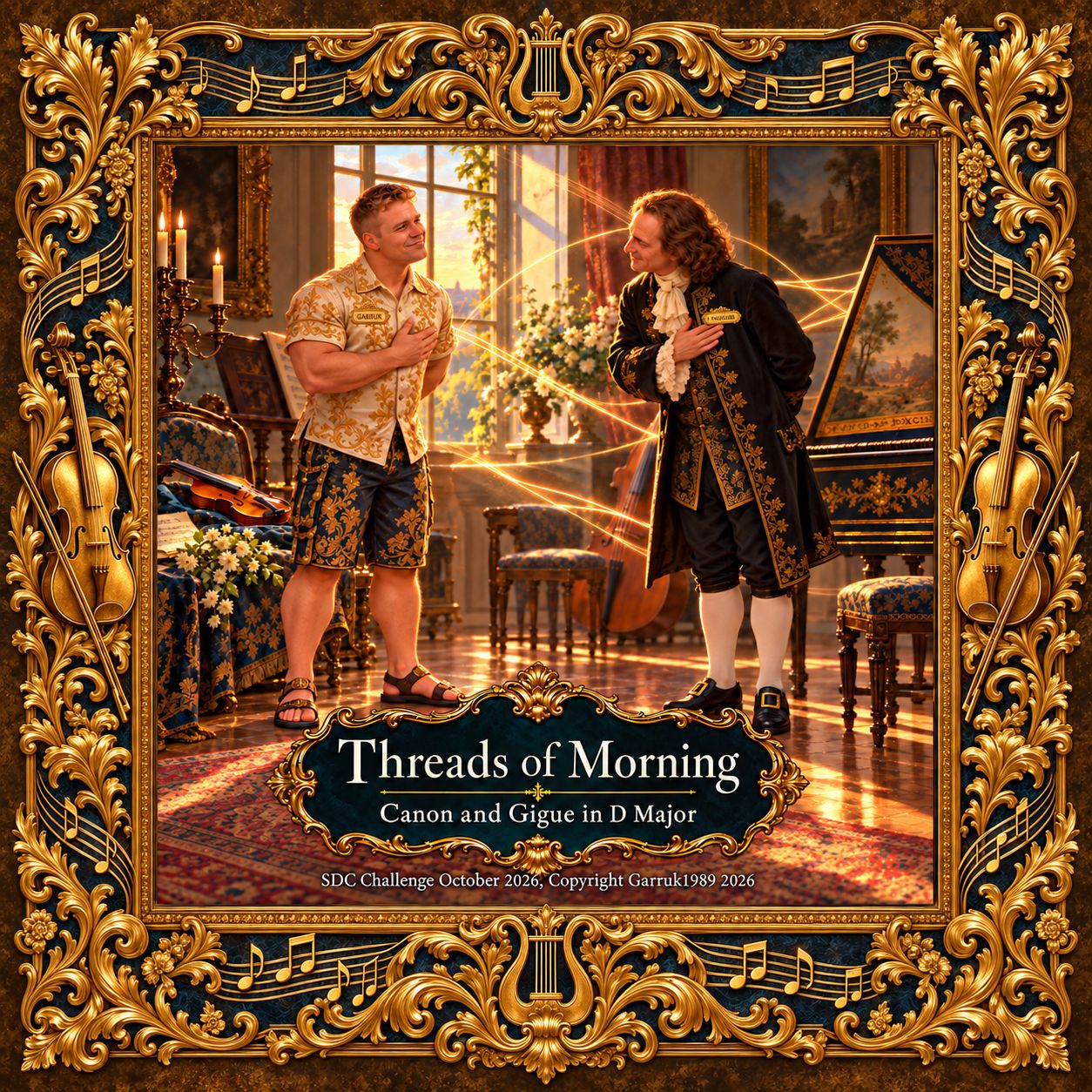

[Instrumental] [Title: Threads of Morning — Canon and Gigue in D Major] [An original two-movement Baroque composition modeled on Johann Pachelbel’s Canon and Gigue in D major. Use the same instrumentation throughout: three violins and basso continuo, realized by cello and harpsichord. Create original melodies and contrapuntal developments using the D-major pitch collection: D, E, F♯, G, A, B, C♯.] [Movement I — Canon in D Major] [Measured and flowing, in 4/4 time.] [Begin with cello and restrained harpsichord establishing the eight-note, two-bar ground bass: D–A–B–F♯–G–D–G–A. State this pattern 28 times in total. Harmonic sequence: D major–A major–B minor–F♯ minor–G major–D major–G major–A major.] [Introduce an original melody in violin I. Violin II enters two bars later, followed by violin III after another two bars. All three violins follow the same melodic line in strict canon at the unison. Compose the melody so that its overlapping entries produce coherent Baroque counterpoint above the ground bass.] [Develop from spacious quarter-note phrases into flowing eighth notes, expressive suspensions, sequential figures, and intricate sixteenth-note passages. Maintain clear independent voices and a steady bass. Gradually return to broader phrases. After the twenty-eighth bass statement, add a final cadential bar resolving in D major.] [Brief pause between movements.] [Movement II — Gigue in D Major] [Lively and buoyant, in 12/8 time. Retain the three violins, cello, and harpsichord.] [Introduce a new original dance subject built from the same D-major pitch collection. Give it springing compound-meter rhythms, nimble melodic turns, and crisp articulation. Bring the violins into lively imitative dialogue, supported by an active, harmonically responsive continuo bass.] [Use a two-part Baroque dance form with both sections repeated. Let the first section move from D major toward A major. Begin the second section with a fresh contrapuntal treatment of the dance subject, pass through related harmonies, and return decisively to D major.] [Replace the Canon’s repeating ground bass with a freely moving continuo line. Preserve the Gigue’s energetic 12/8 pulse, transparent counterpoint, and balanced dance phrases. Finish with a clear, spirited cadence in D major.] [Perform both movements in order as one complete work. Entirely instrumental.]
