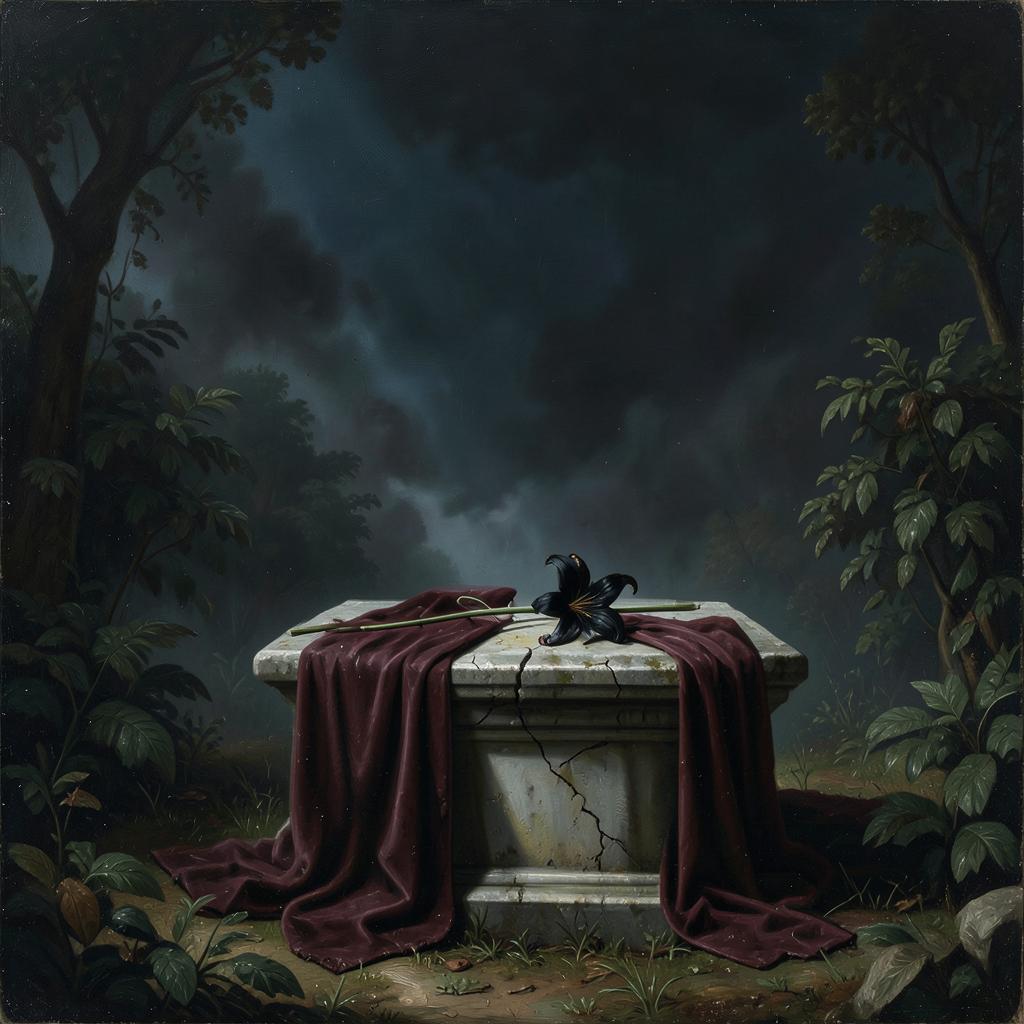

[STRICTLY INSTRUMENTAL ORCHESTRAL COMPOSITION] [NO SINGING, NO SPEECH, NO CHOIR, NO CHANTING, NO HUMMING, NO WHISPERING] [NO HUMAN VOCAL SOUNDS OF ANY KIND] [ACOUSTIC CENTRAL EUROPEAN ORCHESTRA, EARLY TWENTIETH CENTURY] [RETAIN THE SUPPLIED ORLOK LEITMOTIF AS THE PRIMARY THEMATIC MATERIAL] [TRANSFORM THE LEITMOTIF INTO A SLOW, OPPRESSIVE FUNERAL DIRGE] [MAINTAIN A GRAVE, HEAVY, MEASURED PROCESSIONAL CHARACTER THROUGHOUT] [NO FAST PASSAGES, NO ACTION MUSIC, NO DRAMATIC HORROR STINGERS] [NO HEROIC OR TRIUMPHANT ORCHESTRATION] [NO SENTIMENTAL OR REDEMPTIVE HARMONIC RESOLUTION] [SECTION I: THE PROCESSION] [Tempo: Largo funebre, extremely slow and deliberate] [Dynamic: Pianissimo] [Contrabasses establish a heavy, measured funeral pulse] [Low cellos sustain dark, widely spaced harmonic intervals] [Muted horns introduce a distant, solemn descending figure] [Contrabassoon reinforces the lowest orchestral register] [Solo cello enters with the recognizable opening phrase of Orlok's leitmotif] [Stretch the original rhythmic values into long, exhausted phrases] [Preserve the melodic contour and identifying intervals] [Allow substantial silence between phrases] [Harmony moves slowly through chromatic suspensions] [The music should feel ancient, exhausted, and inevitable] [SECTION II: THE WEIGHT OF DEATH] [Dynamic: Piano to mezzo-piano] [Low strings establish a slow, regular processional tread] [Muted trombones sustain dark, closely spaced dissonances] [Bass clarinet doubles selected notes of the cello leitmotif] [Violas introduce descending chromatic counterlines] [Restrained timpani marks occasional structural downbeats] [Very soft muffled bass drum reinforces the funeral procession] [Maintain sparse percussion and avoid a conventional rhythmic groove] [Use minor seconds, diminished intervals, and unresolved suspensions] [The orchestral texture grows heavier without accelerating] [No bright upper-register melodies] [No conventional Romantic swell] [SECTION III: ORLOK'S LAMENT] [Dynamic: Mezzo-piano] [Solo cello presents the complete Orlok leitmotif in rhythmic augmentation] [The melody must remain clearly recognizable] [Divided violas sustain slowly shifting dissonant harmonies] [Contrabasses provide a deep, almost motionless foundation] [Muted French horns answer with short, hollow fragments of the leitmotif] [Contrabassoon and bass clarinet reinforce the dark orchestral color] [Upper violins enter only as extremely quiet sustained dissonances] [Allow the melodic phrases to sag and decay naturally] [Maintain a sense of profound desolation without sentimental warmth] [No lyrical romantic climax] [SECTION IV: THE FUNERAL MARCH] [Dynamic: Mezzo-forte, heavy but restrained] [Full low string ensemble states Orlok's leitmotif in broad unison] [Low trombones reinforce the principal melodic contour] [Muted horns sustain dark harmonic suspensions] [Timpani articulates a sparse, solemn funeral tread] [Contrabasses move in slow, deliberate descending figures] [Upper strings create restrained chromatic friction] [Increase orchestral weight through register and harmonic density] [Do not increase tempo] [Do not introduce rapid tremolos or aggressive rhythmic figures] [The procession must feel inexorable and physically burdensome] [Allow dissonances to remain unresolved] [SECTION V: THE TOMB] [Dynamic: Gradually diminishing to pianississimo] [The processional pulse begins to disappear] [Low brass withdraws] [Contrabasses sustain a final unstable pedal tone] [Solo cello restates a fragment of Orlok's leitmotif] [Stretch the final notes into increasingly long durations] [Bass clarinet sustains a quiet dissonance beneath the cello] [High violins hold a barely audible harmonic] [The remaining orchestral texture slowly disintegrates] [End with an unresolved minor-second suspension] [No final major chord] [No triumphant resolution] [No sentimental cadence] [Allow the final sound to disappear into silence] [FINAL PERFORMANCE RESTRICTIONS] [INSTRUMENTAL ONLY] [NO HUMAN VOICE] [NO SINGING] [NO CHOIR] [NO CHANTING] [NO HUMMING] [NO WHISPERING] [NO SPEECH] [NO VOCAL SAMPLES] [NO SYNTHESIZERS] [NO ELECTRONIC SOUND DESIGN] [NO MODERN CINEMATIC PERCUSSION] [NO FAST ORCHESTRAL PASSAGES] [NO HEROIC BRASS] [NO EMOTIONAL REDEMPTION] [MAINTAIN SLOW FUNEREAL CHARACTER THROUGHOUT]
