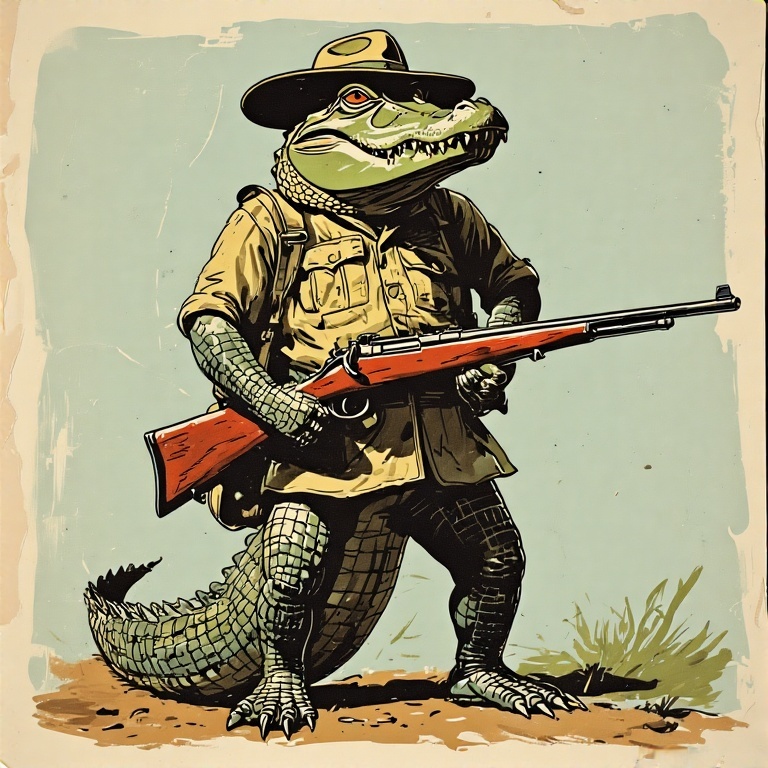

[Hook] The saltwater crocodile. (Crocodylus porosus). The saltwater crocodile. (Crocodylus porosus). The saltwater crocodile. (Crocodylus porosus). The saltwater crocodile. (Crocodylus porosus). [Verse] It is also called, estuarine crocodile, Indo-Pacific crocodile, marine crocodile, sea crocodile, and, informally, the saltie. (the saltie.) [Hook] The saltwater crocodile. (Crocodylus porosus). The saltwater crocodile. (Crocodylus porosus). The saltwater crocodile. (Crocodylus porosus). The saltwater crocodile. (Crocodylus porosus). [Verse] Is a crocodilian native to saltwater habitats, wetlands and freshwater rivers is just where it's at. from India's east coast across Southeast Asia, and the Sundaland to northern Australia and Micronesia. It's been less Concern 1996 and within, It was hunted up to the 70s merely for its skin. Although it is threatened and illegal now to kill , It is regarded as dangerous to find humans for a thrill. [Hook] The saltwater crocodile. (Crocodylus porosus). The saltwater crocodile. (Crocodylus porosus). The saltwater crocodile. (Crocodylus porosus). The saltwater crocodile. (Crocodylus porosus). [Verse] The saltwater crocodile is the largest living reptile. Males can grow up to a weight of 1,000–1,500 kilograms and a length of 6 meters, rarely exceeding 6.3 meters . Females are much smaller and rarely surpass 3 meters). A large and opportunistic hypercarnivorous apex predator, they ambush most of their prey and then drown or swallow it whole. They will prey on almost any animal that enters their territory, including other predators such as sharks, varieties of freshwater and saltwater fish including pelagic species, invertebrates such as crustaceans, various amphibians, other reptiles, birds, and mammals.
