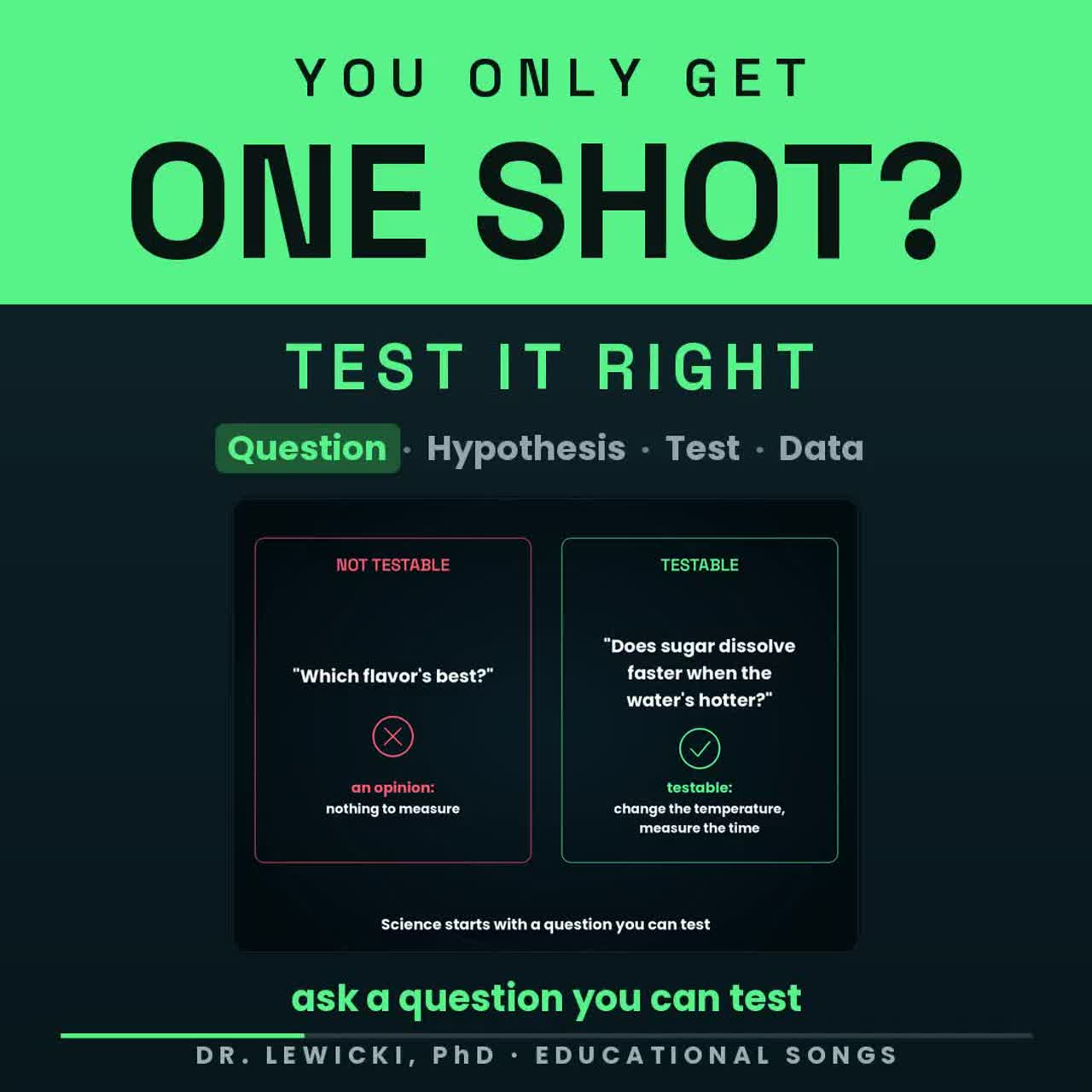
Scientific Method: You Only Get One Shot (Test It Right)
[Intro: spoken, cinematic strings, single piano note, drums kick in] Listen... One question One test Change one thing, measure what happens And let the data talk Will you test it right? Or just guess? [Verse 1] Science starts with a question you can test — not "Which flavor's best?" but "Does sugar dissolve faster when the water's hotter?" Do your research first — read what's already known, so you start where other scientists stopped, and then you go farther. Next, a hypothesis — a testable prediction with a reason built in: if, then, because — a cause, an effect, and why, "If the water's warmer, then the sugar will dissolve faster, because warm water molecules move faster" — now it's ready to try. The one thing you change on purpose is the independent variable — the water temperature: cold, room or hot, The thing you measure is the dependent variable — the seconds till the sugar's gone; it depends on which water it got. Everything else stays the same — the controlled variables: same sugar, same water, same cup, same stirring speed, Change two things at once, and you can't tell which one did it — one change at a time is the rule you need. [Pre-Chorus] A control group is your baseline — room-temperature water, nothing changed, to compare the others to, Run three trials at each temperature — three cups each — because one cup alone could fool you. Write the procedure step by step — exact amounts, exact times — and measure with tools: a stopwatch, a thermometer, a scale, So another scientist can repeat your test the same way — and if they get the same results, your results prevail. [Chorus] You only get one shot — test it right, Ask a question, make a hypothesis — if, then, because — and keep it tight, Change one variable, measure one — keep everything else the same, Use a control and repeat the trials — so chance can't take the blame. This is your moment — let the data lead, Put it in a table, graph it — find the pattern that you need, You only get one shot — say what's true, Supported or not supported — the data decides, not what you wanted it to do. [Verse 2] Data comes in two kinds — quantitative is numbers, like seconds and grams; qualitative is words, like "cloudy" or "clear," Put it in a data table and average the three trials at each temperature — so one odd cup can't steer. Worked example — cold water, ninety seconds; room temperature, sixty; hot water, twenty-five — the average of three tries, Graph it — temperature on the x-axis, seconds on the y-axis — the line slopes down; the hypothesis is supported, no surprise. Supported doesn't mean proved — a new test could still find something new; science stays open to change, And if the data doesn't support it, that's not failure — revise the hypothesis and test it again. In sixteen sixty-eight, Francesco Ray-dee put meat in jars — some left open, some covered with gauze — a fair test, Maggots grew only where flies could land and lay their eggs — not from the rotting meat; the data settled the rest. [Pre-Chorus] Check the facts before you write — a hypothesis is a testable prediction; a theory is a well-tested explanation, like cell theory, A law describes what happens; a theory explains why — a theory never grows up into a law; they do different jobs, you see. Share your results so others can check them — that's peer review — and name your sources of error, like a slow thumb on the stopwatch, too, Test it right — one change, many trials, honest data — and let the evidence tell you what is true. [Chorus] You only get one shot — test it right, Ask a question, make a hypothesis — if, then, because — and keep it tight, Change one variable, measure one — keep everything else the same, Use a control and repeat the trials — so chance can't take the blame. This is your moment — let the data lead, Put it in a table, graph it — find the pattern that you need, You only get one shot — say what's true, Supported or not supported — the data decides, not what you wanted it to do. [Bridge: spoken over swelling strings] Breathe. Ask the question. If... then... because. Change one thing. Measure one thing. Keep the rest the same. A control group. Three trials. The average. A table. A graph. A pattern. Supported — or not. Now write it down — and test it right. [Chorus] You only get one shot — test it right, Ask a question, make a hypothesis — if, then, because — and keep it tight, Change one variable, measure one — keep everything else the same, Use a control and repeat the trials — so chance can't take the blame. This is your moment — let the data lead, Put it in a table, graph it — find the pattern that you need, You only get one shot — say what's true, Supported or not supported — the data decides, not what you wanted it to do. [Outro: single words, fading] Question... Hypothesis... Variable... Control... Data... Graph... One shot... Tested.
