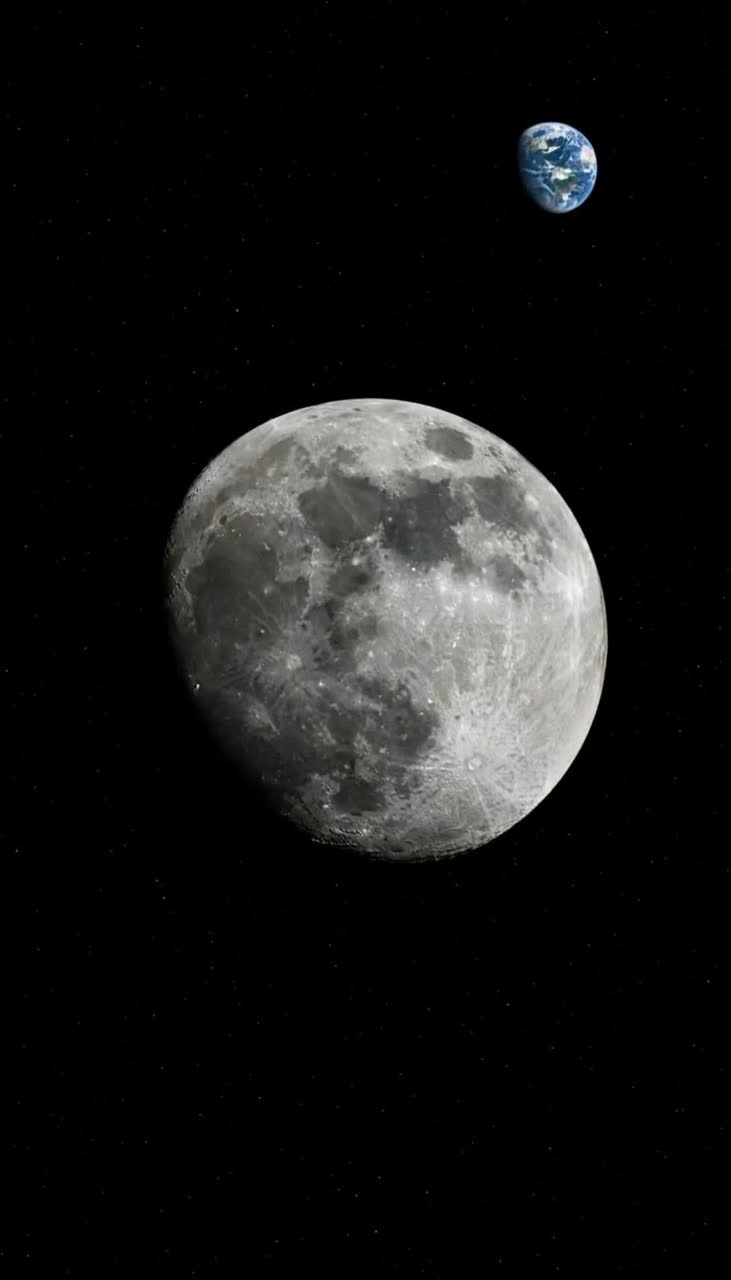

The Moon is Earth’s only natural satellite, orbiting at an average distance of about 384,400 kilometers and formed roughly 4.5 billion years ago, most likely from debris after a giant impact in the early solar system. Its surface is marked by vast dark basaltic plains, rugged highlands, and countless impact craters preserved by the absence of a significant atmosphere, creating sharp contrasts between light and shadow. Through its gravitational pull, the Moon drives Earth’s ocean tides, stabilizes the planet’s axial tilt, and slowly recedes at about 3.8 centimeters per year, serving as a crucial record of planetary formation and the early history of rocky worlds.
