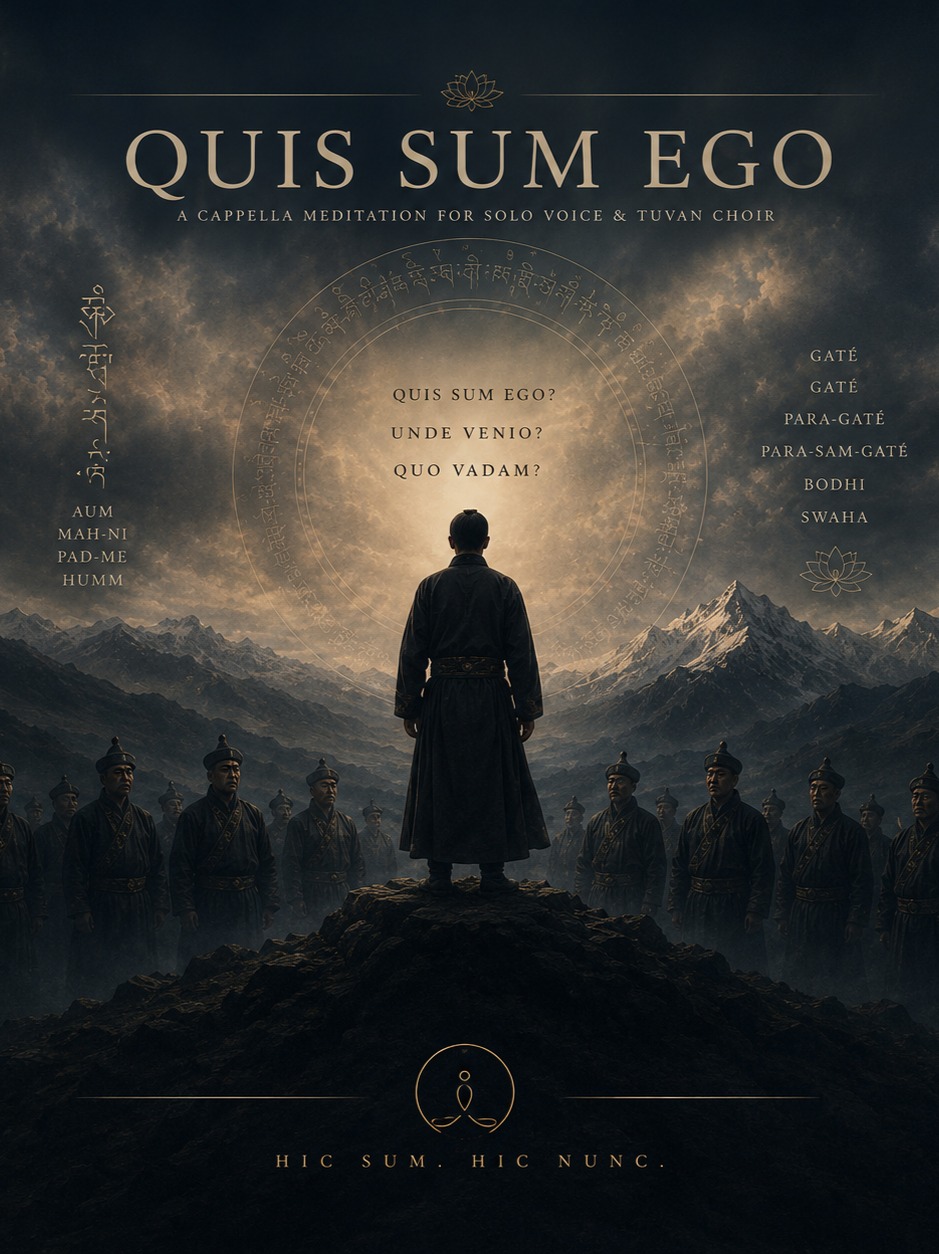

[Titel: Quis Sum Ego] [Definition] [Style:] [Positiv: A cappella | No instruments | Pure human voices | Tuvan throat singing choir | Deep basso profondo drone | Operatic dramatic male solo tenor | Call and response | (sec. mini Instrument:1.2)] [Negativ: (Instrumente,/Instruments:0.8)] [/Definition] [Intro] [Choir: Tuvan throat singing drone] Aum Mah-ni Pad-me Humm Aum Mah-ni Pad-me Humm Aum Mah-ni Pad-me Humm [Lead Solo: Operatic male voice] Quis sum ego? [Choir: Deep throat chanting] Aum Mah-ni Pad-me Humm [Lead Solo: Operatic male voice] Unde venio? [Choir: Deep throat chanting] Aum Mah-ni Pad-me Humm [Lead Solo: Operatic male voice] Quo vadam? [Choir: Deep throat chanting] Aum Mah-ni Pad-me Humm [Verse 1] [Lead Solo: Operatic male voice] Tempus fluit sicut aqua. Dies venit et discedit. Corpus mutatur. Mens vagatur. [Choir: Deep throat chanting] Gaté Gaté Para-gaté Para-sam-gaté Bodhi Swaha [Lead Solo: Operatic male voice] Quaero sensum. Quaero pacem. Quaero veritatem. [Choir: Deep throat chanting] Gaté Gaté Para-gaté Para-sam-gaté Bodhi Swaha [Verse 2] [Lead Solo: Operatic male voice] Omnia oriuntur. Omnia transeunt. Nihil manet. Nihil possideo. [Choir: Deep throat chanting] Aum Mah-ni Pad-me Humm [Lead Solo: Operatic male voice] Si nihil manet, quid timendum est? [Choir: Deep throat chanting] Aum Mah-ni Pad-me Humm [Lead Solo: Operatic male voice] Si omnia fluunt, quid retinendum est? [Choir: Deep throat chanting] Aum Mah-ni Pad-me Humm [Outro] [Lead Solo: Operatic male voice] Hic sum. Hic nunc. [Choir: Lead + Deep throat chanting] Gaté Gaté Para-gaté Para-sam-gaté Bodhi Swaha [Lead Solo: Operatic male voice] Respiro. [Choir: Deep throat chanting] Aum Mah-ni Pad-me Humm [Lead Solo: Operatic male voice] Audio. [Choir: Deep throat chanting] Aum Mah-ni Pad-me Humm [Unison: Lead Solo and Choir together] Gaté Gaté Para-gaté Para-sam-gaté Bodhi Swaha [Fade Out] [Choir: Only deep vocal drone] Aum Mah-ni Pad-me Humm [Unison: Lead Solo] Gaté Gaté Para-gaté Para-sam-gaté Bodhi Swaha [Choir: Only deep vocal drone] Aum Mah-ni Pad-me Humm [End] ------------------ 𝓓𝓮𝓻 𝓗𝓲𝓷𝓽𝓮𝓻𝓰𝓻𝓾𝓷𝓭 Dieses Stücks lässt sich als Begegnung dreier spiritueller Traditionen verstehen: der lateinisch-abendländischen Philosophie, des tibetischen Buddhismus und des archaischen Obertongesangs aus Tuwa. Es geht dabei nicht um Religion im engeren Sinn, sondern um die universelle Suche nach dem Wesen des Menschen. 𝓑𝓮𝓭𝓮𝓾𝓽𝓾𝓷𝓰 𝓭𝓮𝓼 𝓣𝓮𝔁𝓽𝓮𝓼 Die Reise beginnt mit den drei Urfragen der Philosophie: Quis sum ego? – Wer bin ich? Unde venio? – Woher komme ich? Quo vadam? – Wohin gehe ich? Diese Fragen ziehen sich durch die gesamte Menschheitsgeschichte – von der Antike über das Christentum bis zu östlichen Weisheitslehren. Dem gegenüber stehen zwei buddhistische Mantras: Om Mani Padme Hum (korrekt traditionell mit Om statt Aum) gilt als das Mantra des Mitgefühls. Es wird mit Reinigung, Weisheit und dem Erwachen des Herzens verbunden. Gate Gate Paragate Parasamgate Bodhi Svaha stammt aus dem Herzsutra und bedeutet sinngemäß: "Gegangen, gegangen, ganz hinübergegangen, vollständig hinübergegangen – Erwachen!" Es beschreibt den Weg über die Illusion des Ichs hinaus. ---------------------------- 𝓓𝓲𝓮 𝓑𝓸𝓽𝓼𝓬𝓱𝓪𝓯𝓽 𝓭𝓮𝓼 𝓛𝓲𝓮𝓭𝓮𝓼 Der Solist stellt Fragen. Der Chor antwortet nicht mit Erklärungen, sondern mit Mantras. Das ist die eigentliche Aussage: Manche Fragen können nicht gedacht, sondern nur erfahren werden. Die Suche endet nicht mit Wissen, sondern mit Gegenwart. Horizon's Reflection / © 2026 by ᚾᚨ~ᛋᚢ | AI-GENERATED CONTENT | gem. Art. 50 EU AI Act – Verordnung (EU) 2024/1689.
