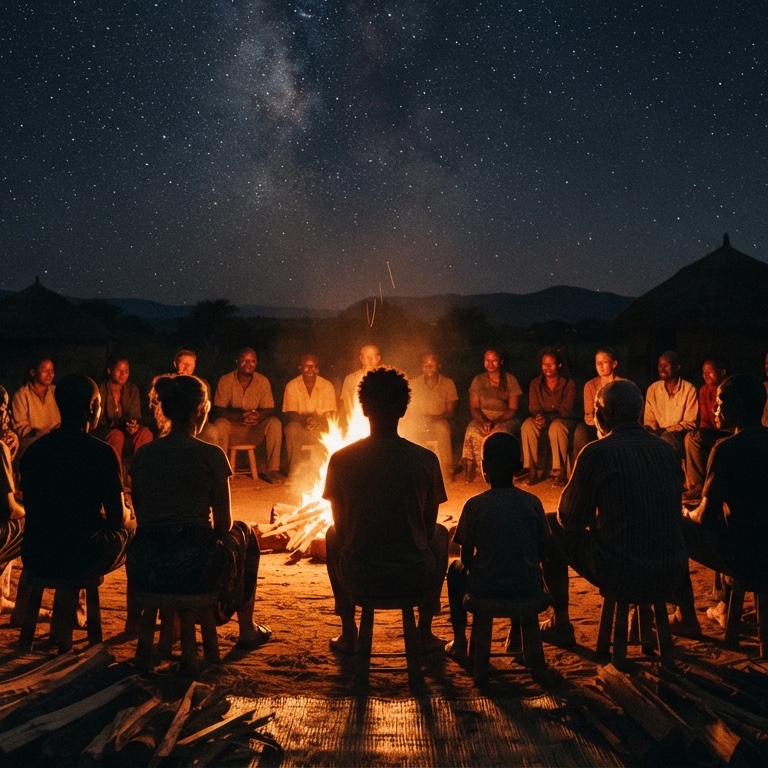
[Seven Doors is a song cycle built on seven doors, seven life stories, and seven iconic music styles paired with their native regional instruments. Each door represents a distinct stage of one man's life - and a musical tradition chosen not for decoration, but because its cultural origin and instrumental voice genuinely embody that stage's emotional truth. Just as world cuisines each carry a distinct, recognizable identity (Italian, Chinese, and so on), these seven genres are each globally iconic in their own right - Celtic folk, flamenco, blues/gospel, tango, Middle Eastern Hijaz folk, West African kora music, Chinese guqin - so that the listener recognizes the "genre" instantly, the way one recognizes a cuisine by taste. The same male voice narrates all seven doors, aging and transforming across the cycle, until the final door circles back to the first.] [Seven Doors - Door 6 - Kinship / Belonging West African Kora Music Having learned surrender in the wilderness, he no longer wanders alone - he is taken in by strangers. "Home" here is not the home of blood, but a tribe willing to hold him. He finally understands: the wounds he's been carrying don't have to be carried alone. Kora music originates from the West African griot oral tradition, where music itself functions as a vessel for family and communal memory - a natural fit for the theme of rediscovering belonging. The kora's layered, arpeggiated texture - a single player sounding like multiple voices in unison - precisely mirrors the sensation of one voice merging into a collective, replacing the solitary, monologue-like melodic line of Door 5's oud. The vocals shift for the first time to call-and-response harmony rather than a solo lead, paying off the foreshadowing planted by Door 3's gospel choir: there, it was "a community witnessing one person's collapse"; here, it becomes "a community actively welcoming." The djembe and talking drum restore a driving rhythmic pulse, but of a different nature than Door 2's palmas - no longer the drive of one person burning alone, but the resonance of a collective heartbeat.] [Intro] I came to a village I'd never seen They knew my name before I spoke A fire was burning in the center Waiting like it always was [Verse 1] I told them of the roads I'd wandered Of every door I'd left behind They did not ask why I had left them They only asked to see me now An old man placed his hand upon me "You carry more than you should carry alone" [Chorus] Sit with us, sit with us The fire does not ask where you've been Sit with us, sit with us We were waiting for you to walk back in [Verse 2] I learned their songs before their language I felt the rhythm before the words The children pulled me into circles I had not danced since I was young I did not lead, I only followed For the first time, that was enough [Chorus] Sit with us, sit with us The fire does not ask where you've been Sit with us, sit with us We were waiting for you to walk back in [Bridge] Somewhere far behind me A hillside, a flame, a ruined hall, a room I brought them all here with me And no one turned away They said, "we are made of what we carry Let us carry it with you" [Verse 3] I used to think that I was walking Alone, unseen, from door to door Now I see the hands beside me Were always there, just out of sight The desert taught me how to listen This village taught me how to stay [Final Chorus] Sit with us, sit with us You do not have to earn your place Sit with us, sit with us The circle always had your space [Outro] We were waiting for you We were waiting for you Waiting for you to walk back in
