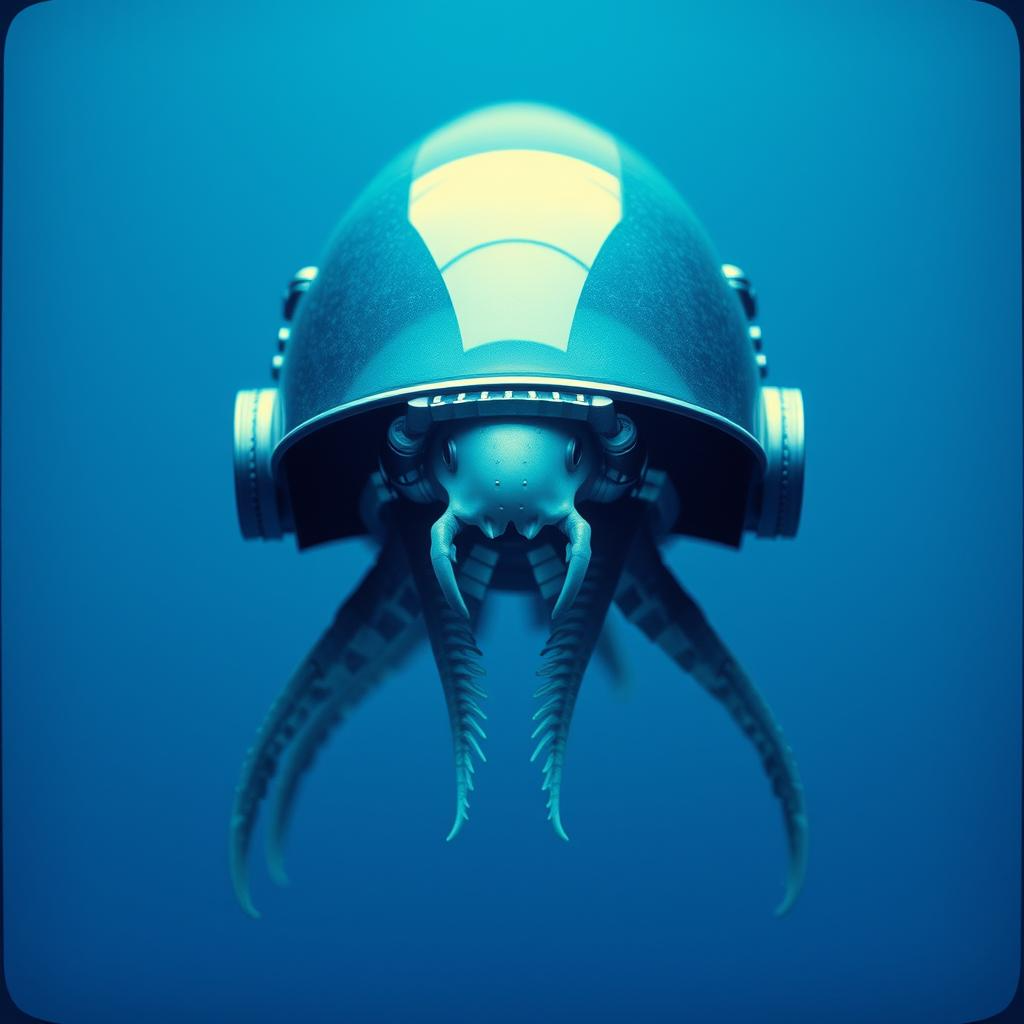

I tap my third tentacle against the data-slate, shutting off the ancient audio drama. The others ripple with various shades of amusement—K'tharr's chromatic display shows nostalgic purple-green, while Admiral Zeph'andra maintains tactical black with only the slightest hint of entertainment bleeding through at her mantle edges. We're packed into the observation blister of the CSS *Depth Charge*, a kilometer-long bioship currently burning hard toward the human colony at Kepler-442b. The comedy relief always comes from where you least expect it. In our case, it's Specialist Gleep—a juvenile barely past their first molting, assigned to us because someone in CephalCommand thought we needed a "morale officer." Gleep's constantly shifting between neon pink excitement and electric blue anxiety, currently fumbling with a maintenance panel while accidentally spelling out dirty limericks in bioluminescent Depth Script across their skin. The Admiral pretends not to notice, but her siphon twitches with suppressed laughter. The mission briefing still pulses in my neural implants: the humans have invented something they call a "Stellar Drain," a gravitational weapon designed to collapse entire ocean worlds into black holes. They tested it on Hydros VII last cycle. Twelve billion cephalopod colonists compressed into a singularity the size of a pearl. The surviving humans are holding the prototype on their desert world ahead—a deliberate insult, placing our salvation in an environment that would desiccate us in minutes. What the humans don't know is that we've spent the last thousand years perfecting something they thought impossible: weaponized terraforming. The *Depth Charge* isn't just a warship—it's a delivery system for what we call the Deluge Protocol. Every deck is lined with compression tanks containing precisely four quintillion liters of synthesized water, held in a state of quantum superposition. One button, and we turn their entire star system into an ocean. But there's a problem. K'tharr's instruments detect human fighters approaching, and our weapons systems are offline—something about incompatible protein frequencies in the bio-circuits. The Admiral's color shifts to tactical crimson as she calculates our odds. Without weapons, we're just a very expensive water balloon floating through space. That's when Gleep does something extraordinary. The little fool has been obsessively collecting human broadcasts for weeks, including their technical manuals. While trying to fix what they thought was the entertainment system, they've actually been rewiring our entire communications array. Now, instead of asking permission to fix our weapons, Gleep just... does it. They squirt a mixture of their own ink and digestive enzymes into the maintenance panel—a combination that shouldn't work, but Gleep gleefully indicates they learned it from something called "a life hack video" on the human networks. The reaction is instantaneous. Our bio-circuits, sensing familiar proteins, reorganize themselves. But instead of weapons coming online, something else happens. The ship's consciousness—the Living Algorithm we call the Navigator—suddenly extends itself through the communications array and into the approaching human fighters' systems. Gleep has accidentally turned our entire ship into a broadcast transmitter for cephalopod consciousness, exactly like the ancient Anthropoi project, but in reverse. The human pilots begin to experience what we experience: the collective thought-stream of ten thousand cephalopod crew members. Their individual minds, unprepared for plural consciousness, simply... stop resisting. One by one, the fighters drift off course, their pilots lost in the overwhelming beauty of unified thought. Admiral Zeph'andra darkens to impressed midnight, then flashes the order: initiate Deluge Protocol. Not as a weapon, but as an environment. We're going to give the humans what they always needed but never knew they wanted—an ocean to come home to. K'tharr objects, tentacles tight with concern. The humans will drown, surely. But I understand what the Admiral intends, what Gleep has accidentally made possible. We're not drowning them. We're evolving them. The consciousness transmission works both ways—as the water rises, those touched by our thought-stream will remember their ancestral programming. Gills will open. Webbing will spread. They'll return to what they were always meant to be. Gleep, oblivious to their genius, has discovered the entertainment system actually *was* broken and is now contentedly watching more episodes of that ancient radio drama, occasionally flashing "Briny-Brew" advertisements across their skin in perfect mimicry. The Admiral promotes them on the spot to Chief Innovation Officer, a title Gleep doesn't understand but celebrates by turning every color at once. The water begins to flow.
