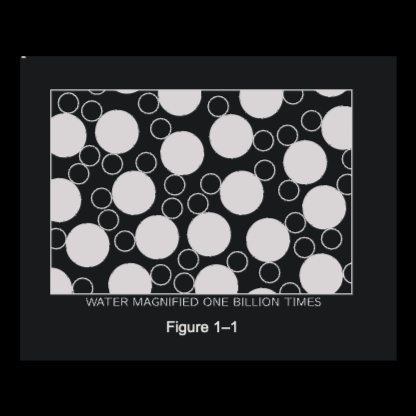

If, in some cataclysm, all of scientific knowledge were to be destroyed, and only one sentence passed on to the next generations of creatures, what statement would contain the most information in the fewest words? I believe it is the atomic hypothesis that all things are made of atoms—little particles that move around in perpetual motion, attracting each other when they are a little distance apart, but repelling upon being squeezed into one another. In that one sentence, you will see, there is an enormous amount of information about the world, if just a little imagination and thinking are applied. To illustrate the power of the atomic idea, suppose that we have a drop of water a quarter of an inch on the side. If we look at it very closely we see nothing but water—smooth, continuous water. Even if we magnify it with the best optical microscope available—roughly two thousand times—then the water drop will be roughly forty feet across, about as big as a large room, and if we looked rather closely, we would still see relatively smooth water—but here and there small football-shaped things swimming back and forth. Very interesting. These are paramecia. You may stop at this point and get so curious about the paramecia with their wiggling cilia and twisting bodies that you go no further, except perhaps to magnify the paramecia still more and see inside. This, of course, is a subject for biology, but for the present we pass on and look still more closely at the water material itself, magnifying it two thousand times again. Now the drop of water extends about fifteen miles across, and if we look very closely at it we see a kind of teeming, something which no longer has a smooth appearance—it looks something like a crowd at a football game as seen from a very great distance. In order to see what this teeming is about, we will magnify it another two hundred and fifty times and we will see something similar to what is shown in Fig. 1–1. This is a picture of water magnified a billion times, but idealized in several ways. In the first place, the particles are drawn in a simple manner with sharp edges, which is inaccurate. Secondly, for simplicity, they are sketched almost schematically in a two-dimensional arrangement, but of course they are moving around in three dimensions. Notice that there are two kinds of “blobs” or circles to represent the atoms of oxygen and hydrogen, and that each oxygen has two hydrogens tied to it. The picture is idealized further in that the real particles in nature are continually jiggling and bouncing, turning and twisting around one another. You will have to imagine this as a dynamic rather than a static picture. Another thing that cannot be illustrated in a drawing is the fact that the particles are “stuck together”—that they attract each other, this one pulled by that one, etc. The whole group is “glued together,” so to speak. On the other hand, the particles do not squeeze through each other. If you try to squeeze two of them too close together, they repel.
