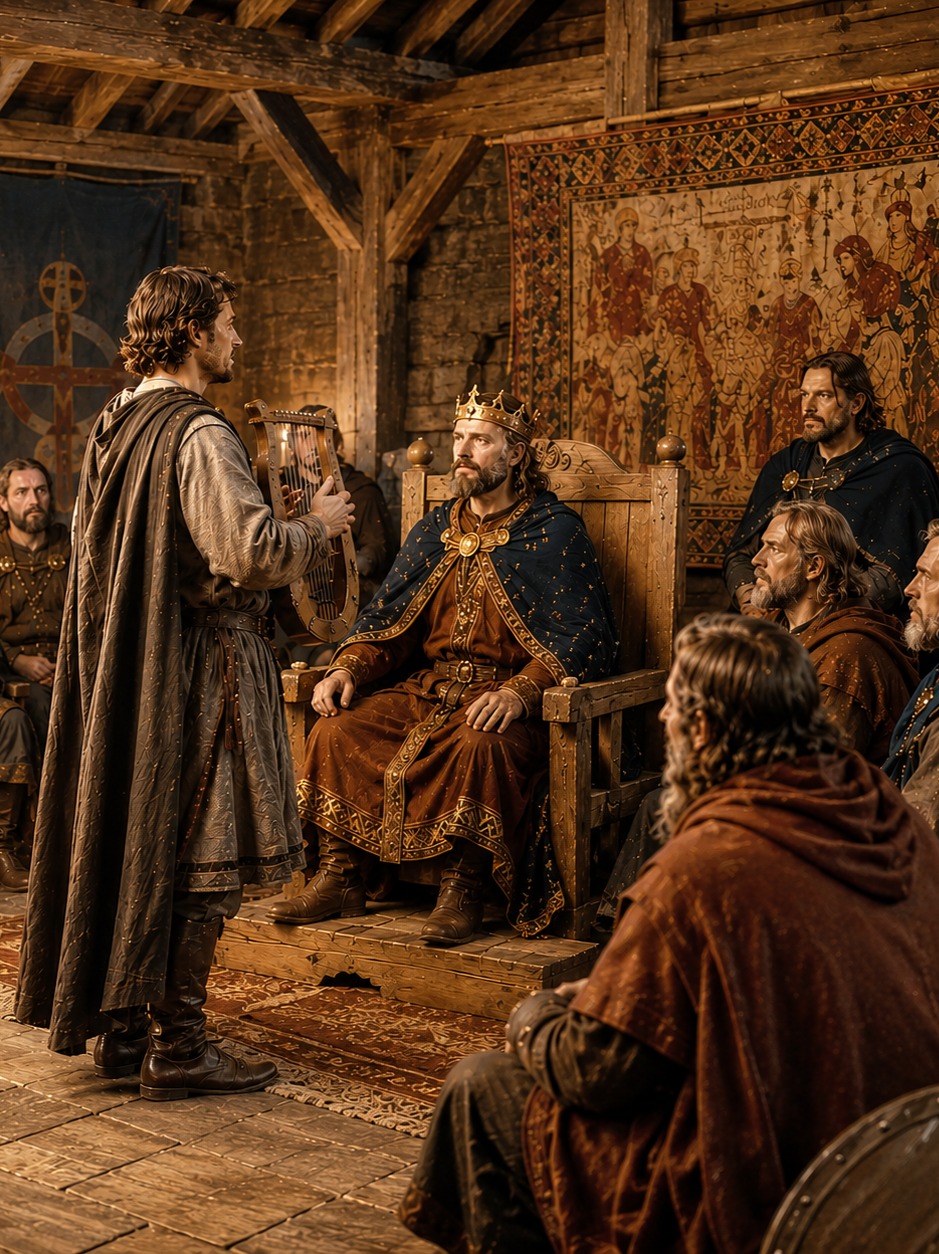
Voices of the Early Middle Ages

The Hildebrandslied is the only surviving example of an Old High German heroic lay, preserved in a 9th-century Carolingian manuscript. Written primarily in an Old High German dialect with some Old Saxon linguistic features, it recounts an episode from the legend of Dietrich of Bern. After about thirty years in exile, Hildebrand returns and encounters the young warrior Hadubrand, who turns out to be his own son. Although Hildebrand reveals his identity and offers gifts as a sign of kinship, Hadubrand rejects him, believing his father to be dead. Bound by the warrior code and their conflicting sense of honor, father and son are forced into a duel. The poem breaks off before revealing the outcome. According to a later Old Norse tradition, Hadubrand is killed. The following musical setting is a reconstruction inspired by archaeological evidence, historical sources, and the better-documented tradition of early medieval church chant. It does not claim to be historically authentic; rather, it is intended as an artistic interpretation of the possible soundscape of the Early Middle Ages. Although the composition was conceived as a monophonic and largely unaccompanied performance, the AI was unable to consistently generate a single vocal line or omit percussion instruments despite explicit instructions. These features should therefore be regarded as technical limitations of the AI. The English translation follows after the Old High German lyrics. 📜📜📜📜📜📜📜📜📜📜📜📜📜📜📜📜📜📜📜📜📜📜📜📜📜📜 Ik gıhorta dat ſeggen dat ſih urhettun ænon muotın · hıltıbrant entı hadubrant untar herıun tuem · ſunu fatarungo · ıro ſaro rıhtun · garutun ſe ıro gudhamun · gurtun ſih · ıro · ſuert ana · helıdoſ ubar rınga do ſie to dero hıltu rıtun · hıltıbrant gımahalta herıbranteſ ſunu · her uuaſ heroro man feraheſ frotoro · her fragen gıſtuont fohem uuortum · ƿer ſin fater ƿarı fıreo ın folche … · eddo ƿelıhheſ cnuoſleſ du ſiſ · ıbu du mı enan ſageſ ık mı de odre uuet chınd ın chunıncrıche · chud ıſt mın al ırmındeot · hadubrant gımahalta hıltıbranteſ ſunu · dat ſagetun mı uſere lıutı alte antı frote dea erhına ƿarun · dat hıltıbrant hættı mın fater · ıh heıttu hadubrant · forn her oſtar gıhueıt floh her otachreſ nıd hına mıtı theotrıhhe entı ſinero degano fılu · her fur laet ın lante luttıla ſitten prut ın bure barn unƿahſan arbeo laoſa · her raet oſtar hına deſ ſid detrıhhe darba gıſtuontum fatereſ mıneſ · dat uuaſ ſo frıuntlaoſ man her ƿaſ otachre ummet tırrı degano dechıſto untı deotrıchhe darba gıſtontun her ƿaſ eo folcheſ at ente ımo ƿaſ eo peh&a tı leop · chud uuaſ her … · chonnem mannum nı ƿanıu ıh ıu lıb habbe … · ƿettu ırmıngot quad hıltıbrant obana ab hevane dat du neo dana halt mıt ſuſ ſippan man dınc nı gıleıtoſ … ƿant her do ar arme ƿuntane bauga cheıſurıngu gıtan · ſo ımo ſe der chunıng gap huneo truhtın · dat ıh dır ıt nu bı huldı gıbu · hadubrant gımahalta hıltıbranteſ ſunu · mıt geru ſcal man geba ınfahan ort ƿıdar orte … · du bıſt dır alter hun ummet ſpaher ſpenıſ mıh mıt dınem ƿuortun ƿılı mıh dınu ſperu ƿerpan · pıſt alſo gıalt& man ſo du eƿın ınƿıt fortoſ · dat ſagetun mı ſeolıdante ƿeſtar ubar ƿentılſeo dat ınan ƿıc furnam · tot ıſt hıltıbrant herıbranteſ ſuno · hıltıbrant gımahalta herıbranteſ ſuno · ƿela gıſihu ıh ın dınem hruſtım dat du habeſ heme herron goten dat du noh bı deſemo rıche reccheo nı ƿurtı · ƿelaga nu ƿaltant got quad hıltıbrant ƿeƿurt ſkıhıt · ıh ƿallota ſumaro entı ƿıntro ſehſtıc ur lante · dar man mıh eo ſcerıta ın folc ſceotantero ſo man mır at burc enıgeru · banun nı gıfaſta · nu ſcal mıh ſuaſat chınd · ſuertu hauƿan breton mıt ſinu bıllıu eddo ıh ımo tı banın ƿerdan · doh maht du nu aodlıhho ıbu dır dın ellen taoc · ın ſuſ heremo man hruſtı gıƿınnan rauba bıhrahanen · ıbu du dar enıc reht habeſ · der ſi doh nu argoſto quad hıltıbrant oſtar lıuto der dır nu ƿıgeſ ƿarne nu dıh eſ ſo ƿel luſtıt · gudea gımeınun nıuſe de mottı · ƿerdar ſih hıutu dero hregılo rumen muottı · erdo deſero brunnono bedero uualtan · do lettun ſe ærıſt aſckım ſcrıtan ſcarpen ſcurım dat ın dem ſcıltım ſtont · do ſtoptun to ſamane ſtaım bort chludun · heƿun harmlıcco huıtte ſcıltı · untı ımo ıro lıntun luttılo ƿurtun · gıƿıgan mıtı ƿabnum … ___________________________________________________________ ENGLISH I heard it said that as challengers they strove individually: Hildebrand and Hadubrand between two armies. Son and father prepared their armour, tightened their battle garments, girded their swords upon themselves, the heroes, over the armour, as they rode to the fight. Hildebrand spoke, Heribrand's son; he was the older man, more experienced in life; he began to ask, with few words, who his father had been among the men of the people... "...or from what people you are. If you name one to me, I know the others, the men in the realm; all mankind is known to me." Hadubrand said, Hildebrand's son: "Our people told me, old and wise men, who had lived there before, that Hildebrand was called my father; I am called Hadubrand. Formerly he rode eastward; he fled the wrath of Odoacer, thither with Dietrich and many of his warriors. He left behind in the land, poor, the wife in the hut and the immature son, without inheritance. He rode eastward. Therefore since then Dietrich suffered the absence of my father. He was a man so without friends. He was exceedingly angry with Odoacer, the dearest of Dietrich's warriors. He was always at the head of the army; battle was always too dear to him. He was known... among the bravest. I do not believe that he still lives..." "God knows," spoke Hildebrand, "above from heaven, that you have never thus allowed related men to become involved in such a matter!" Then he unwound twisted rings from his arms, made of imperial gold, as the king had given them to him, the ruler of the Huns. "These I now give you in friendship!" Hadubrand, Hildebrand's son, said: "With the spear one should accept gifts, point against point! You think yourself, old Hun, exceedingly clever. You entice me with your words; you wish to throw your spear at me. You are such an old man that you forever have deceit in mind. Sailors told me, west over the ocean, that battle carried him away: dead is Hildebrand, Heribrand's son!" Hildebrand, Heribrand's son, said: "Indeed I see from your armor that at home you have a good lord, that in this realm you have never been driven into exile. Well then, now may God rule," said Hildebrand, "evil happens: I wandered sixty summers and winters outside the land; wherever they always assigned me among the army of warriors. At every fortress they could not bring death upon me. Now my own child shall strike me with the sword, strike me down with the blade - or I shall become his slayer. You may easily - if your strength is sufficient - win armor from such an old man, seize booty, if you have any right to it. Let him now indeed be the most cowardly," said Hildebrand, "among the eastern people, who now refused you combat, since you desire it so greatly, a mutual fight. Let whoever can now try which of the two today must leave the garment and shall rule over the armor of both." Then first they let the ash-spears shatter in fierce combat, so that they stuck fast in the shields. Then they rode against one another, split painted shields, struck fiercely upon white shields, until their linden shields went to pieces, destroyed by the weapons...
