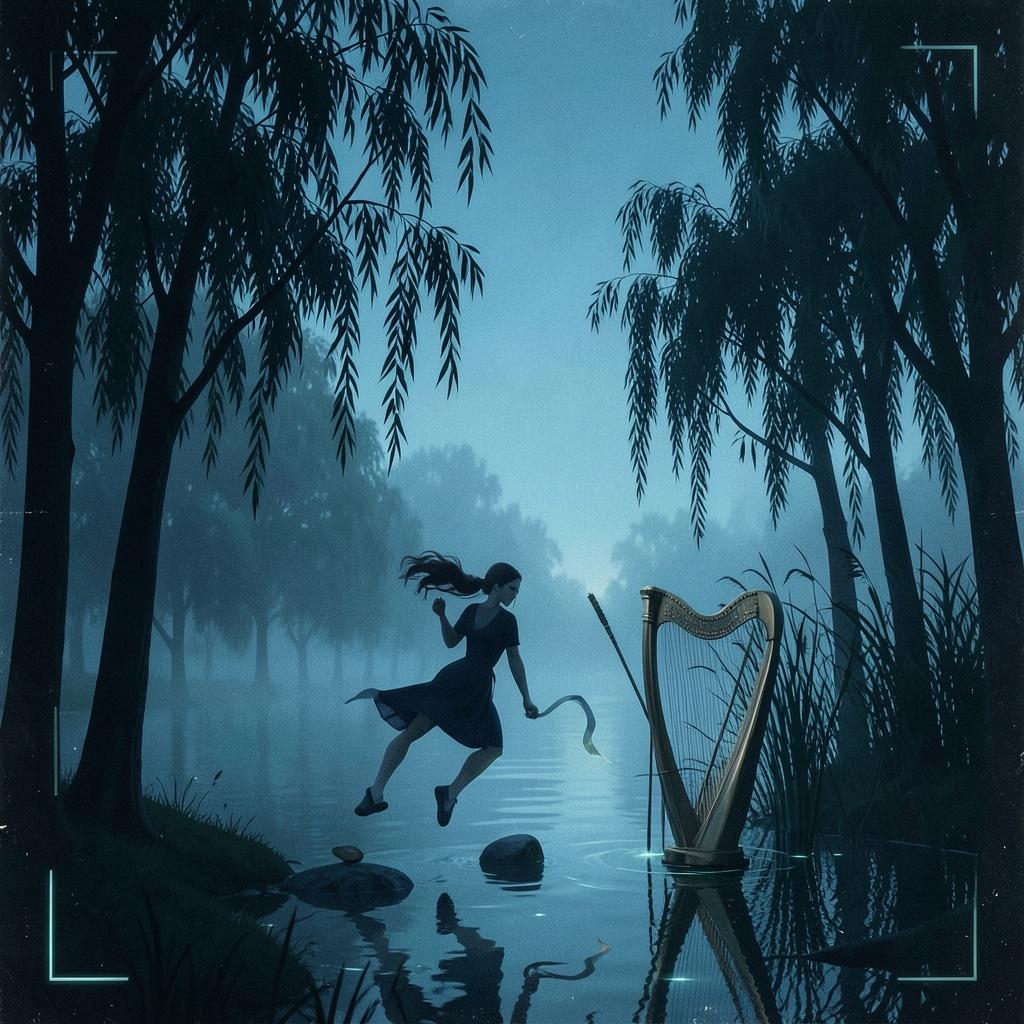
SCENE THREE — THE QUESTION The warm camp tones cool to a misty twilight at the water's edge. The willows hang heavy with their silent harps, silhouetted. AVIVA, twenty now, stands at the river, skipping a flat stone across the dark water. She twists a strip of bright Babylonian ribbon between her fingers — a small, telling thing: she has been to the market, among them, and liked it. MIRYAM enters behind her with a basket of dried reeds, and stops, watching her daughter's restlessness with a familiar ache. AVIVA. (without turning) The girls at the market taught me a new song today. A counting game — you bounce a corded ball off the wall and count the gates of the city. (she hums a sharp, bright, rhythmic Babylonian phrase) It's silly. (beat) I liked it. MIRYAM. (setting the reeds down carefully) Did you. AVIVA. Don't. Don't do that — the quiet thing. The sacred disappointment. MIRYAM. I didn't say a word. AVIVA. You never do. You just go still, and somehow that's louder than shouting. (she turns) Mama, every night of my life you have sung me a golden city. Doves, and morning, and a temple full of singing. And every day I wake up here. In the mud. By a river that isn't ours, in a country that doesn't want us, singing about a place I have never seen and never will. (harder) How do I know it was ever even real? How do I know it isn't just a beautiful story you tell so I won't notice where we actually are? MIRYAM. (low, steady, the temple still in her voice) Because I stood in it. The stones were real. The oil lamps were real. The smoke off the altar went up straight into the blue, and my father played the harp beneath me while I sang, and it was the most real thing that has ever happened to me. (beat) It is realer than Babylon. Babylon is the dream, Aviva. A long, gold, ugly dream we're waiting to wake up from. AVIVA. Then why are we still asleep? (quieter, the real question under the anger) It's been seventy years, Mama. Saba's hands are going. You cough in the night and think I don't hear it. The old ones are dying with their faces pointed at a city none of us under thirty has ever seen. (she gestures at the willows) The harps just... hang there. Rotting. (beat) How do you grieve a home you've never had? Tell me, because I feel it — I do, I feel this enormous weight pulling at me every time you sing those chords — and I don't understand it, and no one will give me a straight answer. MIRYAM. (crossing to her, taking her face in both hands) Some things can't be explained, little bird. They can only be carried. (softly) You think the song is a weight because you're still standing on the wrong side of the desert. The day you set it down where it belongs — that's the day you'll understand what it was for. She kisses Aviva's forehead, picks up her basket, and goes, humming. AVIVA is left alone in the deepening blue, the silent harps above her. AVIVA. (to herself, looking up at them) And what if we never cross it? (beat) What if the song is all we ever get to have?
