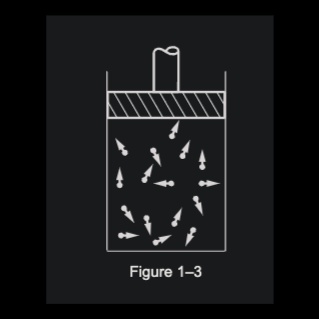

Let us see what some of the properties of steam vapor or any other gas are. The molecules, being separated from one another, will bounce against the walls. Imagine a room with a number of tennis balls — about one hundred — bouncing around in perpetual motion. When they bombard the wall, this pushes the wall away. This means that the gas exerts a jittery force which our coarse senses — not being ourselves magnified a billion times — feel only as an average push. In order to confine a gas, we must apply a pressure. Figure One Dash Three shows a standard vessel for holding gases, a cylinder with a piston in it. Now, it makes no difference what the shapes of water molecules are, so for simplicity we shall draw them as tennis balls or little dots. These things are in perpetual motion in all directions. So many of them are hitting the top piston all the time that, to keep it from being patiently knocked out of the tank by this continuous banging, we shall have to hold the piston down by a certain force, which we call the pressure. Really, the pressure times the area is the force. Clearly, the force is proportional to the area, for if we increase the area but keep the number of molecules per cubic centimeter the same, we increase the number of collisions with the piston in the same proportion as the area was increased. Now let us put twice as many molecules in this tank, so as to double the density, and let them have the same speed — that is, the same temperature. Then, to a close approximation, the number of collisions will be doubled, and since each will be just as energetic as before, the pressure is proportional to the density. If we consider the true nature of the forces between the atoms, we would expect a slight decrease in pressure because of the attraction between the atoms, and a slight increase because of the finite volume they occupy. Nevertheless, to an excellent approximation, if the density is low enough that there are not many atoms, the pressure is proportional to the density. We can also see something else: If we increase the temperature without changing the density of the gas, i.e., if we increase the speed of the atoms, what is going to happen to the pressure? Well, the atoms hit harder because they are moving faster, and in addition they hit more often, so the pressure increases. You see how simple the ideas of atomic theory are.
