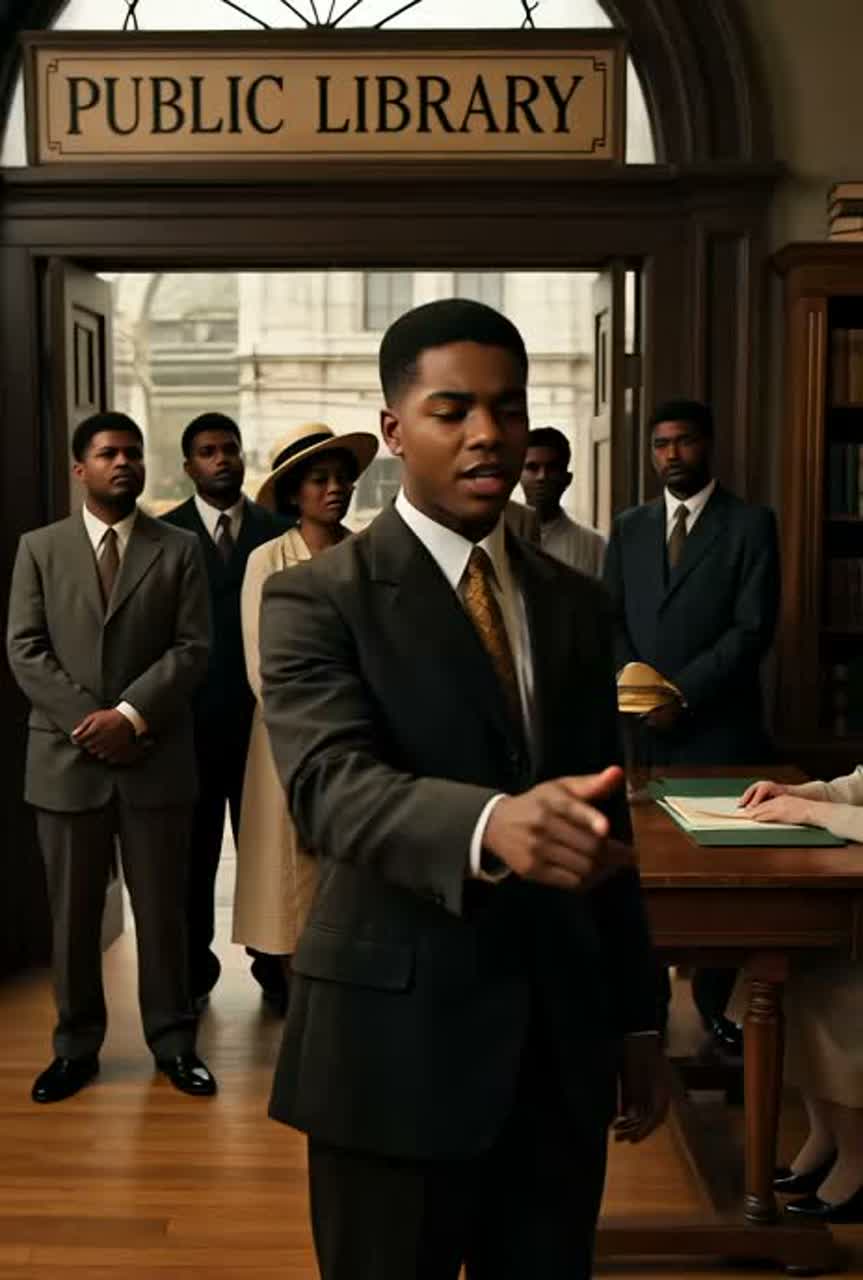
Part One: The Boy Without a Library Card (America) In a small Southern town in America, many years ago, there lived a quiet Black boy named Caleb. He loved words the way other boys loved baseball. Letters felt like doors; books felt like maps. One summer afternoon, Caleb walked into the town library holding his school recommendation letter. The librarian looked at his face, then at his skin, then slid the paper back across the desk. “We don’t issue library cards to your kind.” Caleb didn’t shout. He didn’t cry. He stood there, staring at shelves full of books he was not allowed to touch. That night, Caleb asked his mother, “Why does knowledge have a color?” His mother answered softly, “Because people fear what they don’t want you to know.” So Caleb read anyway. He borrowed books secretly. He listened outside classrooms. He memorized pages read aloud by others. Years later, Caleb became a teacher in a freedom school—one of those who taught Black children to read when the system wanted them silent. The library card he never received became the fire that built many libraries inside people. Part Two: Mohan Biswas and the Closed School (Indian Subcontinent) Far away, across oceans and centuries of tradition, lived Mohan Biswas. Mohan was born a Shudra-Chondal, a name society used not to describe work—but worthlessness. Yet Mohan had a mind sharper than any ritual knife. He loved numbers, stars, soil chemistry, and healing herbs. He walked one day to a Brahmin School of Science, where astronomy, medicine, and mathematics were taught. The gatekeeper stopped him. “Your caste is not permitted. Knowledge here is pure. You will pollute it.” That night, Mohan sat by the fire and looked at the children of his tribe—barefoot, bright-eyed, destined to inherit silence. He said to himself: “If I stay inside this wall, my grandchildren will inherit darkness. No letters. No numbers. No questions.” So Mohan did the unthinkable. He left the tribe. Not because he was ashamed— but because he refused to let oppression be hereditary. What Happened After Mohan Left? Mohan walked to distant lands where caste carried less weight than curiosity. He worked as a laborer by day. At night, he learned—from wandering scholars, from discarded manuscripts, from stars themselves. He married outside the rigid order. He taught his children to read before they learned to bow. His son became a clerk. His daughter learned medicine from midwives and texts. His grandchildren entered schools that once denied his name. But Mohan paid a price. His old tribe called him a traitor. The upper caste never fully accepted him. He lived between worlds—belonging nowhere. Yet one evening, watching his granddaughter read aloud, Mohan smiled and said: “I lost my place in society so you could find your place in history.” The Shared Truth Caleb and Mohan never met. Different continents. Different colors. Different systems. But the injustice was the same: Knowledge guarded by fear Doors locked by birth Power terrified of educated children Both chose resistance—not with weapons, but with learning. And because they refused to accept the walls around them, millions after them learned to read, write, think, and challenge.
