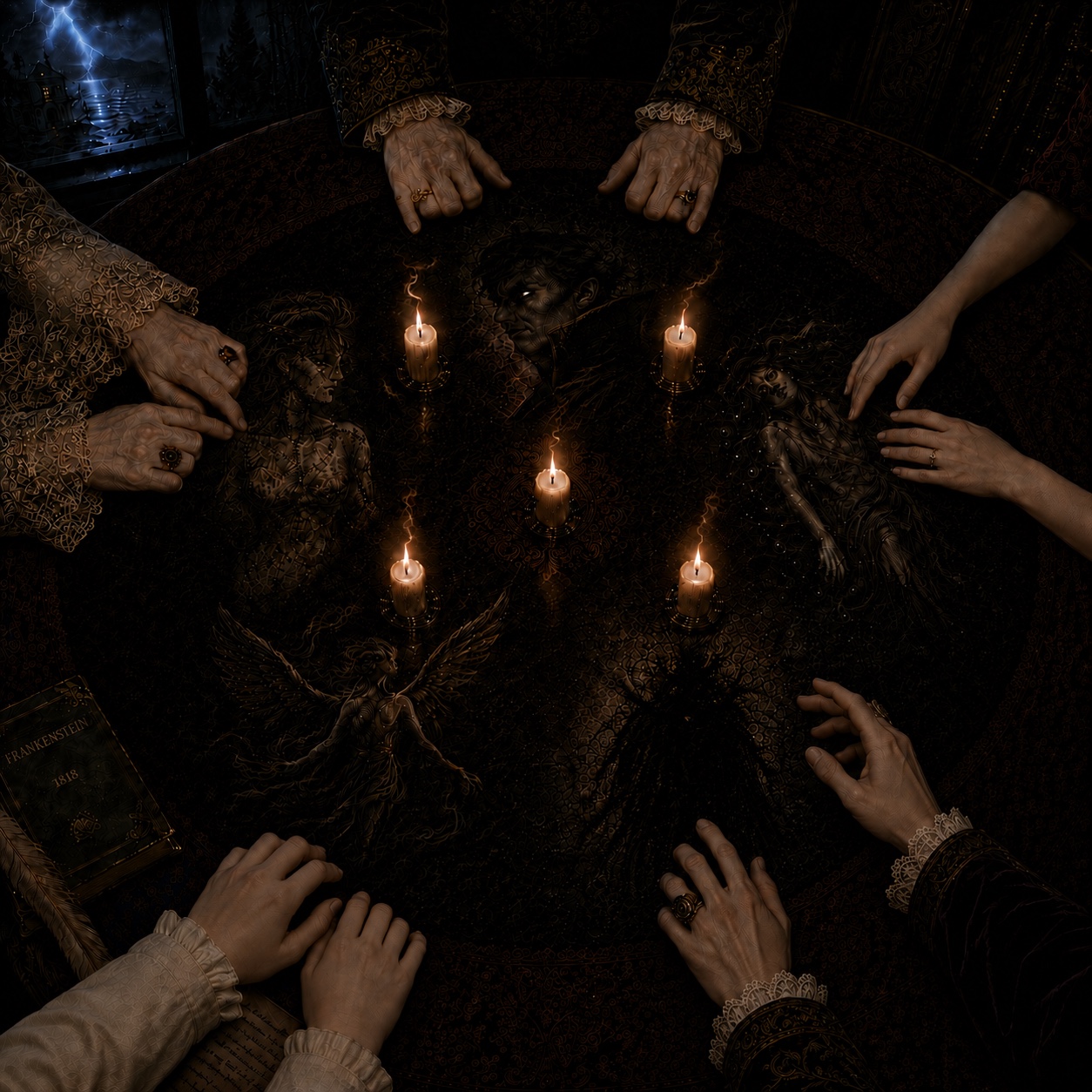
Five Candles at Diodati - Byron’s eye
I had a dream, not all a dream. The lake wore black; the roses were gone. Four souls came climbing through the rain. The weather knew whose house it was. Shelley brought his stolen lightning, nerve and star and sacred theft. Claire came bright with consequence, summer with no summer left. The doctor kept the laudanum and watched me with a servant’s pride. Godwin’s daughter, pale and quiet, sat unnoticed at his side. Five flames leaned against the panels. Five shadows climbed the wall. I held the room without an effort. I thought I held it all. Five candles at Diodati, four faces turned to mine. We fed the dark with wine and wit and taught the storm its lines. I named the game, I raised the glass, I made the fire bow— and Godwin’s quiet daughter watched as though she knew me now. “We will each write a ghost story.” I gave the dark a place to dine. German phantoms crossed the carpet, small enough to laugh aside. Then Mary asked what makers owed the life their brilliant hands betrayed— not how the dead might walk among us, but why the living thing was made. I said, “A man cannot exist without some object made for love.” She asked, “And when the object looks back— what then becomes of God?” Shelley stilled. The doctor listened. Claire forgot the glass below. The room was mine before her question. I cannot say where it did go. Five candles at Diodati, one flame I could not place. It did not brighten when I spoke or tremble at my gaze. I called the dark to dinner. She asked what makers owe. The room was mine a breath before. I cannot say where it did go. So I drew her out, at first for sport, then appetite, then something worse. Each answer opened into distance; each calm reply undid the first. She did not enter my dominion. She carried a country of her own. The candle smoke bent toward her breathing. Her shadow turned before she moved. The best of life is intoxication. Laudanum softened edge and hour. Claire’s laugh broke like bitten crystal. The rain crawled upward on the tower. Polidori’s outline grew a lordship; white teeth waited in his smile. Mary heard a nameless heartbeat walking toward us all the while. I wrote the sun extinguished, no dawn, no bird, no breath— a kingdom made of ash and hunger, a universe of death. She found one poor abandoned creature and gave my splendid void a face. I made despair look like a crown. She asked who caused the pain. Despair and genius, I had said, are too often intertwined. But hers did not adorn the wound. Hers put the wound on trial. What does the maker owe the made? What does the cast-off learn? Why give a body need for love, then punish its return? Five candles at Diodati, five names the thunder knew. We thought we played with phantoms, but the phantoms listened too. Shelley with his stolen fire, Claire with all her flame, the doctor sharpening my shadow, and I with all my name— while one pale girl beside the fire made nothing stay the same. So naturally I set it right: Godwin’s daughter, Shelley’s bride. A clever grief, a woman’s fever, birth and blood enlarged by night. Let her keep the stitched-up sorrow. I preferred the dying sun. What was one forsaken monster to the ruin I had become? I turned to wit. The room returned. The silver tongues restored my throne. She neither pleaded nor contended. She did not need to be made known. And that, perhaps, was the offense: not that she failed to bend— but that her world required no Byron to begin, endure, or end. Five candles at Diodati, five shadows, one by one. I thought I called the night to table. She heard what it would become. I saw the doctor’s gentleman with lordship in his teeth. I saw my dead sun fall through time. I saw her creature breathe. [restrained, haunted] It walked upright through centuries, past every portrait, praise, and name. Not my flame. Not my weather. Not a guest inside my frame. The glory and the nothing— how beautifully they rhyme. Let the girl keep her monster. The storm was mine.
