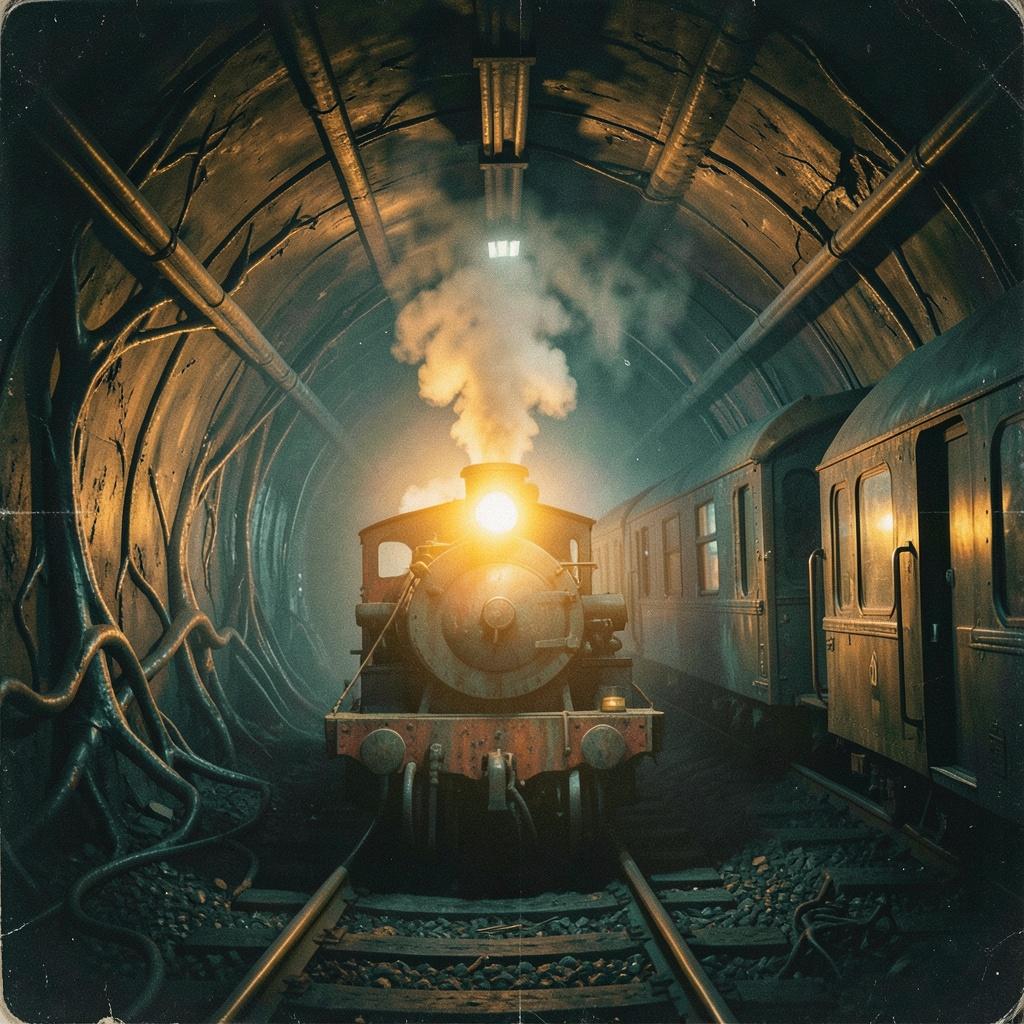
The Little Engine That Could Eat Part 1
THE LITTLE ENGINE THAT COULD EAT by Mr Denn Chapter One: The Sound It Makes When It Breathes Part 1 Chug chug chug. Puff puff puff. The sound had weight now. It pressed against the walls of the tunnel like a second atmosphere—thick, damp, and almost chewable. Leon noticed that first. Not the darkness. Not the smell. Not even the way the tracks seemed to pulse beneath his boots like something with a circulatory system. No. It was the sound. Chug chug chug. Too wet. Too… deliberate. Leon adjusted the strap of his camera bag, though he hadn’t taken a single photograph since entering Bradbury Grove’s abandoned lower station. The air down here resisted documentation. Light behaved poorly. Angles refused to remain angles. Even memory felt… pre-chewed. “You hear that?” he asked, though he was alone. The tunnel answered by narrowing. Not physically—no, the concrete remained where it was—but the idea of space constricted. The walls leaned inward in a way his eyes couldn’t prove but his spine understood intimately. Puff puff puff. Closer now. Warmer. A faint sweetness threaded through the rot—cotton candy left too long in a child’s mouth. The scent clung to the back of his throat, sticky, nostalgic, wrong. Leon swallowed. It swallowed back. The tracks beneath him were not rusted. They were tired. Steel should not sag like that. Should not bow inward as though bearing a weight that had nothing to do with gravity. He crouched, fingers hovering just above the metal, and felt heat radiating upward in slow, exhausted waves. Like a fever that had given up trying to break. “Maintenance should’ve sealed this line years ago,” he muttered. But even as he said it, the lie curdled. This place wasn’t abandoned. It was unattended. There is a difference. One implies neglect. The other implies design. Chug chug chug. The darkness ahead inhaled. Leon stood very still. He became aware—painfully, intimately—of his own body as an object. His lungs dragging air in too loudly. His heartbeat knocking against his ribs like something trying to be let out. The slight tremor in his fingers, which he tucked into fists as if shame could stabilize them. “You’re just documenting,” he whispered. “Urban decay. That’s all this is.” The tunnel did not agree. Something shifted far ahead—not movement exactly, but intention. A gathering. Like the moment before a mouth closes. Light appeared. Not from above. Not from ahead. From within the dark. A dull, amber glow that seemed to seep through the tunnel walls rather than illuminate them. It revealed just enough to suggest shape—just enough to imply something vast, something waiting. Leon raised his camera. The screen flickered. The image smeared. Where the light should have formed a coherent outline, the pixels instead stretched into long, trembling strands—as if reality itself were being pulled through something narrow. “Come on,” he hissed, tapping the side. “Focus.” The camera refused. But his eyes did not. And that was worse. The Engine emerged slowly, as though reluctant to be seen all at once. First: the front. Not a face. Not yet. Just the suggestion of one—the curved metal softened by time into something almost… yielding. The headlamp glowed dimly, like a cataracted eye struggling to remember its purpose. Then: the body. The boiler expanded and contracted with each breath. Because it was breathing. Leon felt it before he accepted it. The air shifted in rhythm with the machine’s movement, drawn inward, pushed outward, carrying with it that same sickly sweetness layered over iron and something older. Something that had once been alive and had not forgiven the transition. Puff puff puff. Steam hissed from its sides, but it did not rise cleanly. It clung. It curled back. It lingered against the metal as though reluctant to leave, like breath on cold skin. “Jesus,” Leon whispered. The word sounded wrong here. Too small. Too… unused. Then the cars came into view. One by one. Endless. Each one slightly different. Each one… full. Leon stepped closer before he realized he was moving. The first car’s door hung ajar. Inside: shapes. Not immediately recognizable. Not organized the way cargo should be. They were piled, yes—but not carelessly. There was intention in the arrangement. A kind of reverence. Or consumption. His camera lifted again, almost of its own accord. Click. The flash did not fire. But something inside the car reacted. A shift. A soft, collective tightening. Like a room full of lungs remembering how to hold breath. Leon froze. “Hello?” he called. The word slid into the car and did not come back.
