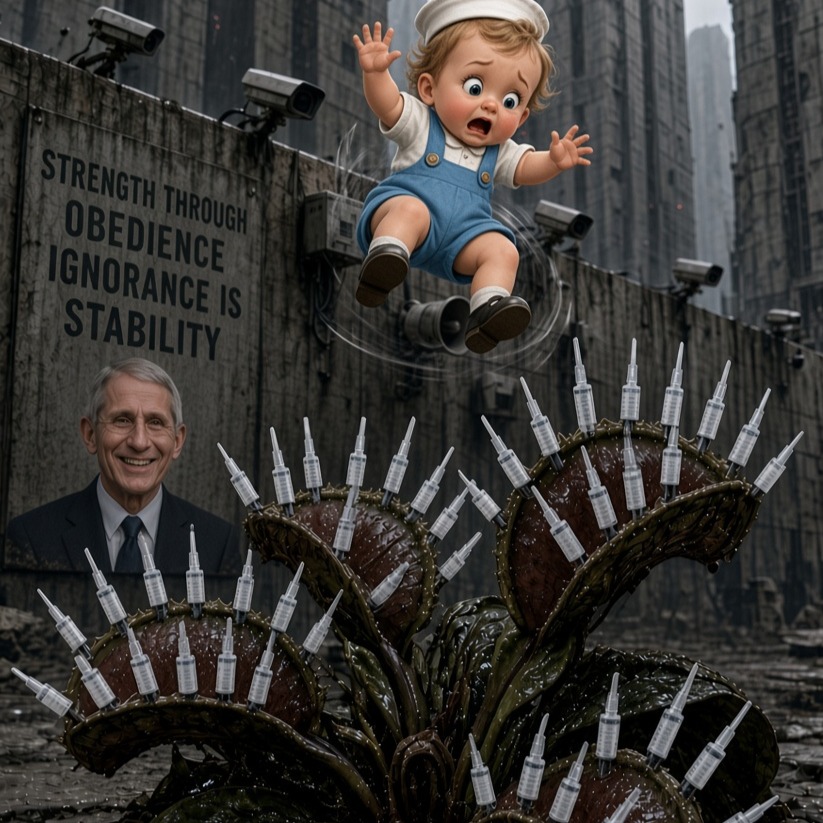

I sit with a knowledge that feels increasingly solitary. Not the kind of knowledge that arrives as revelation, but the slower, heavier sort that accumulates through reading, cross-checking, and watching patterns repeat themselves under different banners. One watches a majority of one’s fellow citizens accept, recite, and then defend narratives whose omissions are never random. The absences are structural. They are designed. And the collective recitation of those incomplete stories does something to the individual who notices the gaps. It produces a quiet, continuous alienation—an estrangement that is social, psychological, and, in the end, political.We learned this with particular clarity during the years of pandemic measures. Contradictions, once made visible and held in public view, retained a residual power. Standing by an analysis that diverged from the dominant messaging required absorbing institutional pressure and carefully targeted campaigns. One of the more revealing documents of that period came from Yale. In the summer of 2020, well before any vaccine had received authorization, researchers at the university ran a randomized experiment testing a battery of persuasive messages intended to increase future uptake intentions. The trial, registered as NCT04460703 and later published in the journal Vaccine, examined appeals built around community interest, reciprocity, guilt, embarrassment, economic benefit, trust in science, and the reframing of refusal as recklessness rather than bravery. Certain messages—particularly those that invoked prosocial duty and the social cost of non-compliance—shifted stated intentions measurably. The study was not hidden. It was science doing what science sometimes does: mapping the levers of consent before the product itself was ready for distribution. To notice this is not to invent a conspiracy. It is simply to read the paper. Today the vocabulary has changed, yet the architecture feels familiar. The word “war” is again written in capital letters. Acceptance of a particular threat narrative originating in the East is treated as the price of seriousness. One is invited to forget that this continent has heard variations of the same urgent music before. The economy stagnates while rearmament accelerates. Questions about resources, industrial capacity, and long-term strategic interest are waved aside as unserious. Europe, one is told, has no alternative. The old Latin phrase returns unbidden: quo vadis? What impulse, internalized and repeated, steers the direction?In the United States the equivalent of the evening Tagesschau is the network news—those polished half-hours on CBS, NBC, or ABC that still set the emotional temperature for millions. The American counterpart to Die Zeit’s long, carefully argued essays might be found in the pages of The Atlantic or the more reflective corners of this newspaper’s own opinion section. The tone differs, the institutional accents differ, yet the function is comparable: to supply the respectable framing within which disagreement becomes faintly disreputable. On social platforms one observes parallel inoculation campaigns, rapid, coordinated, and moralized. The visual language has simply updated itself. Where political leaders were once photographed in masks, they now appear in camouflage or against martial backdrops. Continuity of posture is more striking than the change of costume.I do not wear the costume. The knowledge does not confer superiority; it confers a particular loneliness. One continues, nevertheless, to speak the analysis aloud, to make the contradictions legible, to refuse the demand that private judgment be subordinated to the current collective chant. The energy of that refusal is modest. It is not a movement. It is only the decision to keep playing the quieter notes—peacefully, persistently, without the protection of the majority’s approval. The dissonance remains. It seeks a face, or at least a voice that will not be absorbed back into the Matrix.
