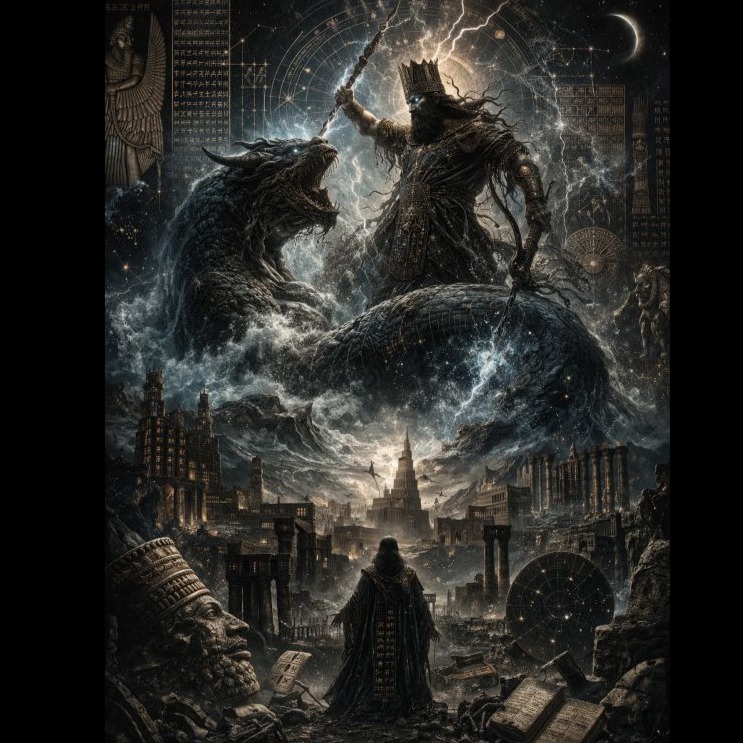
Babylonian Abstraction (On Dividing Tiamat)
Before the silence learned its name, We spoke in gods to mask the flame. Salt and fresh in restless embrace, Not elements - but a thinking place. Tiamat moved in every breath, Apsu whispered beneath all death. We called it birth, we called it will, To give the shapeless something still. But noise became a threat to form, And myth arose to still the storm. So Marduk rises - or so we say, To carve the night, to force a way. With borrowed winds and borrowed sight, He splits the dark to name it light. We dressed the void in teeth and scales, In wrathful queens and war-torn tales. Not chaos - but a mind undone, That could not face what had begun. Qingu crowned in borrowed blame, A vessel forged to hold the shame. An army shaped from fear’s design, To make disorder seem malign. For if the infinite has no face, We forge a god to take its place. So Marduk rises - or so we claim, To bind the stars, to number flame. An arrow loosed through formless night, To split the whole to wrong and right. Did she swell with storm - or breath withheld? Did he divide - or we compelled? Her body stretched across the sky, Or was it us who asked it why? We drew the lines through flesh and void, Declared the chaos overthrown. But every law, each ordered sphere, Still hums with something not our own. From broken forms we shaped a frame, Gave blood a purpose, dust a name. From Qingu’s veins - or so we write, We made ourselves to serve the light. Yet something lingers in the seam, A fractured edge within the scheme. A quiet pulse beneath the law, A trace of what we thought we saw. No Marduk rises - only mind, Imposing shape on what we find. No final war, no cosmic throne, Just order carved from the unknown. Where once the heavens pressed like fire, Now distance cools the old desire. The gods retreat, their voices thin Yet still their echoes move within. Not truth, but need, gave myth its breath, A shield against the weight of death. And though the sky no longer speaks, We hear it still in what we seek.
