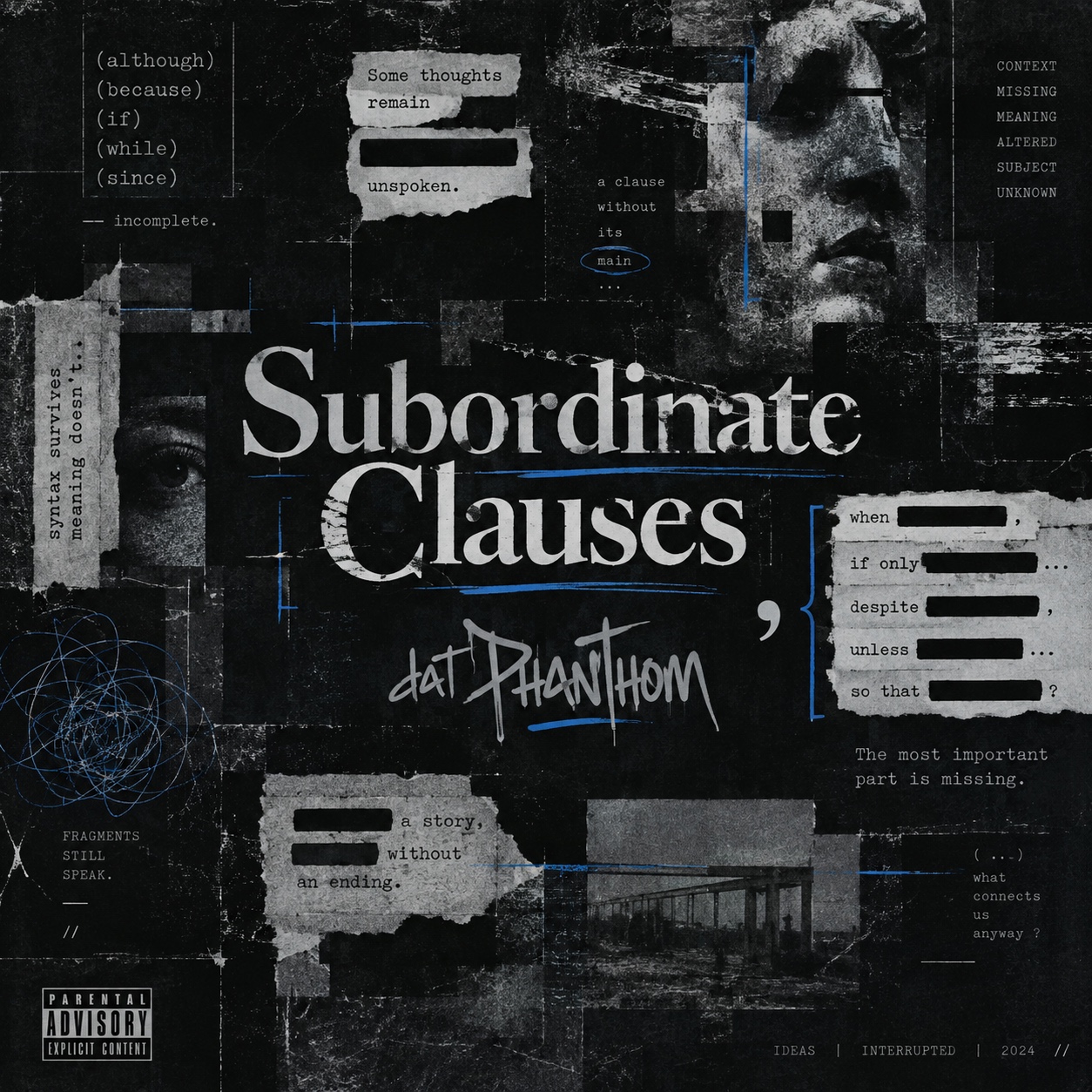
Subordinate Clauses


# Subordinate Clauses [Verse 1] He said, “I did it.” Clean statement. Case closed. But nobody asks what happened two seconds before. “She left.” Yeah — after you locked every door. “He swung first.” Yeah — after you pushed him to war. “They refused.” After every condition got changed. “He broke the deal.” After the deal got rearranged. Main clause hits hard, short enough for the screen. Cut off the tail and the sentence looks clean. Grammar stays legal, meaning gets robbed. Truth didn’t disappear — it got carefully cropped. [Break – Call / Response] **What did he say?** — The main clause. **What did he hide?** — The reason. **Sentence complete?** — Grammatically. **Message complete?** — Not even. [Verse 2] “I support you” — as long as you don’t disagree. “You’re free here” — as long as your freedom looks like me. “We want debate” — unless your question cuts deep. “We value truth” — if the truth stays cheap. That little *if* can flip the whole frame. That little *but* can burn down the claim. Because words before commas get quoted and sold, while everything after gets quietly folded. Headlines need impact, meetings need pace, politics need fragments that fit into space. So everybody heard it. Nobody heard why. A sentence stayed factual while the message learned to lie. [Long Break – Call / Response] **Main clause?** — Loud. **Subordinate clause?** — Gone. **What came first?** — Cut. **What came after?** — Cut. **Condition?** — Missing. **Reason?** — Missing. **Consequence?** — Missing. **But the quote?** — Correct. **The wording?** — Correct. **The message?** — Wrong. **Again.** **“He refused.”** — Because? **“She walked out.”** — After what? **“They failed.”** — Under which rules? **“He reacted.”** — To what? **Say the whole thing.** — They won’t. **Why not?** — Too much context. **Too much context?** — Too little control. **Main clause?** — Wording. **Subordinate clause?** — Sense. **Cut the second half—** — Change the first. **Leave the words intact—** — Still twist the truth. [Verse 3] So give me the clause after *because*, *although*, *when*. Give me what happened before, then say it again. Give me the condition, the limit, the doubt. Don’t hand me the quote with the consequence cut out. I dissect conjunctions, inspect every seam, where context gets buried to manufacture meaning. One missing sentence part can reverse what you know. Not every lie needs fiction — sometimes omission runs the show. So when they say, “That’s exactly what he said,” I don’t check the quote first. I check what they left dead. Because language ain’t only the words that survive — sometimes the subordinate clause is where the message was alive. [Final Break – Extended] **Main clause?** — Wording. **Subordinate clause?** — Sense. **What was said?** — One piece. **What was meant?** — The whole sentence. **Quote accurate?** — Maybe. **Meaning accurate?** — Prove it. **Where’s the “because”?** — Gone. **Where’s the “although”?** — Gone. **Where’s the “if”?** — Gone. **Where’s the “when”?** — Gone. **Then what remains?** — A statement. **And what disappeared?** — The message. **Read before.** — Read after. **Read the condition.** — Read the consequence. **Don’t give me fragments.** — Give me context. **Don’t give me wording.** — Give me sense. **Main clause.** — Half the truth. **Subordinate clause.** — The missing half. **Cut the context?** — Change the message. **Keep the whole sentence?** — Now we can talk.
