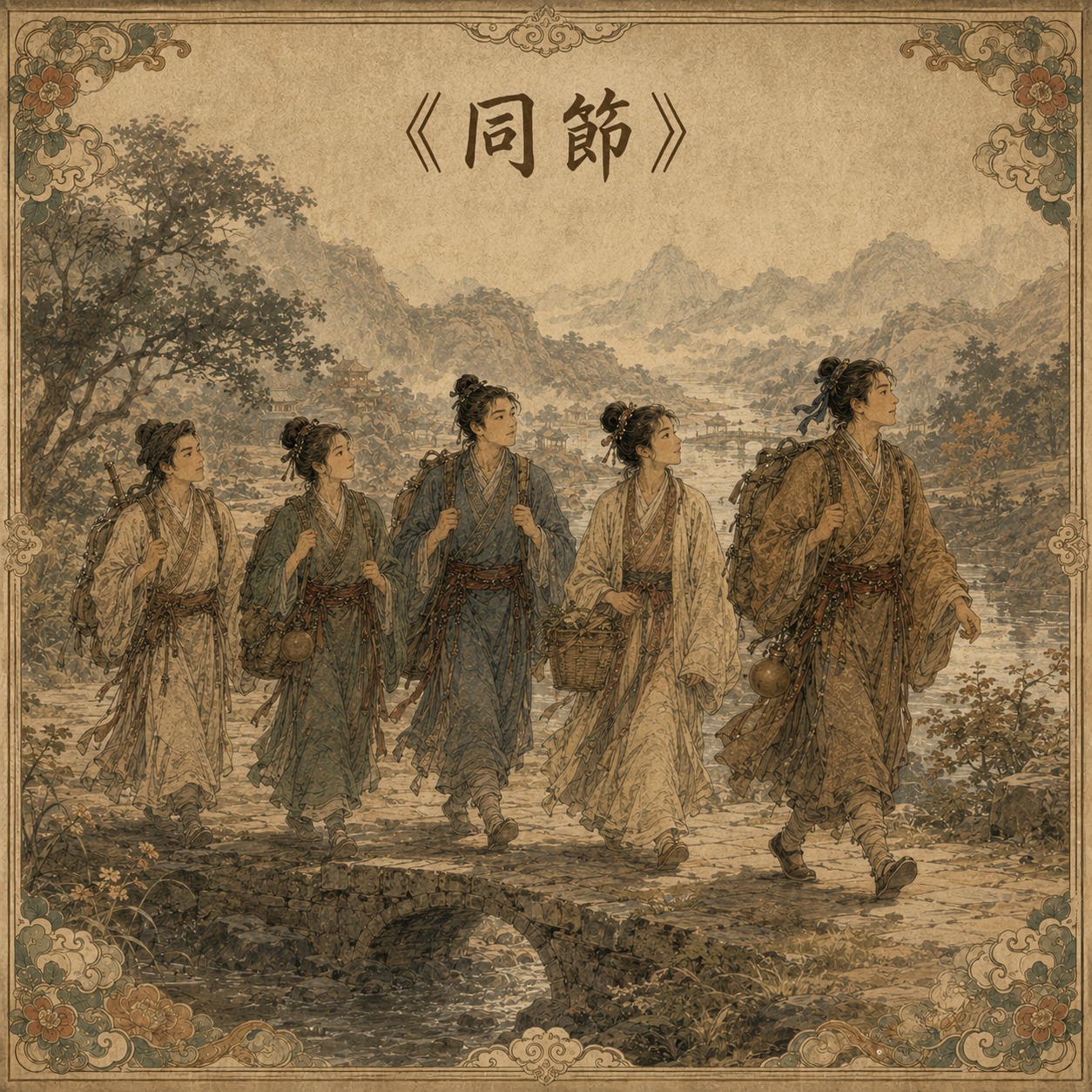
2.《同節》(Ancient Chinese)

[短引 — 清晨上路] 雞鳴野店外, 露白草鞋輕。 五人辭小店, 一杖向東行。 前山方見日, 後路已無聲。 有人回首問: 「長安尚遠否?」 (有歌則不遠!) [主歌一 — 五人輪唱] 一人行步疾, 一人愛徐吟。 一人逢橋唱, 一人入林聞。 最少言者後, 拾起故人巾。 前者稍停步, 後者趕來齊。 自此無人催, 亦無人獨遲。 [預副歌] 鼓可催人足, 歌須待人聲。 一句留餘地, 四聲自來承。 不必同其調, 但須知其情。 五步成一節, 一路漸相明。 [副歌] 同節,同節,踏過長亭, 山有高下,足有徐疾。 你唱其首,我續其聲, 有時相和,有時且聽。 同節,同節,莫爭先行, 一人倦處,四人稍停。 長安尚遠?笑問前程—— (有歌則不遠!) 有歌則不遠行。 [主歌二] 午渡青溪水, 舟小載五人。 一人扶琴匣, 一人護行囊。 一人分乾餅, 一人讓半觴。 餘者無多語, 低聲起舊腔。 船夫聞而笑: 「五口怎同歌?」 五人未相答, 先將一曲和。 [預副歌二] 聲密反成亂, 聲疏乃可聞。 高者收三分, 低者讓一門。 有呼便有應, 有止亦成文。 五聲非一聲, 同行自有倫。 [副歌] 同節,同節,踏過長亭, 山有高下,足有徐疾。 你唱其首,我續其聲, 有時相和,有時且聽。 同節,同節,莫爭先行, 一人倦處,四人稍停。 長安尚遠?笑問前程—— (有歌則不遠!) 有歌則不遠行。 [橋段 — 黃昏遇坡;歌聲漸少] 暮色壓山路, 風急石又傾。 一人足下滑, 四手已相迎。 此時無人唱, 但聞五足聲。 一步,又一步, 同落暮山徑。 直到坡頭坐, 有人忽笑問: 「方才誰忘了唱?」 四人齊笑應: 「忙著等你行!」 [短間奏 — 木梆保持步伐;笛聲一句,琵琶留白,再由笙接應] [終副歌 — 五聲更開闊,各自成線] 同節,同節,踏過長亭, 山有高下,足有徐疾。 你唱其首,我續其聲, 不須相似,亦能相應。 同節,同節,共此前程, 一人望遠,四人同行。 長安尚遠?再問晨昏—— (有歌則不遠!) 有歌則不遠行。 同節,不同聲, 同行,不同程。 今日五人並馬去, 明朝何處又聞笙? (長安!) [尾聲] 月出驛橋外, 五影一時長。 無人數其步, 步步自相當。 遠處城未見, 路旁蟲已鳴。 一人輕開口—— 四人且先聽。 ———————— English Translation ———————— One Measure [Short Intro — Setting Out at Dawn] A cock crows beyond the roadside inn, dew whitens the grass beneath their light shoes. Five young men leave the little inn, walking east with a staff in hand. The sun has only just appeared beyond the hills; the road behind them has already fallen quiet. Someone looks back and asks: “Is Chang’an still far?” (With a song, it is never far!) [Verse 1 — The Five Sing in Turn] One likes to walk quickly, another likes to sing at an easy pace. One sings whenever they cross a bridge, another listens when they enter the woods. The quietest one walks behind and picks up a companion’s fallen cloth. Those in front slow their steps; the one behind catches up. From then on, no one urges the others forward, and no one is left to lag alone. [Pre-Chorus] A drum may hurry the feet, but a song must wait for another voice. Leave a little space after one phrase, and four voices will come to carry it. They need not share the same melody, only understand what the others mean. Five sets of footsteps become one measure, and along the road they slowly learn one another. [Chorus] One measure, one measure, past the roadside pavilions, the hills rise and fall, and every foot has its own pace. You begin the line; I carry the sound— sometimes we harmonize, sometimes we simply listen. One measure, one measure—there is no need to race ahead. Where one grows weary, the other four slow down. “Is Chang’an still far?” we ask, laughing at the road ahead— (With a song, it is never far!) With a song, no road is far. [Verse 2] At noon they cross a clear stream, five travelers crowded into a little boat. One steadies the instrument case, another guards the traveling bags. One divides the dry cakes, another passes half his cup. The last says very little, but quietly begins their old tune. The boatman hears them and laughs: “How can five mouths sing one song?” The five do not answer him with words. Instead, they answer with a song. [Pre-Chorus 2] When every voice crowds in, the music turns confused; when voices leave space, each can finally be heard. The higher voice draws itself back a little, the lower one leaves an opening. Where there is a call, there can be an answer; where there is a pause, there can still be form. Five voices are not a single voice, yet travelers together find their proper relation. [Chorus] One measure, one measure, past the roadside pavilions, the hills rise and fall, and every foot has its own pace. You begin the line; I carry the sound— sometimes we harmonize, sometimes we simply listen. One measure, one measure—there is no need to race ahead. Where one grows weary, the other four slow down. “Is Chang’an still far?” we ask, laughing at the road ahead— (With a song, it is never far!) With a song, no road is far. [Bridge — A Steep Road at Dusk; the Singing Falls Away] Evening settles heavily upon the mountain road; the wind rises, and loose stones shift beneath their feet. One of them slips— four hands are already reaching for him. Now no one sings. Only five sets of footsteps can be heard. One step, then another, falling together along the darkening mountain path. Only when they reach the top and sit down does someone suddenly laugh and ask: “Who forgot to sing back there?” The other four laugh together: “We were busy waiting for you!” [Short Instrumental Break — Wooden clappers keep the walking pulse; one dizi phrase, an answering silence from the pipa, then the sheng enters] [Final Chorus — The Five Voices Open into Separate Lines] One measure, one measure, past the roadside pavilions, the hills rise and fall, and every foot has its own pace. You begin the line; I carry the sound— we need not sound alike in order to answer one another. One measure, one measure—we share the road ahead. One looks toward the distance; four walk beside him. “Is Chang’an still far?” we ask again through dawn and dusk— (With a song, it is never far!) With a song, no road is far. One measure, different voices. Traveling together, though each has his own road. Today five companions ride onward side by side— where tomorrow will we hear the sheng again? (Chang’an!) [Outro] The moon rises beyond the post-station bridge, and five shadows lengthen together. No one counts the rhythm of their steps anymore; each step naturally falls beside the next. The distant city is still nowhere to be seen. Only insects sing beside the road. One of the five softly begins a line— and the other four, for now, listen.
