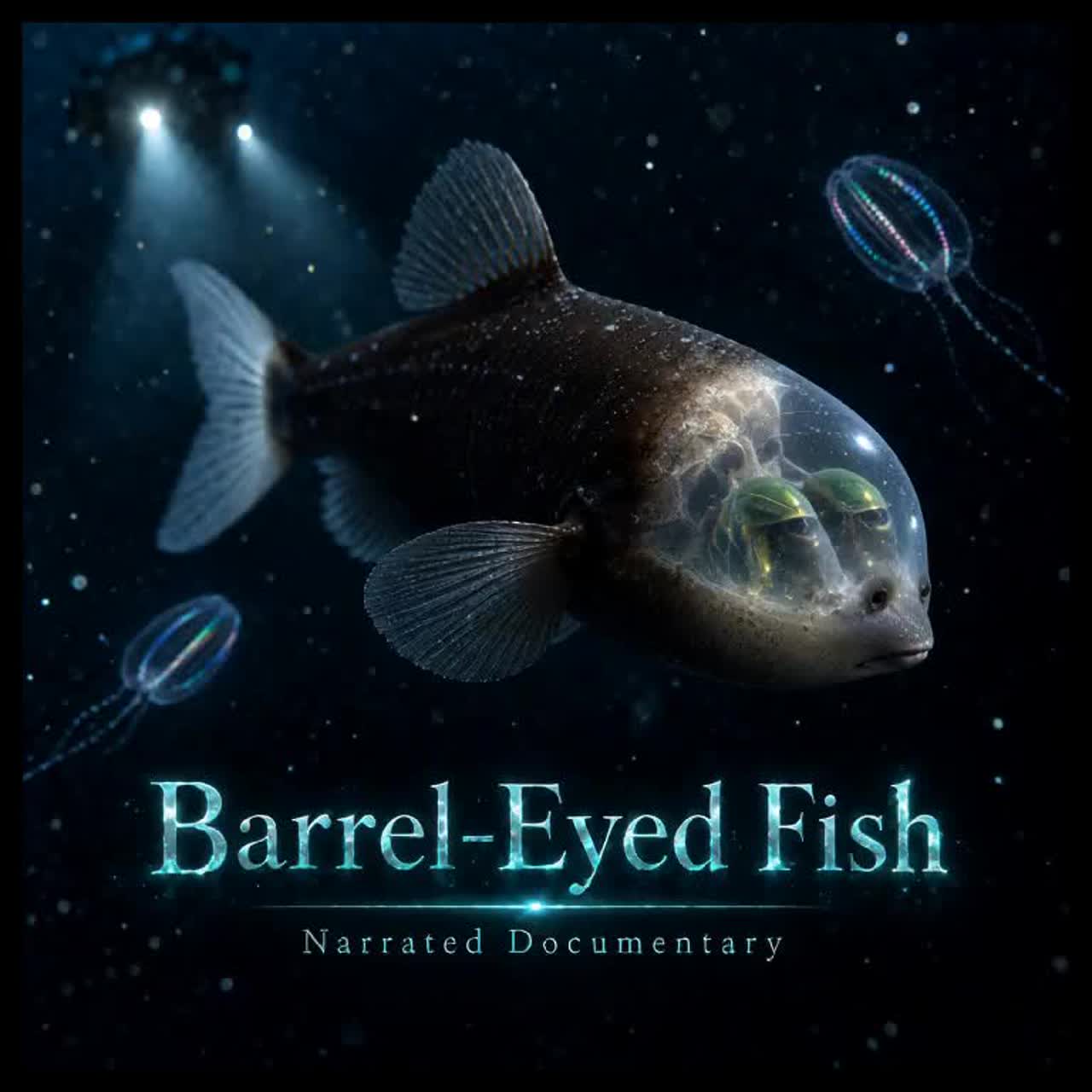

[Opening soundscape: ocean surf, water movement, distant seabirds, then a submersible hatch seals and the vessel begins its descent. A gentle propeller turns beneath the waves.] [Narrator - British, clean clear narration] We are about to send the submersible below the surface, into water where sunlight thins by the minute. The first few meters are familiar... Small fish move through the upper water, following food carried by currents... Farther down, comb jellies pulse with bands of colour.. Lanternfish pass in scattered groups, carrying their own faint points of light... A slow-moving oarfish can appear like a silver ribbon, while a gulper eel opens a mouth much larger than its narrow body suggests. At greater depths conditions become colder, darker, and pressure increases... Many animals conserve energy by moving slowly... Others use light, vibration, or sensitive organs to find prey that cannot be seen. Now the seafloor is falling away beneath us... The submersible is entering the midwater zone, where transparent bodies and delicate fins are common... There is very little shelter here, so concealment becomes a form of protection. Ahead is what we are mostly here to see, one of the ocean’s most weirdest fish: the barrel-eyed fish. Its scientific name is Macropinna microstoma... The fish is small, but its eyes are remarkable. They are set inside a clear, fluid-filled shield that covers the top of its head. From a distance, the eyes appear to point upward, collecting the faintest light from above. The two dark shapes near the front of its face are not its eyes. They are openings for the nose, called nares. The actual eyes are the green, tubular structures beneath the transparent dome. Those eyes are usually directed upward while the fish searches for silhouettes of prey. When the fish finds something worth pursuing, the eyes can rotate forward. This allows the barrel-eyed fish to look ahead while it feeds. Its body is pale and nearly transparent in places. The clear shield may protect the eyes from stinging siphonophores, animals that drift through the same dark water. The fish can also remain almost motionless, using enlarged fins to hover with very little effort. For many years, scientists knew the species only from damaged specimens. The delicate head shield often collapsed when the fish was brought to the surface. Observations from remotely operated vehicles later showed that the living animal has a rounded, transparent canopy and eyes capable of changing position. The barrel-eyed fish does not chase through the darkness. It waits, watches the water above, and responds when a small meal drifts within reach. We are now passing below the faintest useful daylight... The propeller slows. In the beam of the submersible’s lights, the fish turns, and its green eyes face forward for a moment before returning to the dark water overhead. This is a brief view of an animal adapted to a place where almost every feature has a purpose: a transparent shield, movable eyes, sensitive openings, and fins designed for hovering rather than speed. The submersible will continue its descent, leaving the barrel-eyed fish above us, suspended between darkness below and the last traces of light above.... [The propeller purr softens. The orchestral bed thins into distant strings and low water ambience.]
