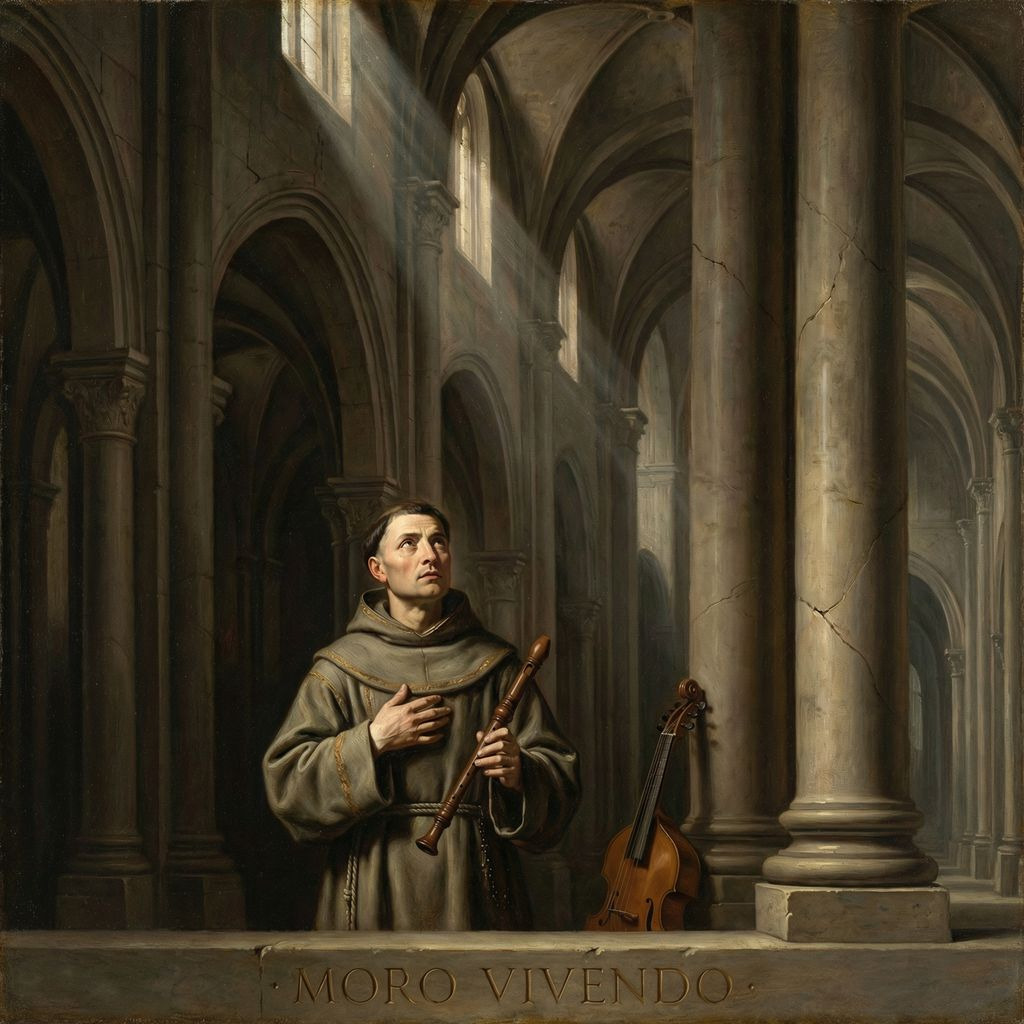

MORO VIVENDO A Lament in the Manner of an Old Chronicle And it came to pass that there was a man who loved the light. He sought it as a pilgrim seeketh water in a barren land. He stood beneath vaults of stone, and lifted his face unto the narrow beams thereof, saying in his heart, Surely this brightness shall lighten my burden. Yet the light made his burden known. For when it fell upon his countenance, it uncovered the furnace of his own marrow. And behold, the flame was not kindled by decree, neither was it sent forth in wrath; but it lay within him from the beginning, close-bound and patient. Then was his heart moved as the sea is moved when the deep breaketh its bounds. He withdrew into the hollows of the sanctuary, and the stones thereof rose unyielding about him. He descended into shadow, yet the shadow clave unto him. He bowed himself low, but the fire bowed not. And he cried, Why am I consumed and yet stand? But the answer came not in tempest, nor in trembling earth, but in weight. For the flame devoured not his flesh. It fashioned him as iron in the forge is wrought. The heat entered his bones and hardened them. The burden became his pillar. The blaze became the iron of his sinews. That which he named death was found to be the marrow of his strength. And he perceived a fearful mystery: That the fire which seemeth to slay is oft the covenant that sustaineth. Thus he walked within the burning and was not consumed. Thus he stood beneath arches of granite shadow and did not break. Thus he died daily, and yet his frame endured. Yet mark this: the flame abideth still. It hath not slackened. It shall not depart. And in the last hour, when the light is fullest and the shadow fleeth away, it shall be revealed whether the fire was curse or covenant, ash or altar, ruin or crown. Until that hour, he endureth. He perisheth, yet he abideth. Moro vivendo. — From a folio recovered, Naples, circa 1613. [Words, Production, and Direction by Noizgenie.] [Cover Art Direction by Noizgenie. © 2026 Noizgenie.]
