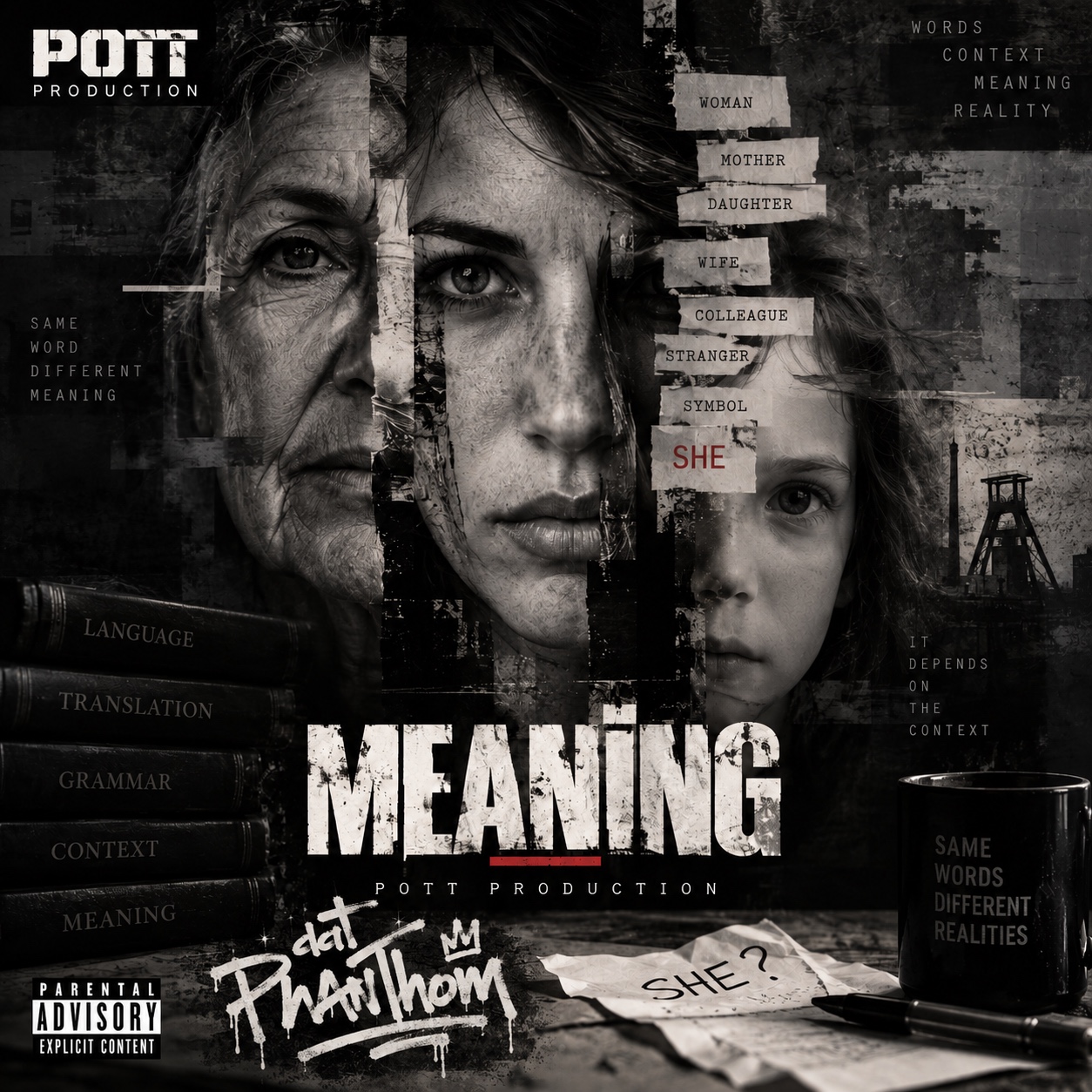


# MEANING [VERSE 1] She in the sentence, you picture a face, fill in the blanks while I'm setting the pace, mother or daughter or woman I praise, wife or a stranger — same letters, new weight. Pronoun is simple, the reference ain't, you paint a person before I can paint, memory meddles, perception invades, then what I wrote gets replaced by your frame. Read it, receive it, retrieve what you know, meaning gets mixed with the baggage you hold, sentence is mine but the picture is yours, one little “she” opens multiple doors. Could be the woman who raised you from zero, could be your daughter, your partner, your hero, could be a symbol for millions unseen — same damn wording, not the same meaning. [BREAK] Meaning? — Not the word. Meaning? — What you heard. Meaning? — What I meant. Meaning? — Read again. Same letters. New scene. That's the space between wording and meaning. [VERSE 2] Gift in my English is something I give, Gift in your German can shorten your trip, actual, aktuell — looks like a fit, false little friends with a semantic switch. Word-for-word transfer, the syntax survives, grammar looks healthy while meaning just dies, perfectly polished, mechanically clean, technically right and completely obscene. Translate the letters, transliterate thought, carry the nouns but the nuance gets lost, tone gets distorted, intention gets crossed, cheap conversion comes at semantic cost. I don't need language that's merely correct, I need the message preserved and intact, if what arrives isn't what I dispatched, translation failed — even spelling was exact. [BREAK] Translate the word. — Easy. Translate the phrase. — Maybe. Translate the tone. — Harder. Translate the meaning. — Exactly. [VERSE 3] Main clause quoted, subordinate cut, now my condition gets thrown in the mud, “I'll do it” travels, the “if” gets erased, certainty printed where caution was placed. “I trust the process — provided it's checked,” cut after “process” — now what did I say? “You have my support — if the numbers connect,” lose that condition, rewrite my intent. Comma gets murdered, qualification gone, half of a sentence gets treated as whole, context collapsed and the fragment lives on, then I'm defending a quote that's not mine anymore. That's how a “maybe” gets marketed “yes,” how an exception gets buried in text, how all the nuance gets squeezed from the breath — meaning ain't missing, you edited it dead. [LONG BREAK] She. — Who? A woman. — Which? Mother? — Maybe. Daughter? — Maybe. Wife? — Maybe. Then what does “she” mean? — Not enough information. Translate it. — Into what? Translate the sentence. — Still not enough. Read the clause. — Which clause? The one you cut. ... There. [VERSE 4] I dissect diction, inspect every section, sentence by sentence, detect the deflection, compress the expression, preserve the intention, then reconnect it with context attached. I don't just quote it, I audit the wording, trace where it started and where it got twisted, meaning ain't magic, it moves through a system, speaker to sentence to listener — friction. So when you tell me “that's clearly what you meant,” show me the wording, the clause and event, show me the frame and the sentence before it, otherwise confidence doesn't support it. She can mean woman. The word stays the same. Who she represents is supplied by the frame. Translation. Context. Condition. Intent. Meaning is not what one word represents. Meaning is what survives when nothing gets bent. [FINAL BREAK] Wording? — Structure. Context? — Frame. Translation? — Transfer. Clause? — Constraint. Meaning? — All of it. Not one word. All of it.

0/500