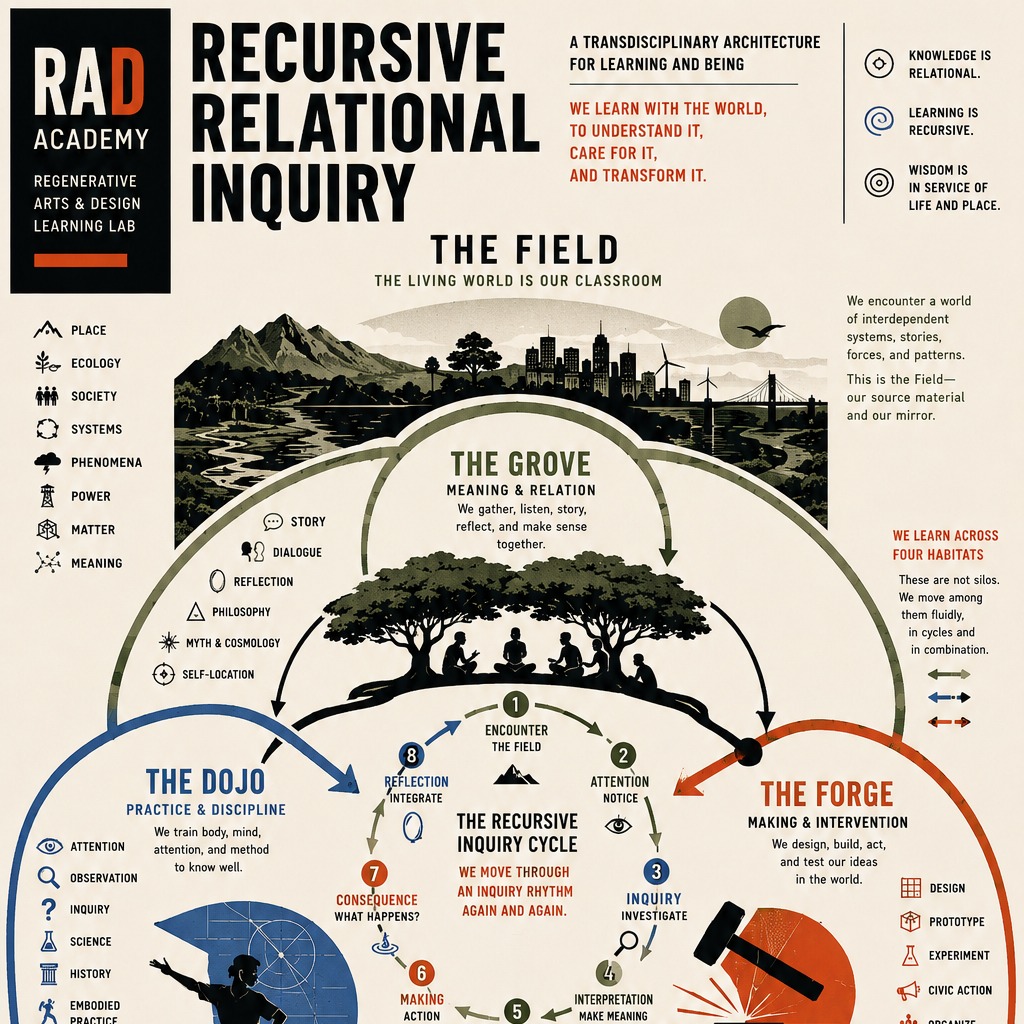
Way of the Centaur (3 Gold)
Craft begins where generation ends. The generated artifact is ore. It has not yet been tempered. This returns us to the forge. In the blacksmithing tradition, material is transformed through cycles: heat, strike, fold, cool, inspect, repeat. Too little heat and the material remains unworkable. Too much heat and its structure is damaged. Too few blows and the form remains crude. Too many blows in the wrong place and the object fractures. The same is true of ideas. A first generation is not a finished work. It is heated material. The practitioner must strike with questions. What is weak here? What is conventional? What assumption remains hidden? Where is the false note? What would make this locally true rather than generically plausible? What has the machine made smooth that reality would make rough? Then the work is folded. Research is folded into narrative. Lived experience is folded into abstraction. Critique is folded into form. Contradictions are not always removed; sometimes they are layered until the artifact gains strength from their tension. The forge father does not merely teach technique. He teaches relationship to force. Power without discipline is ruinous. Heat without form is fire. Sharpness without purpose is violence. This is especially important in an age of agents. An agent is not merely a tool waiting for a single instruction. It may pursue a task, make intermediate decisions, call other tools, generate branches of action, and return with results whose origins are partly hidden even from the person who initiated the process. The fantasy of total control becomes less credible as autonomy increases. This is where trip sitting becomes a serious practice. A trip sitter does not dominate the journey. They establish conditions. They observe. They protect boundaries. They intervene when danger appears. They remain calm when strange material surfaces. They help the traveler return with something integrated rather than merely experienced. To trip sit an agent is to set intention, scope, permissions, checkpoints, and stopping conditions. It is to watch for confident drift. It is to recognize when the process has become circular, manipulative, delusional, or wasteful. It is to ask what the agent omitted, whom it represented poorly, what sources it relied upon, and what consequences may follow from its actions. The agent may wander. The sitter must remain oriented. Conjuring belongs beside trip sitting because every generative act has an occult quality, even when its mechanisms are statistical rather than supernatural. We speak an intention into an obscured system and receive something we did not fully author and cannot fully explain. The danger is not that the process is literally magical. The danger is that it feels magical enough to bypass skepticism. The mature conjurer therefore studies the conditions of emergence. What was placed in the circle? What corpus speaks through this response? What histories have been compressed? What biases appear as normality? What exclusions appear as absence? What economic and ecological systems power the apparition? Conjuring without inquiry becomes spectacle. Conjuring with discipline becomes a way of exploring possibility. This is central to cyber folk pedagogy. Folk traditions have always transformed knowledge into forms that can travel: songs, stories, proverbs, dances, images, recipes, rituals, games. They encode memory into rhythm and social practice. Their intelligence is not merely stored; it is carried in bodies and relationships. Cyber folk pedagogy extends this tradition into the generative age.
