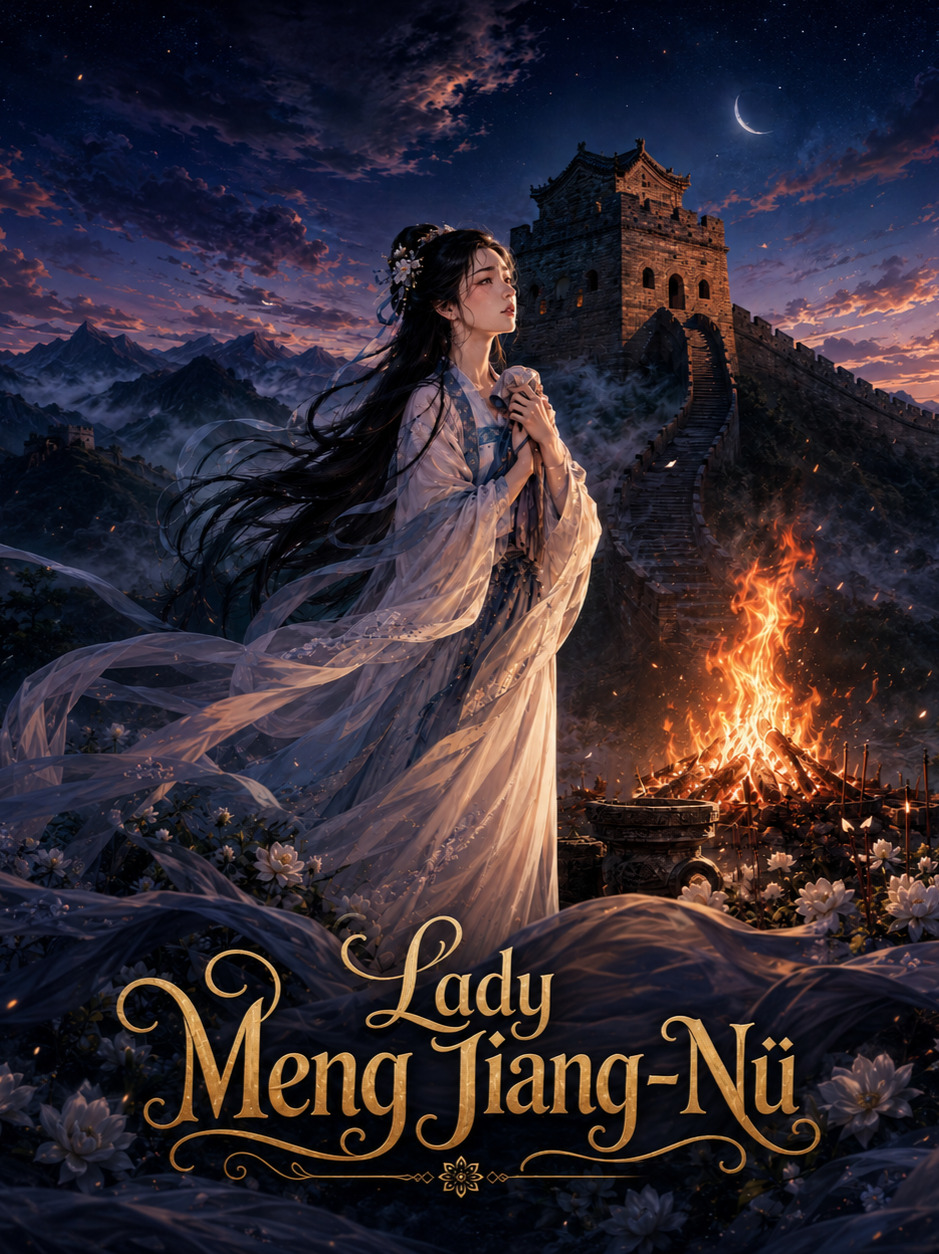

A Brief History of the Legend The legend of Lady Meng Jiang-Nü is one of China’s most famous traditional stories and is counted among the Four Great Folktales of China. Its roots reach back more than two thousand years, beginning with earlier tales of a grieving wife whose mourning was powerful enough to move heaven, earth, and stone. Over the centuries, the story evolved through many forms — historical anecdotes, ballads, regional dramas, songs, opera, film, and popular retellings. In later and best-known versions, the legend is set during the Qin dynasty, under Qin Shi Huang, the First Emperor. Lady Meng Jiang-Nü’s husband is forced into labor on the Great Wall, dies there, and is sealed within the stones. When she reaches the Wall and learns the truth, her grief causes part of it to collapse, revealing his remains. Across more than 2,000 years, many variations of the tale have changed details of her journey, marriage, confrontation with imperial power, and final fate. Yet its heart has remained constant: Lady Meng Jiang-Nü stands as a timeless symbol of faithful love, human sorrow, and moral courage against cruelty and tyranny. ✨✨✨✨ My AI-enhanced progressive-folk musical transforms this ancient tale into a cinematic musical journey, blending acoustic storytelling, dramatic choral writing, and progressive folk textures with the atmosphere of Chinese legend. The arrangements draw, in free artistic interpretation, on Chinese folk and traditional melodic material, including “High Green Mountain” (高山青), *Rainbow Sister” (虹彩妹妹), “Mother is the Best in the World” (世上只有妈妈好), and “Spring River in the Flower Moon Night” (春江花月夜). This production honors Meng Jiang-Nü not only as a tragic heroine, but as a timeless symbol of faithful love, moral courage, and memory stronger than stone. ✨✨✨Note: Of course, this is a musical interpretation of a Chinese legend created by a person from a Western cultural background. I approached the story with deep respect for Chinese culture and tradition, and I sincerely hope that this respect can be felt throughout the work. If any details feel unnatural or inaccurate from the perspective of those who know this culture from within, I kindly ask for understanding and forgiveness.✨✨✨ 🎭🎭🎭All rights reserved. This musical, including its concept, lyrics, dialogue, arrangements, staging ideas, visual presentation, and related materials, is an original creative work. No part of this work may be copied, translated, adapted, sampled, reproduced, distributed, published, or used in derivative works without prior written permission.🎭🎭🎭 © Le Fox de Funk 2026 @lefoxdefunk I hope you enjoy the tale! ✨✨✨✨ Lady Meng Jiang-Nü The musical opens with the image of the Great Wall of China rising through mist, mountains, and centuries. The Narrator welcomes the audience to an ancient Chinese tale of love, grief, and devotion — the story of one place where the mighty Wall fell, and of the woman whose tears were stronger than stone. Long ago, when the Wall had only just begun to be built, two neighboring families lived in the village of Xujiazhuang: the Mengs and the Jiangs. Their houses stood side by side. One summer, a pumpkin sprout grew in the Meng garden, climbed over the fence, and blossomed on Jiang soil. By autumn, a huge pumpkin had grown, and the two old women began to quarrel over whom it belonged to. To keep peace, they decided to cut the pumpkin in two. But when they opened it, they found a tiny little girl inside, smiling up at them. Since she belonged to both houses, they named her Meng Jiang-Nü. She grew between the two families, loved by both, and became kind, wise, and beautiful. At the same hour, far to the south in the land of Gusu, a boy was born: Fan Hong-liang. He grew strong and healthy, but sorrow came when Qin Shi Huang commanded the Great Wall to rise. Men were seized for labor, beaten by officers, and those who fled were sealed into the Wall alive. Fan Hong-liang was taken north to work among the stones. For a year he labored on the Wall, carrying heavy stones from dawn to night. At last, longing for home, he escaped through the rain. He walked south until morning and hid in a willow tree by a village pond. There Meng Jiang-Nü came to rinse woven cloth. Seeing his reflection in the water, she startled and fell into the pond. Fan Hong-liang leapt down and saved her. When she asked who he was, he told her of the Wall, the guards, and his escape. She hid him and returned home to tell both families that he had saved her life. With their blessing, she brought him back. The families welcomed him, and soon Meng Jiang-Nü and Fan Hong-liang were married. Their happiness was brief. The officials counted the workers and found one man missing. Guards seized Fan Hong-liang, bound his wrists, and drove him north again. Meng Jiang-Nü ran after them, crying that he was her husband. The guard answered that he belonged not to her, but to the Great Wall. Fan Hong-liang turned to her and told her to go home. Perhaps, he said, he might escape again. Meng Jiang-Nü returned and waited. She stitched him a winter coat, then summer clothes, but he never came back. One night she dreamed of him; when she reached for his hand, her fingers touched cold stone. She woke knowing he had been killed. She set out for the Great Wall to perform the burial rites. After a long journey, she reached the Wall and asked the stonecutters about her beloved. They told her the truth: Fan Hong-liang had been walled up alive one year before. She asked to be led to the place where he had been sealed. Meng Jiang-Nü climbed the Wall and wept. Her tears were so burning that the stones cracked and rolled down. Stone by stone, the Wall opened, revealing her husband’s remains. She buried him, put on mourning white, and walked slowly away. Imperial officials tried to repair the breach, but every new block fell as soon as it was laid. No order, no shouting, and no labor could make that place stand again. The officials reported to Qin Shi Huang that a woman had destroyed the Wall with her tears. He ordered her brought before him. At first he considered what punishment she deserved. But when he saw Meng Jiang-Nü, he forgot his anger. Though he had many beautiful wives, none could compare with her. He ordered preparations for a wedding feast: she was to become his wife. Meng Jiang-Nü knew she could not openly defy the Emperor. She agreed, but only on three conditions: he must build a tomb for Fan Hong-liang, raise a temple in his honor, and perform the sacrifice at his grave with his own hands. Qin Shi Huang agreed. A tomb was built, a temple was raised, and at dawn the Emperor came in a yellow-silk palanquin to fulfill the final rite. A funeral fire burned beside the grave; temple bells trembled in the air; sacrificial paper money waited on a lacquered tray. At that moment, Meng Jiang-Nü drew back the curtains of her palanquin, leapt to the ground, and threw herself into the fire. No one had time to cry out before the flames took her. Thus Meng Jiang-Nü kept faith with her husband, Fan Hong-liang. Centuries have passed. The Great Wall still stands across the ancient Chinese lands. Yet just as strong in the hearts of the people is the memory of Meng Jiang-Nü. When they speak of someone faithful, brave, and true — a heart that grief could not bend and fear could not break — they say: a heart like Meng Jiang-Nü. ✨✨✨✨
