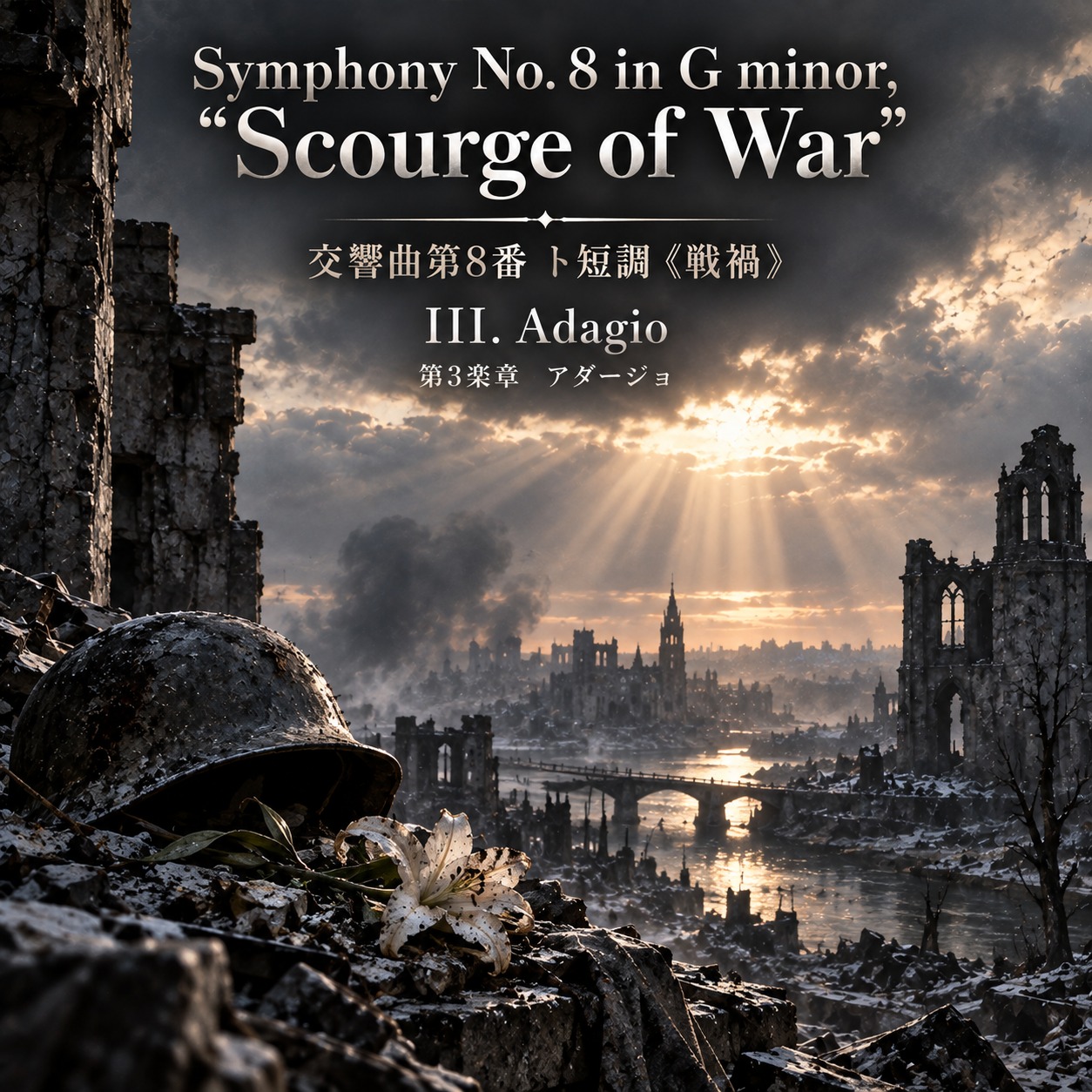

III. Adagio The Third Movement emerges slowly from a dark sonority in the lower register, with a quiet melody rising from the strings. The violent conflicts of the First Movement and the relentless motion of the Second have disappeared. Yet this is not a return to the peace that existed before the war. The silence is already burdened by what has been lost: this is a world after destruction has passed through it. Centered on F minor, the opening is built upon a deeply sunken foundation in the lower strings, while the upper strings and woodwinds exchange long melodic lines. The music refuses to hurry forward, allowing each harmony—and even the silence between phrases—to carry its own weight. This sorrow is not expressed through violent emotion. Instead, the music seems to remember, one by one, those who were lost. The restrained melodic movement suggests a grief so profound that even crying out has become impossible. Gradually, the strings gain weight and the melody expands across the orchestra. Brass joins as the music rises toward its first major climax, transforming private mourning into a vast elegy for countless victims. The powerful brass chords do not proclaim victory. Accumulated sorrow can no longer be contained and erupts through the full orchestra. Tense upper strings and heavy lower sonorities reveal the scale of what war has taken away. After the climax, the music returns to stillness, but not to where it began. Solitary woodwind melodies emerge like individual voices isolated within the vastness of history. The strings respond, and long melodic lines pass between instruments, as though personal grief were being handed from one person to another until it became the memory of an entire generation. In the central section, a momentary warmth appears. Major harmonies enter the predominantly minor landscape, recalling ordinary life before the destruction: time with family, peaceful days, and familiar landscapes. But this warmth cannot remain. Ominous motion continues beneath the surface, and the harmony gradually darkens. The clearer those memories become, the more painful their distance from the present feels, drawing the music back into the sorrow of F minor. In the latter half, the strings become increasingly active as the movement builds toward a second great climax. The quiet melodies of the opening expand across the full orchestra, now joined by brass and percussion. This time, grief and anger become inseparable. Why did so many lives have to be lost? No answer is given. Urgent strings and forceful brass transform personal mourning into an accusation directed at war itself. The violence of the earlier movements seems to return—not as battle, but as the wounds left within human memory. The physical conflict may have ended, but the war within has not. After the climax, the orchestra rapidly loses its strength. Dense string textures dissolve, solitary woodwinds return, and long silences open between individual voices, suggesting a world in which countless voices have disappeared. Toward the end, heavy notes in the lower strings sound at measured intervals beneath fragmented melodies. They resemble bells marking lost time, drawing the movement gradually into deeper darkness. Yet complete despair does not remain. A faint warmth survives within the sustained strings and gentle woodwinds. It is neither certainty nor a clear declaration of hope, but the will to continue living while carrying the memory of those who were lost. The movement closes quietly without full resolution. Its tonal center shifts from F minor toward C, the dominant region, avoiding a completely stable conclusion and allowing its unresolved grief to pass into the Fourth Movement. The First Movement portrayed the outbreak and expansion of war; the Second, its madness and mechanized violence. The Third quietly confronts what war has taken away. What remains is not the battle itself, but the grief that survives after it is over—and the human memory that continues to carry it. ーーーーーーーーーーーーーーーーーーーーーー 第3楽章:Adagio 第3楽章は、低音域に広がる暗い響きの中から、弦楽器による静かな旋律がゆっくりと立ち上がる。 第1楽章の激しい対立や、第2楽章の猛烈な運動はここで姿を消す。しかし、訪れるのは戦争以前の平穏ではない。音楽を覆う静けさには、すでに失われたものの重さが染み込み、破壊が通り過ぎた後の世界が広がっている。 主調はヘ短調を中心としている。 冒頭では、低弦が深く沈んだ土台を作り、その上で高音弦と木管楽器が長い旋律を受け渡していく。音は急いで次へ進まず、一つ一つの和音が長く保たれる。旋律の間に生まれる余白も音楽の一部となり、言葉にできない悲しみが静かに蓄積されていく。 ここでの悲哀は、激しい感情の噴出ではない。 戦争によって失われた人々の名前を、一人ずつ確かめるような音楽である。旋律は大きく跳躍することを避け、隣り合う音をたどりながら進む。その抑制された動きによって、泣き叫ぶことすらできないほど深い喪失が描かれている。 やがて弦楽器の響きが厚みを増し、木管楽器から受け取った旋律を管弦楽全体へ広げていく。 音楽は少しずつ高音域へ向かい、金管楽器も加わりながら最初の大きな頂点を形成する。ここでは静かな追悼が一時的に個人の内面を越え、無数の犠牲者へ向けられた巨大な哀歌へと変わる。 金管楽器の強い和音は勝利を告げるものではない。 積み重なった悲しみが抑えきれなくなり、管弦楽全体から一斉に噴き出す。弦楽器の高音は鋭く張り詰め、低音楽器は逃げ場を塞ぐように重い響きを支える。戦争によって奪われたものの大きさが、初めて全管弦楽の規模で示される場面である。 頂点を越えると、音楽は再び静けさの中へ戻っていく。 しかし、冒頭と同じ場所へ戻るわけではない。一度大きく解放された感情の記憶が残り、静かな旋律にも以前より深い傷が刻まれている。独奏的に現れる木管楽器の旋律は、巨大な歴史の中に残された一人の声のように孤立する。 その声に弦楽器が応答し、やがて複数の旋律が重なり始める。 この楽章では、一つの主題を明確に区切って提示するというより、長い旋律が楽器から楽器へ受け継がれながら、少しずつ姿を変えていく。個人の悲しみが別の人間へ渡され、やがて一つの世代や社会全体の記憶へ変わっていくような構造である。 中盤では、音楽に一時的な明るさが差し込む。 短調の暗い響きの中に長調的な和音が現れ、弦楽器の旋律にも温かさが加わる。それは戦争の終結や救済を表す明るさではない。失われる以前の日常、家族との時間、穏やかだった風景が記憶の中に浮かび上がる場面である。 その温かさは長く定着しない。 旋律の背後では低音が不穏に動き続け、和声も再び暗い方向へ傾いていく。幸福な記憶をたどるほど、現在との隔たりが際立ち、音楽は再びヘ短調の深い悲哀へ引き戻される。 後半に入ると、弦楽器の動きが次第に活発になり、音楽は二度目の大きな高揚へ向かう。 冒頭では静かに語られていた旋律が拡大され、金管楽器と打楽器を伴って全管弦楽へ広がっていく。最初の頂点が悲しみの噴出であったのに対し、ここでは悲しみと怒りが分かち難く結び付いている。 なぜこれほど多くの命が失われなければならなかったのか。 その問いに答えは与えられず、管弦楽だけが激しく膨張する。高音弦の切迫した旋律と金管楽器の強奏は、個人の嘆きを越え、戦争そのものに対する告発へ変わっていく。 頂点では、第1・第2楽章で前面に出ていた戦争の暴力が、再び楽章の内部へ侵入する。 ただし、ここで描かれるのは戦闘の光景ではない。戦争が人々の心に残した傷、その傷が年月を経ても消えず、記憶の中で何度もよみがえる姿である。外面的な戦闘は終わっていても、内面の戦争は終わっていない。 大きな頂点の後、音楽は急速に力を失っていく。 弦楽器の厚い響きは徐々にほどけ、木管楽器による孤独な旋律が再び現れる。管弦楽の空間は広くなり、各楽器の間に長い沈黙が生まれる。多くの声が消えた後に、わずかな生存者だけが残されたような静けさである。 終盤では、低弦による重い音が一定の間隔で現れ、その上に弦楽器と木管楽器が断片的な旋律を重ねる。 この低音は歩みを示すものではなく、失われた時間を刻む鐘のような役割を担う。一音ごとに音楽の重心が沈み、楽章は終結へ向かいながら、さらに深い暗闇へ入っていく。 それでも、最後の部分には完全な絶望だけが残されるわけではない。 弦楽器の長い音と木管楽器の穏やかな旋律の中に、ごくわずかな温かさが保たれている。それは未来への確信や、明確な希望ではない。失われた人々を忘れず、その記憶を抱えながら生き続ける意志である。 楽章は大きな解決を示さず、静かな響きの中で閉じられる。 最終部ではヘ短調から属調領域であるハを中心とする響きへ重心が移り、完全に安定した終止を避けている。そのため、第3楽章単独で悲しみが完結するのではなく、解決されないまま第4楽章へ受け渡される。 第1楽章が戦争の勃発と拡大を描き、第2楽章がその狂気と機械的な暴力を描いたのに対し、第3楽章は、戦争が奪ったものを静かに見つめる。 長く息をする旋律、厚く広がる弦楽器、悲痛な金管楽器の頂点、そして再び戻ってくる孤独な木管の声。 この楽章で語られるのは、戦争の最中に起こる出来事ではない。戦争が終わった後にも残り続ける悲しみと、人間の記憶そのものである。

0/500