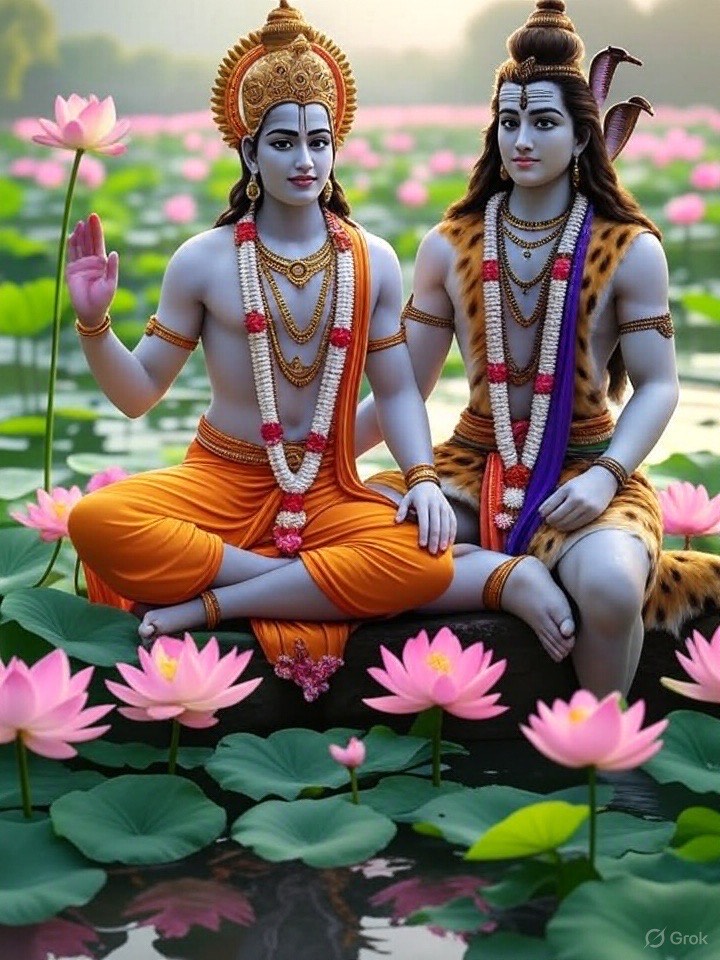

**Song Title**: Padma Stuti (Hymn to the Lotus) [Verse 1: [Slow tempo 50–60 BPM], [Sitar intro with soft tabla rhythm], [Tanpura drone], [Male vocalist with devotional tone], [Use gentle gamakas and subtle meend for smooth Indian classical phrasing]] Padmaṃ divyaṃ, udati jala-madhye śuddhaṃ, (Holy lotus, rising pure from the water’s heart,) Viṣṇave samarpitaṃ, sampadaḥ prakāśati. (Offered to Vishnu, it shines with abundance.) Śivāya kamalaṃ, mokṣa-dāyakaṃ śāntaṃ, (To Shiva, the lotus, granting salvation’s peace,) Pūjāyāṃ petalaiḥ, hṛdayaṃ samarpāmi. (With petals in worship, I offer my heart.), [Chorus: [Medium tempo 70–80 BPM], [Add harmonium and flute], [Layered male and female choir], [Use vibrant gamakas and alaap-like flourishes at the start], [Emphasize devotional intensity]] Padma divyaṃ, devānāṃ śobhanaṃ, (Sacred lotus, glory of the divine,) Viṣṇu-Śiva-stuti, hṛdi bhakti vardhati. (Praise to Vishnu and Shiva, devotion grows in the heart.) Kamalaṃ śuddhaṃ, mokṣa-sampad-dāyakaṃ, (Pure lotus, giver of salvation and wealth,) Stotraṃ gāyāmi, padmaṃ namāmi. (I sing this hymn, I bow to the lotus.), [Verse 2: [Medium tempo 70–80 BPM], [Tabla intensifies with intricate rhythms], [Sitar continues with tanpura drone], [Male vocalist with expressive meend and subtle taans for emotional depth]] Viṣṇuḥ kamala-nābhiḥ, jagataḥ pālanaṃ, (Vishnu, lotus-naveled, protector of the world,) Sampatti-dātā, padmaṃ tava āspadaṃ. (Giver of abundance, the lotus is your throne.) Śivaḥ śuddha-hṛdayaḥ, nīla-kaṇṭhaḥ śāntiḥ, (Shiva, pure-hearted, blue-throated, peace,) Mokṣa-pradāyakaḥ, padmaṃ tava priyaṃ. (Grantor of salvation, the lotus is your beloved.), [Chorus: [Medium tempo 70–80 BPM], [Full ensemble with sitar, tabla, harmonium, flute, and manjira], [Choir swells with dynamic gamakas and synchronized alaap flourishes], [Maintain devotional uplift]] Padma divyaṃ, devānāṃ śobhanaṃ, (Sacred lotus, glory of the divine,) Viṣṇu-Śiva-stuti, hṛdi bhakti vardhati. (Praise to Vishnu and Shiva, devotion grows in the heart.) Kamalaṃ śuddhaṃ, mokṣa-sampad-dāyakaṃ, (Pure lotus, giver of salvation and wealth,) Stotraṃ gāyāmi, padmaṃ namāmi. (I sing this hymn, I bow to the lotus.), [Bridge: [Slow tempo 50–60 BPM], [Flute solo with soft tanpura drone], [Minimal tabla], [Reflective tone], [Vocalist uses long meend and soft alaap to evoke meditative calm]] Padmaṃ nir-malaṃ, saṃsāra-sāgara-tāraṃ, (Pure lotus, crossing the ocean of existence,) Hṛdaye bhaktiḥ, deva-darśana-kāraṃ. (Devotion in the heart, revealing the divine vision.) Viṣṇu-Śiva-padmaṃ, śānti-sampad-dhāmaṃ, (Lotus of Vishnu and Shiva, abode of peace and wealth,) Namāmi nityaṃ, stotraṃ gāyāmi. (I bow eternally, I sing this hymn.), [Chorus: [Medium tempo 70–80 BPM], [Full ensemble with sitar, tabla, harmonium, flute, and manjira], [Doubled choir with powerful gamakas and taan flourishes], [Peak devotional energy]] Padma divyaṃ, devānāṃ śobhanaṃ, (Sacred lotus, glory of the divine,) Viṣṇu-Śiva-stuti, hṛdi bhakti vardhati. (Praise to Vishnu and Shiva, devotion grows in the heart.) Kamalaṃ śuddhaṃ, mokṣa-sampad-dāyakaṃ, (Pure lotus, giver of salvation and wealth,) Stotraṃ gāyāmi, padmaṃ namāmi. (I sing this hymn, I bow to the lotus.), [Outro: [Slow tempo 50–60 BPM], [Soft tanpura and flute fade], [Single male vocalist with gentle reverence], [Minimal gamakas], [Long sustained notes for serene closure]] Padmaṃ śāntaṃ, deva-hṛdaya-nivāsaṃ, (Peaceful lotus, dwelling in the divine heart,) Viṣṇu-Śiva-pūjā, nityaṃ samarpitaṃ. (Worship of Vishnu and Shiva, eternally offered.) Kamalaṃ divyaṃ, mokṣa-patha-prakāśaṃ, (Divine lotus, illuminating the path to salvation,) Namāmi padmaṃ, hṛdi sadā sthitam. (I bow to the lotus, ever in my heart.)]] --- **Suno Formatting Notes**: - **Structure**: Copy only the Sanskrit lyrics into Suno’s lyric input field, excluding the English translations in parentheses, which are for reference only. Each section starts with `[Section: [Instruction 1], [Instruction 2], ...]`, with commas between instructions, a single closing bracket `]`, and commas between sections. The Outro ends with double square brackets `]]`. - **Vocal Inflections**: - **Gamakas**: Ornamental oscillations (gentle in Verse 1, vibrant in Chorus, powerful in final Chorus). - **Meend**: Smooth glides between notes (subtle in Verse 2, long in Bridge). - **Alaaps**: Improvisational melodic phrases (at Chorus start, soft in Bridge). - **Taans**: Fast melodic runs (subtle in Verse 2, dynamic in final Chorus). - Male vocalist with a warm, reverent tone; doubled choir in final Chorus for intensity. - **Genre**: Select “Indian Devotional” or “Classical Indian” in Suno, per the metadata tags: Indian Devotional, Classical Indian, Sanskrit, Bhajan, Sitar, Tabla, Harmonium, Flute, Tanpura, Manjira, etc. - **Tempo**: Slow (50–60 BPM for Verse 1, Bridge, Outro), medium (70–80 BPM for Chorus, Verse 2). - **Instrumentation**: - **Sitar**: Melodic foundation. - **Tabla**: Rhythmic backbone, intensifying in Verse 2 and Chorus. - **Harmonium**: Harmonic support in Chorus. - **Flute**: Soulful solos in Bridge and Outro. - **Tanpura**: Drone for spiritual grounding. - **Manjira**: Rhythmic accents in Chorus. - **Pronunciation**: Ensure clear Sanskrit pronunciation (e.g., “Viṣṇu” as “Vish-nu,” “Śiva” as “Shi-va,” “Padmaṃ” as “Pad-mam”). Check Suno’s vocal preview for accuracy. - **Suno Settings**: Verify that Suno recognizes `[]` instructions as metadata, not lyrics, and commas between sections as separators. Input only the Sanskrit lyrics for singing. Preview to ensure vocal inflections and transitions are correct. **Additional Notes**: - The song is streamlined for readability: one Sanskrit line with its English translation in parentheses per line, separated by blank lines for clarity. Only the Sanskrit lyrics should be sung in Suno. - The song retains its focus on the lotus as an offering to Vishnu (abundance) and Shiva (salvation), with the approved devotional tone and structure. - For cover art, would you like an image of a lotus with Vishnu and Shiva iconography? Please confirm. - If you need tweaks (e.g., adding mantras like “Om Namo Narayanaya” or “Om Namah Shivaya”) or further simplification, let me know!
