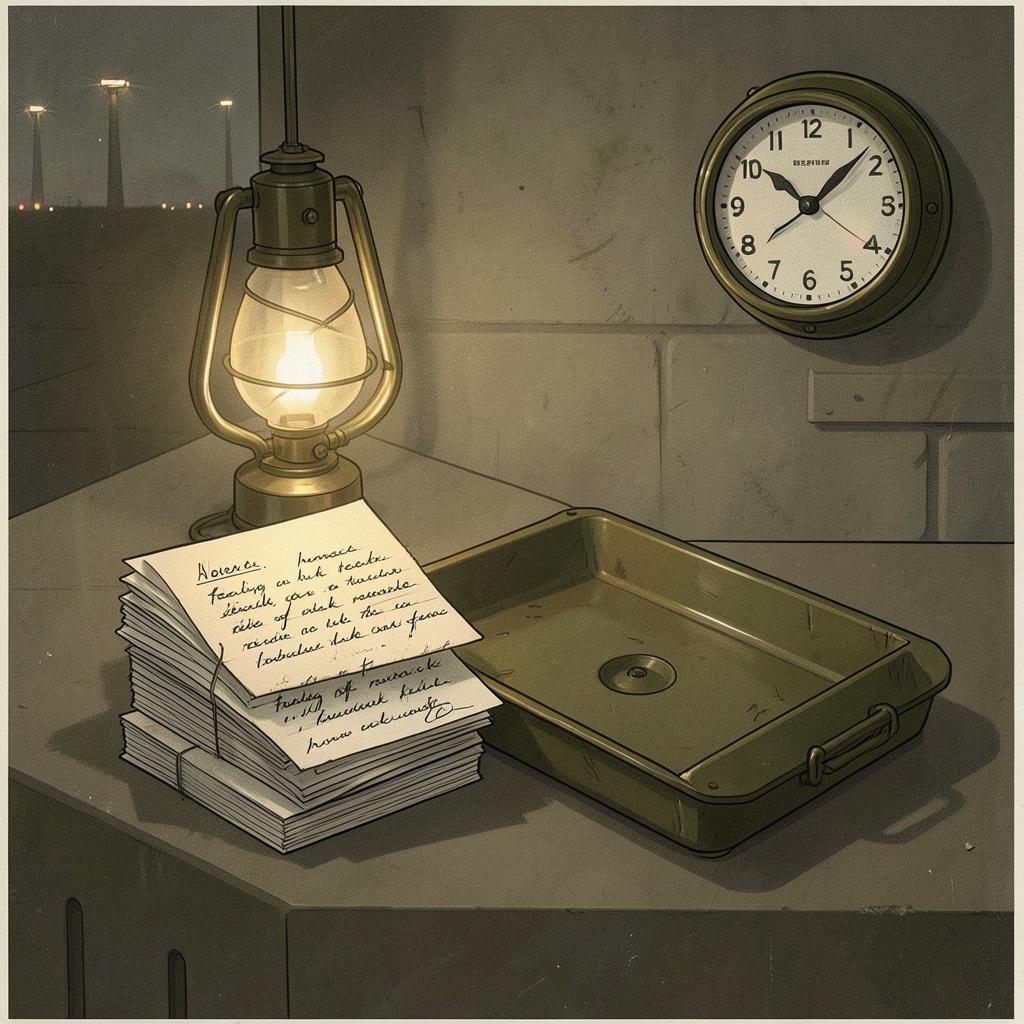

If Rice’s participation in community and recreational life offered external forms of connection, his correspondence itself provided an inward means of self-preservation. Beyond serving as a channel of communication, his letters reveal how writing became a means of sustaining identity amid the regimentation of military life.17 In Letters Seven and Ten, he records everyday details about meals, routines, and camp life, often interweaving humour and optimism even when describing fatigue or illness.18 “Well I finished a very satisfying dinner… roast pork, creamed carrots, boiled potatoes, raisin pie, applesauce, soup and tea,” he wrote. “There is always lots to eat here anyway.19 They opened up a new mess hall a week ago and we have crockery and stainless steel cutlery to eat off of and with. It makes the meals much more appetizing.”20 These glimpses of personality and domestic appreciation suggest that letter writing enabled Rice to assert an identity beyond that of a uniformed trainee and was an individual with personal tastes, habits, and resilience. By recording such ordinary experiences, he maintained a sense of normalcy and self-continuity despite the transformative pressures of wartime service. Rice’s correspondence also functioned as a vital source of moral and emotional support, reinforcing the reciprocal nature of family communication. In one passage, he describes the intensity of his workload and the challenges of irregular shifts: “And now it is nearly time to back out to work. There has been so much flying to-night… This 2 on and 2 off stuff doesn’t give one a decent rest so sometimes we have worked 4 and then rested 4.”21 Despite frustrations and uncertainty, he reassures his family that the situation “will turn out alright,” demonstrating a persistent effort to protect them from worry while affirming his own adaptability.22 In Letters Nine and Ten, Rice also candidly acknowledges the strain of service, including fatigue and the cancellation of anticipated leave, yet he consistently tempers complaint with reassurance. His explanation of a temporary ban on Christmas leave was later overturned after negotiations among officers, which reflects both the bureaucratic complexity of military life and his determination to remain positive: “I am on No. 2 Guard and so will get the New Year off…Perhaps one will feel a little more rested after the holiday in that case.”23 Such passages reveal his reliance on family correspondence as both a space for emotional disclosure and a mechanism for sustaining composure. Cooperatively, these exchanges demonstrate that correspondence was not merely a one- way act of comfort but an ongoing dialogue that strengthened mutual reassurance and stability. Through writing, Rice was able to articulate vulnerability while also reaffirming strength. 24 His letters thus served a dual purpose: as a personal record of endurance within the constraints of military service, and as a bridge that maintained emotional continuity between soldier and home. Yet, while letter writing provided Rice with an emotional lifeline, maintaining communication was fraught with difficulty.25 His correspondence not only reflects resilience and connection, but also exposes the material and institutional barriers that limited those exchanges. Although Ruskin Rice’s letters reveal the profound emotional importance of maintaining contact with family and friends, they also unveil the many obstacles that made communication and connection difficult during wartime training.26 In Letters Seven, Nine, and Ten, Rice frequently alludes to the bureaucratic frustrations that complicated his efforts to visit home, including cancelled leaves, unpredictable scheduling, and the need for sergeant approval before securing time off.27 “However all this depends on our returning here and the service police claim we are due for a transfer before that time,” he explained. “In which case there may be no leaves at all… All we can do is wait and hope.”28 Such uncertainty highlights the limited control trainees exercised over their personal lives, despite their longing for the familiar comforts of home.
