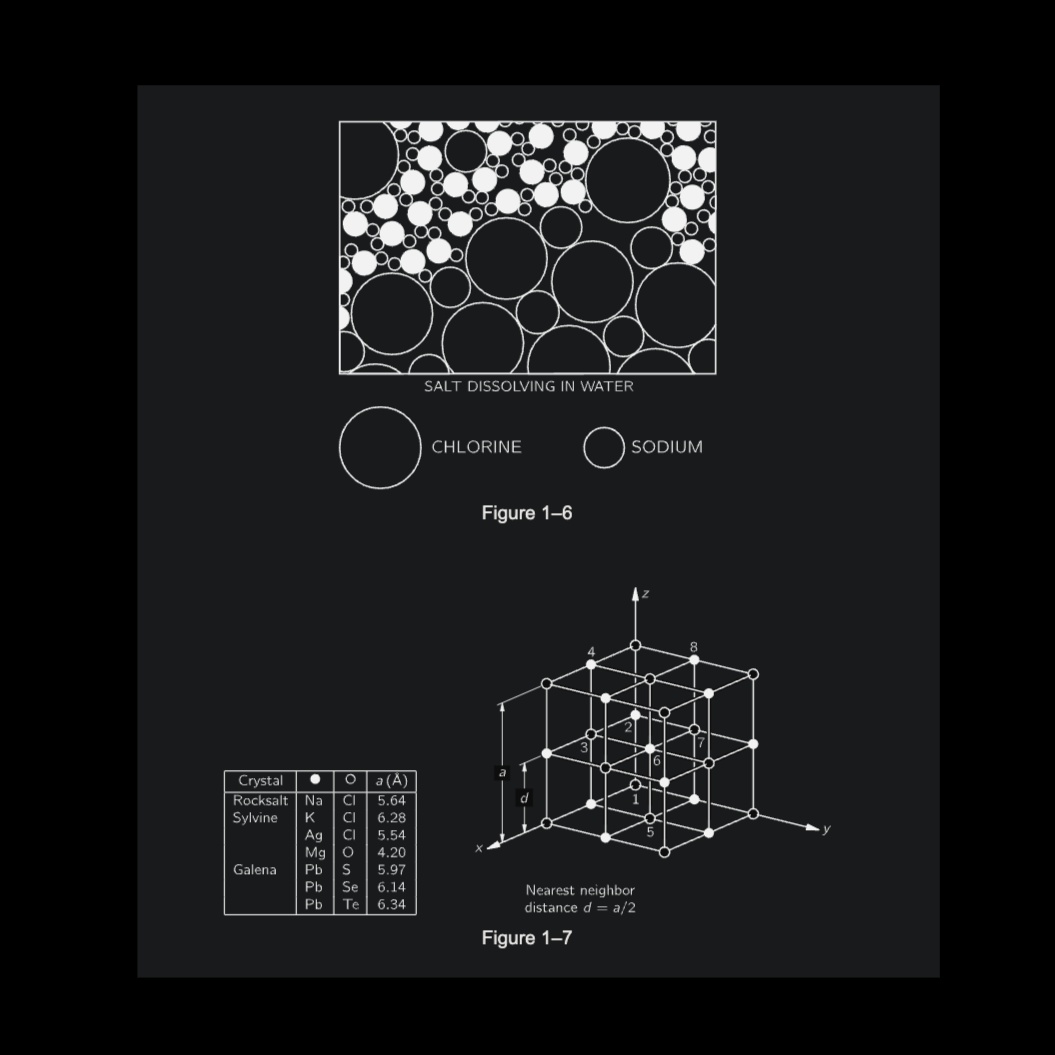

Now we go on to another process. In Fig. 1–6 we see, from an atomic point of view, a solid dissolving in water. If we put a crystal of salt in the water, what will happen? Salt is a solid, a crystal, an organized arrangement of “salt atoms.” Figure 1–7 is an illustration of the three-dimensional structure of common salt, sodium chloride. Strictly speaking, the crystal is not made of atoms, but of what we call ions. An ion is an atom which either has a few extra electrons or has lost a few electrons. In a salt crystal we find chlorine ions (chlorine atoms with an extra electron) and sodium ions (sodium atoms with one electron missing). The ions all stick together by electrical attraction in the solid salt, but when we put them in the water we find, because of the attractions of the negative oxygen and positive hydrogen for the ions, that some of the ions jiggle loose. In Fig. 1–6 we see a chlorine ion getting loose, and other atoms floating in the water in the form of ions. This picture was made with some care. Notice, for example, that the hydrogen ends of the water molecules are more likely to be near the chlorine ion, while near the sodium ion we are more likely to find the oxygen end, because the sodium is positive and the oxygen end of the water is negative, and they attract electrically. Can we tell from this picture whether the salt is dissolving in water or crystallizing out of water? Of course we cannot tell, because while some of the atoms are leaving the crystal other atoms are rejoining it. The process is a dynamic one, just as in the case of evaporation, and it depends on whether there is more or less salt in the water than the amount needed for equilibrium. By equilibrium we mean that situation in which the rate at which atoms are leaving just matches the rate at which they are coming back. If there is almost no salt in the water, more atoms leave than return, and the salt dissolves. If, on the other hand, there are too many “salt atoms,” more return than leave, and the salt is crystallizing. In passing, we mention that the concept of a molecule of a substance is only approximate and exists only for a certain class of substances. It is clear in the case of water that the three atoms are actually stuck together. It is not so clear in the case of sodium chloride in the solid. There is just an arrangement of sodium and chlorine ions in a cubic pattern. There is no natural way to group them as “molecules of salt.” Returning to our discussion of solution and precipitation, if we increase the temperature of the salt solution, then the rate at which atoms are taken away is increased, and so is the rate at which atoms are brought back. It turns out to be very difficult, in general, to predict which way it is going to go, whether more or less of the solid will dissolve. Most substances dissolve more, but some substances dissolve less, as the temperature increases.

0/500