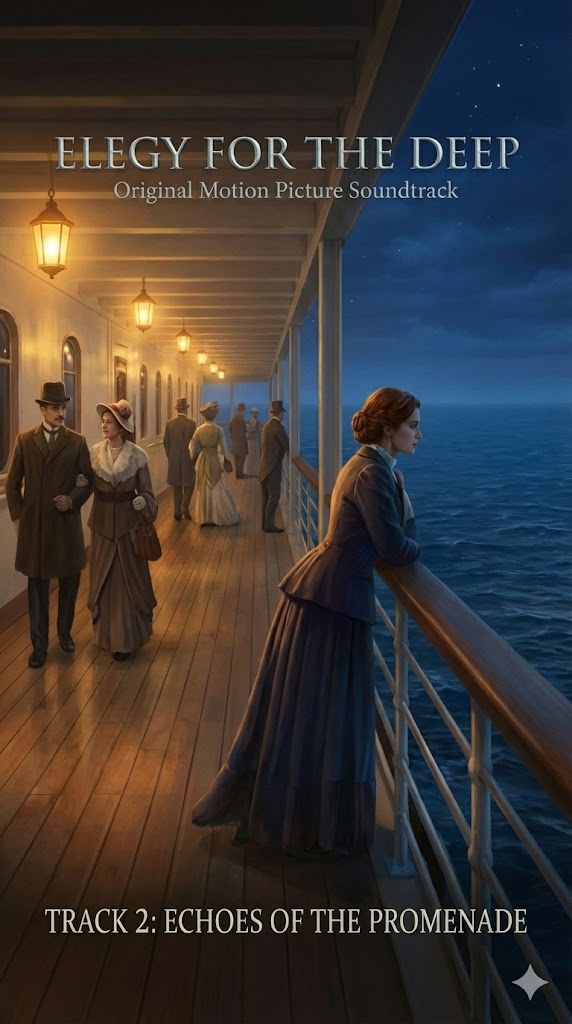
Echoes of the Promenade - Elegy for the Deep / Track 2

The screen fades in from darkness, the final echo of the opening cello still lingering like a breath held too long. Now we drift upward into a soft, muted glow, early evening light suspended over the grand ocean liner in her prime. This is the first flashback, the audience’s introduction to the world as it once was, alive, immaculate, and unaware of its fate. The promenade deck stretches endlessly along the ship’s starboard side, polished wood gleaming under warm lanterns. The ocean here is calm, a mirror that reflects the fading gold of sunset. Gentle waves break against the hull in steady, reassuring rhythms. A small string ensemble plays somewhere out of frame, their graceful phrases floating through the air like perfume. The melody matches the rising woodwinds of Track 2, wrapping the scene in a sense of elegant nostalgia. Passengers stroll in relaxed clusters. Some are tourists in crisp linen suits, trying their best to capture the light in handheld cameras, others are families wrapped in layers of excitement, children darting between adults with the unbothered freedom of innocence. Elderly couples walk arm in arm, their pace slower but no less joyful. There is laughter, conversation, the soft clinking of teacups from the deck café, a world perfectly balanced between luxury and serenity. Amid the bustle, the camera focuses on a younger version of Aurelius Mare’s relative, the young woman from the locket. Her name, we learn through subtle visual cues rather than dialogue, is Elara Mare. She stands near the railing, gazing out over the water with the contemplative stillness that she and Aurelius share across time. She's dressed modestly compared to the wealthier passengers, but her presence has a quiet brightness that draws the viewer’s attention more effectively than any glittering gown. Near her feet lies a small leather-bound journal, open to a page filled with delicate handwriting and musical sketches. She rests her hands gently on the railing, letting the wind lift strands of her dark hair as she hums a motif that, to the attentive ear, hints at the core theme of the entire score. Elara does not know that her private melody will one day travel through decades and reach Aurelius’s heart, becoming a thread connecting past and present. The camera glides behind her, revealing the ship’s upper decks, bustling with life. Crew members move efficiently, adjusting lamps, securing ropes, preparing for the evening’s events. The ship’s towering funnels glow warmly as smoke drifts upward, joining the sky in soft plumes. Lanterns flicker on in orderly rows, casting golden reflections across the water as twilight deepens. Music swells softly when a particular moment occurs. Elara notices a child standing alone near the rail, holding a toy wooden boat carved with surprising craftsmanship. The child’s parents are only a few paces away, but the boy is entranced by the immensity of the sea, lost in a world entirely his own. Elara kneels beside him and asks, in a tone we hear only through her expression, about the little boat. The child gestures proudly, miming the boat’s imagined voyage across the waves. This tiny interaction is simple, even mundane, but it builds emotional resonance. It reminds us that every life aboard has dreams, stories, and quiet moments worth remembering. The camera cuts to the overhead view of the deck, and the strings in the score introduce the clarinet theme, calm, lilting, and hopeful. Passengers continue strolling, the ship lights now fully blending with the twilight. The sense of peace is overwhelming, and yet the audience, knowing what lies ahead, feels an emotional ache beneath the beauty. The promenade is almost too perfect, its serenity a fragile illusion suspended above an impending void. The scene transitions to a moment of visual poetry. Lantern reflections ripple across the side of the hull, stretching downward like elongated beams of starlight reaching for the deep. We descend with them again, the music softening, before rising back into the present timeline. Now we return to modern-day Aurelius aboard the small vessel. He stands near the rail in the same place Elara once stood. For the first time, we see his face clearly. There is a quiet wonder in his eyes, as if this place, this moment, allows past and present to overlap. His breath catches as he opens the locket once more. In the soundscape, Elara’s hum subtly returns, woven into the orchestration. Aurelius whispers: “This was her favorite hour... the moment light became memory.” The camera drifts backward along the vessel, mirroring the promenade pan from earlier. The waves glimmer softly, and we are left with the emotional impression that time itself is folding, that Aurelius is not only remembering, but listening to echoes left behind. As the scene concludes, the clarinet’s motif returns, just as warm and hopeful as in the flashback. But in the present moment, it carries a bittersweet weight, a fragile echo of what once was, and what can never return. Fade to gentle darkness. ⌬-----⌬-----⌬-----⌬-----⌬-----⌬-----⌬ [© 2025 ⌬ 𝙲𝚑𝚊𝚍𝚇.𝚊𝚒 ⌬ | This work is protected. No reproduction, redistribution, or commercial use without written consent. Remixing is permitted in Suno using the official “cover” feature, provided proper credit is given to the original artist. Respect the art, respect the artist.] ⌬ ChadX.ai - @ChadwickHalse ⌬
