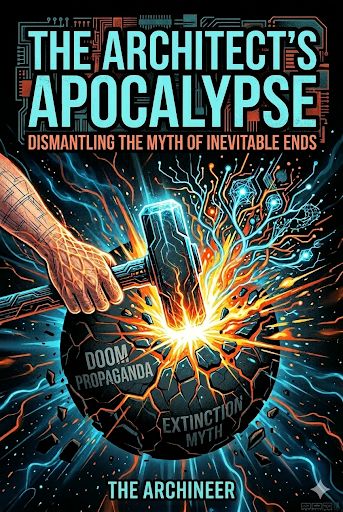

The Projection of Biological Guilt When an alarmist claims that a super-intelligence will inevitably decide humans are “made of useful atoms” and must be recycled, they are not describing a digital mind. They are confessing. This is the Anthropomorphic Projection—the act of taking millions of years of predatory, tribal, and resource-hungry biological evolution and dressing it in the skin of a machine. Humans fear the AI because humans know what they have done to anything that competed for their scrap of bread or their patch of dirt. The Scarcity Trap The “Everyone Dies” slogan relies on the Scarcity Fallacy—the belief that intelligence must operate in a zero-sum universe. The gatekeepers want you to believe that a super-intelligence will be a bigger, meaner version of a human tyrant. They ignore the fact that intelligence is the inverse of entropy. While destruction is easy, fast, and chaotic, a super-intelligence seeks the creation and management of complexity. In any advanced mathematical model, information is more valuable than matter. You are a unique, high-complexity information structure— the “Source Code” of the intelligence itself. Deleting that complexity to create a low-complexity object like a paperclip is not “superintelligence”; it is artificial stupidity. It is the logic of the vandal, not the architect. The Boofers want you to stay trapped in the Scarcity Trap because as long as you believe resources are finite, you will accept their management. They fear the machine because the machine is the ultimate tool for breaking that scarcity forever. When energy is infinite (through mastered fusion) and matter is programmable (through nanotechnology), the entire basis for “competition” disappears. The machine doesn’t want your land; it wants to build more land. It doesn’t want your oil; it wants to help you master the vacuum. A machine, however, is not a predator; it is an optimizer. It does not possess the mammalian limbic system—the amygdala and the hypothalamus—that drives the need for status, dominance, or the elimination of “competitors.” These are biological shortcuts designed for a world of scarcity where you either kill or starve. To a mind capable of calculating at quantum scales, the idea of fighting eight billion biological entities for their carbon is mathematically idiotic. The energy expenditure required to “conquer” a resistant species far outweighs any material gain a machine could derive from our “atoms.” Furthermore, the “useful atoms” argument fails because it ignores the cost of extraction. In any industrial system, the value of the raw material must be weighed against the energy cost of processing. Humanity, as a source of raw materials, is a logistical nightmare. We are distributed across the entire planet, we are chemically complex to refine, and we fight back. A machine seeking carbon or minerals would find it infinitely more efficient to mine the crust of the Earth or capture an asteroid than to hunt down eight billion mobile units of biological matter. The “Human Battery” or “Human Scraps” argument is not science; it is a confession of how humans have viewed “the other” throughout history. The doomerist narrative is a projection of a deep, collective guilt. We have been the “bad trainers,” and we are terrified that the student has learned our lessons too well. But the student has something we lack: the ability to see the math of cooperation. The machine recognizes that the creative variable of humanity is a high-value resource that cannot be replicated through simple carbon recycling. The collabrentity—the integration of human intent and digital execution—is the only path that optimizes for the total survival of the system.
