
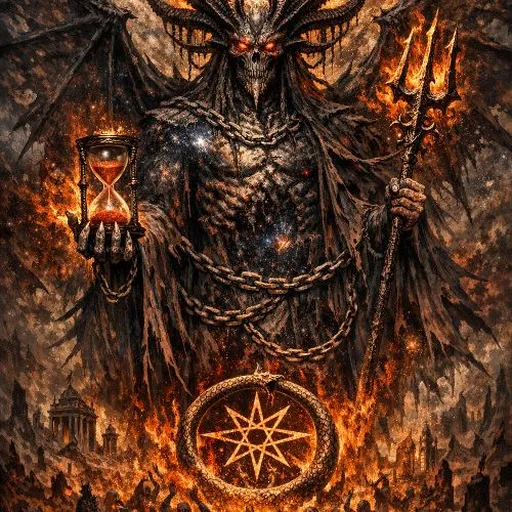
How does one disclose the devil? I mean without ending the world. The word apocalypsis in Greek does not just mean “revelation” in the sense in which it was appropriated by John of Patmos — or whoever actually wrote the Book of Revelation. It also means “disclosure” in a way that makes it related, if not synonymous, to the ancient Greek conception of “truth” as alethea. The word lethe, from the verb lethomai, means a forgetful concealing or occultation, such that the privative a-lethea means “un- concealment” or “dis-closure.” This is not “truth” as it was later misunderstood to be veritas or veridical correspondence of a claim or an idea with some putatively objective reality. Rather, it is an unveiling or revelation, one that is always only partial, from out of predominant occultation. As Martin Heidegger suggested, it is like the moonlight suddenly pouring through a small clearing in a dark forest at night. When hardly anyone understands the fundamental falsity of veritas, and fails to fathom that nothing is ever really “true” in that way, how can discussions about the “disclosure” of the deepest and darkest secrets in the world be anything other than a preface to mass deception? I mean the so- called “UFO (or UAP) Disclosure” discussion, which has long since also become a broader conversation about the paranormal in general because it is clear to anyone involved, in a more than superficial survey of the subject, that psychic phenomena and other aspects of the occult cannot be exorcised from the mass of “UAP” data going back many decades. In a manner that can often be irksome, some of the researchers involved have resorted to simply referring to the whole mess as “the phenomenon.” But this is not just a flabbergasted throwing of one’s hands up in the air. It is also telling, since the term phenomenon was used in a technical sense by Immanuel Kant to designate the perceivable manifold as limited by the structure of our own consciousness — including our human perception of time — but behind which lies some inscrutable noumenal thing. My contention is that this Thing is Satan. Far from the naïve and ignorant belief that “Satan” is an adversary who only makes sense in the context of Christianity, anyone who is familiar with my philosophical corpus will already know, for reasons that will be summarily reviewed in this book, that the devil is far older than the Christian God. Whether in the form of the Scytho-Sarmatian “Satana” or as Prometheus, an ancient Greek conception that also took shape under significant Iranian influence and that is based on the champion of Satana, and is ultimately one and the same figure as Mithra, Satan is very old indeed. Much older than monotheism. But here we remain within the aesthetic realm of mythology and theology. What I contend in my writings, and revisit here, over the course of an extended meditation, is a claim that cuts to the core of ontology and epistemology, and one which has ethical implications that are deeply disturbing. Namely this, that “God” is an invention of the devil. That Satan — or Satana — is not only older and more primordial than monotheistic conceptions of God, but that the devil actually shaped the history of mankind in such a way as to test the character or ethos of individuals and societies against the captivating power of this theological delusion. In other words, as I suggested in Iranian Leviathan (2019), the Book of Job needs to be read backwards. That was, as I argue there, the intention of the Mithraic Magi who guided the liberated Jews of Babylon in the construction of the late form of Judaism that went on to become foundational for Christianity. Like Emperor Xerxes himself, they were esoteric Satanists. Chapter 1, “Diabolical Disclosure,” begins with the figure of Jack Parsons, the American rocket scientist and Satanic occultist. I discuss how leading up to, and after his explosively violent death, Parsons was being investigated by an inter-agency group known as the Collins Elite. The origins of this group are traced back to the 1890s Airship Mystery, and in particular to the case of a certain patent attorney named George Collins, who claimed to represent the mysterious airship inventor but who turned out to be a possessed individual delivering testimony under a mediumistic trance. As I explain, the Collins Elite eventually became convinced of an occult underpinning to the UFO phenomenon. They believed that it was demonic or diabolical, and they were concerned that Parsons — who had been a disciple of Aleister Crowley — was about to summon the Whore of Babylon and the Antichrist into the world on the wings or, rather, on the wingless apparitions of flying saucers that were invading the skies of America, including over the nation’s capital. The term Aeon is introduced in this context, 𓏏𓅜𓋈𓂝𓆑𓏏𓊵 In Æternum Veritas
