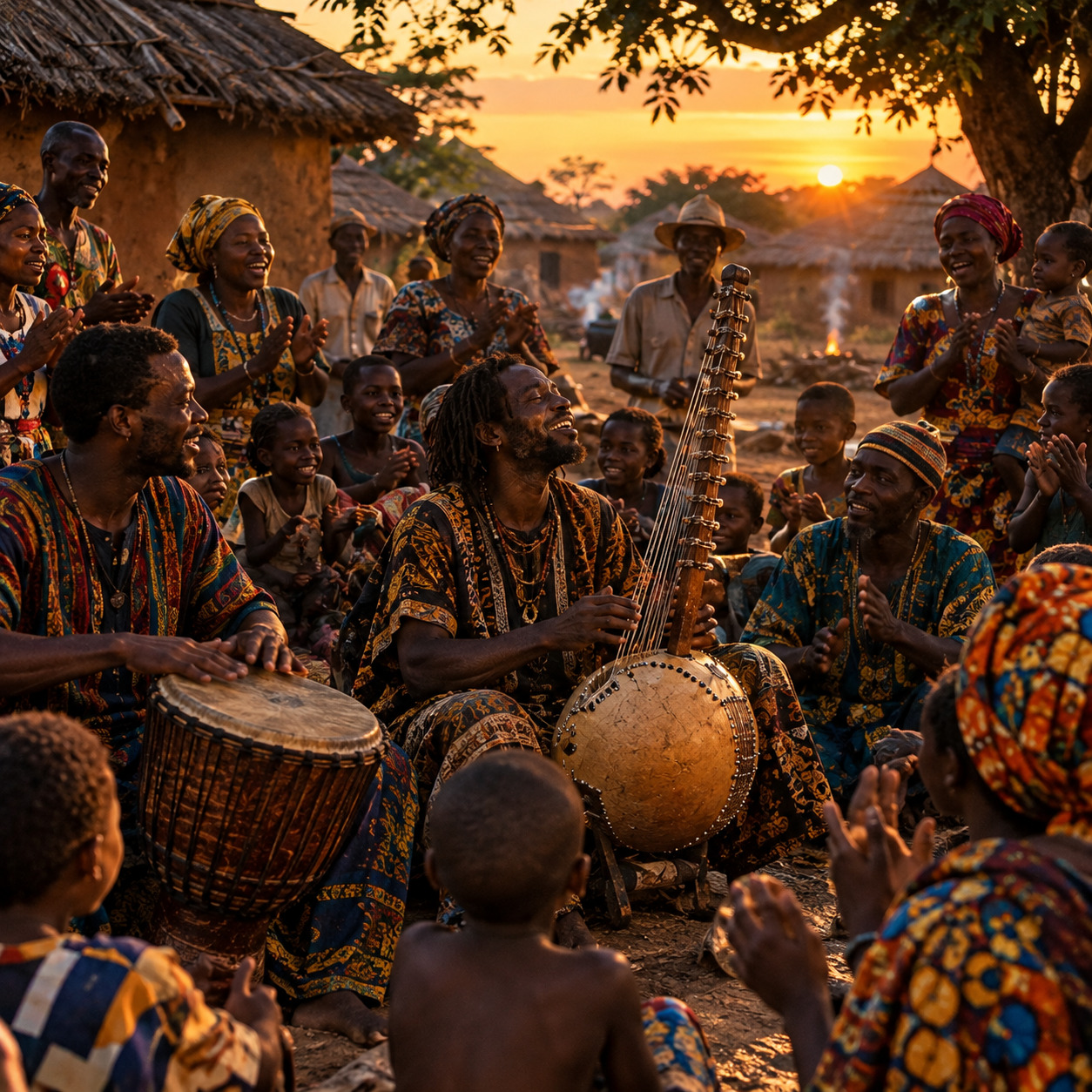
Sissokou carries a memory of people, place, and belonging. Its name can be heard in different ways across communities, and traditions are never exactly the same from one family to another. So let us approach it with curiosity and respect, listening first to the people who keep its stories alive. In many African traditions, music and storytelling are woven into everyday life. A gathering may bring together elders, children, neighbors, and guests. Someone speaks, others respond, and a familiar phrase can hold the attention of the whole circle. The voice does more than tell what happened. It gives shape to experience, passes knowledge forward, and reminds listeners that they are part of a shared history. The kora, with its bright strings and flowing patterns, is one instrument associated with West African musical heritage. Hand percussion can add a steady pulse, while a singer or storyteller guides the meaning. Yet no single instrument defines every tradition, and sissokou may be practiced and understood differently depending on the place and the people. The details matter. The language, the occasion, and the voices of the community all help tell us what a performance means. To learn about a tradition, we can begin with simple questions. Who shares it? When is it performed? What stories or values does it carry? How do younger people learn from older generations? These questions make room for knowledge that cannot be reduced to a label. They also invite us to hear the tradition as something living: remembered, practiced, and renewed by people in the present. Respectful listening means avoiding the idea that Africa has one culture or one musical voice. Across the continent, communities hold many languages, histories, and artistic forms. Even within one tradition, there can be local styles and changing interpretations. A careful listener does not assume; a careful listener pays attention, learns the context, and gives credit to the people who share their knowledge. Sissokou, approached in that spirit, becomes an invitation to listen closely. It asks us to value oral knowledge, to notice how a community shapes its own expression, and to let the story remain connected to the people who carry it. A tradition is not only something inherited from the past. It is also a relationship between generations, renewed each time someone listens with care and passes understanding along.
