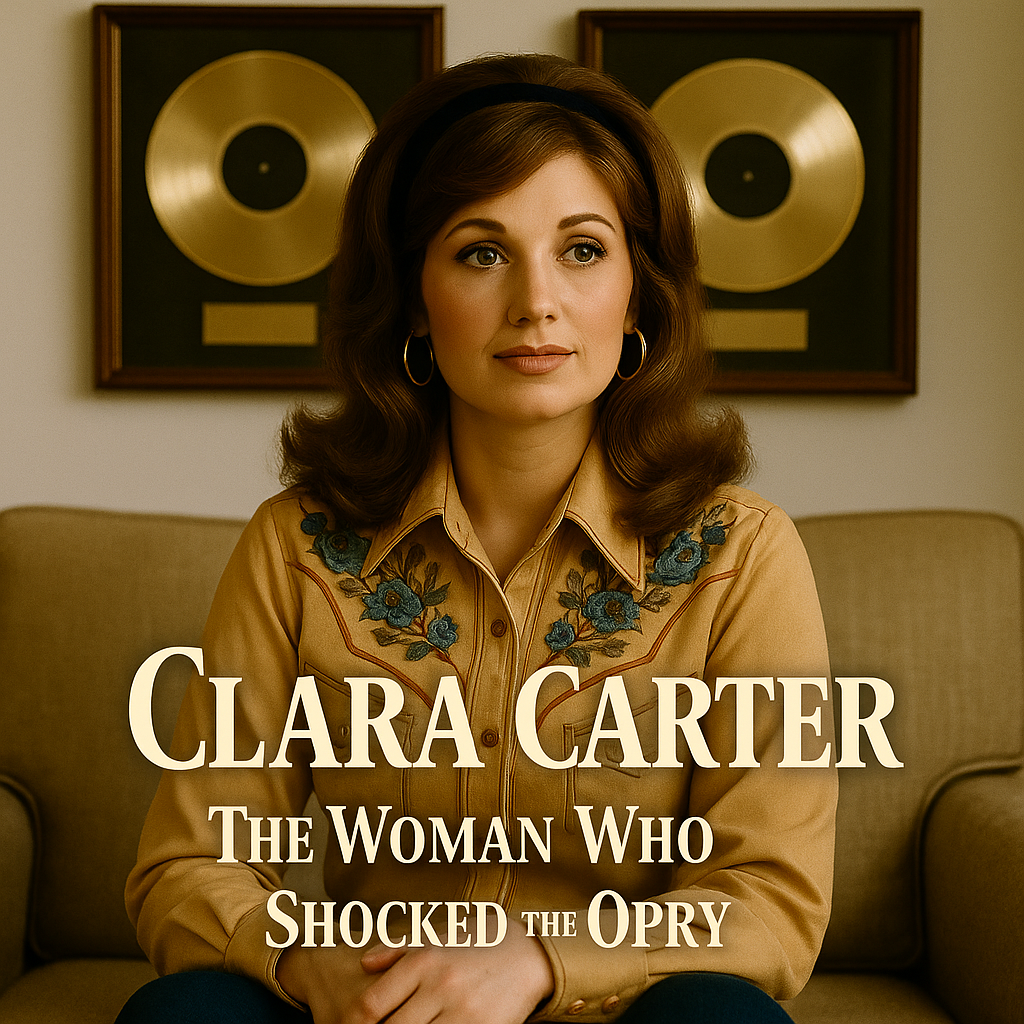

CLARA CARTER — “THE WOMAN WHO SHOCKED THE OPRY” In a time when country music belonged to the men who wrote the rules, Clara Carter came along and quietly rewrote them. From the first trembling notes of her debut “Where the Evening Turns to Gold” in 1958, audiences knew she wasn’t just another girl singer with a pretty voice. Clara sang like she lived — honest, barefoot, and unafraid of the dark. She brought a resonator guitar to the Opry stage, thumb-picked her own rhythm, and let the truth ring in every line. When “Sugar in My Coffee Cup” turned heads and headlines, she answered the controversy not with apology, but with grace — in the hymn-like “If the River Knows My Name.” Her songs told of longing and belief, heartbreak and defiance, and the small-town strength of a woman who refused to be told what she couldn’t sing. From the haunting simplicity of “No Light But the Moon” to the bold poetry of “The Hand That Holds the Plow,” Clara Carter’s voice carried both dust and deliverance. By the early ’60s, she had walked away from major labels and found her own road — recording spare, soulful songs like “Ain’t Nobody’s Girl” and “The Road Will Know My Name.” Now, for the first time, her full story is told — from the raw Sun Studio demo that started it all, to the long-lost duet “I’ll Walk You Home” with Opry favorite Hank Lawson, shelved for decades after a tangle of contracts and pride. What remains is the sound of a woman who believed that truth could be sung, and that a guitar in the right hands could be as mighty as any sermon. “The Woman Who Shocked the Opry” is not just a title — it’s a testament. The girl from Tennessee didn’t just sing country music. She changed what country could be. [Verse 1] They tell me a woman should learn to bake bread, Keep the fire warm and the table spread. Smile when spoken to, bow her head down — But I’ve seen more truth in a field gone brown. [Chorus] The hand that holds the plow can write a song, Can build a dream, can right a wrong. If love’s worth givin’, it should allow A woman her voice — and her hand on the plow. [Verse 2] They talk of heaven like it’s bought and sold, Like grace wears lace and does what she’s told. But the good Lord made both heart and brow, And mine was born to sweat somehow. [Chorus] The hand that holds the plow can write a song, Can build a dream, can right a wrong. If love’s worth givin’, it should allow A woman her voice — and her hand on the plow. [Verse 3] Now I ain’t no preacher, but I know this much, Faith without freedom is out of touch. So I’ll sing my truth, though the church bells sound, And stand my ground on this sacred ground. [Final Chorus] The hand that holds the plow can write a song, Can build a dream, can right a wrong. If love’s worth givin’, it should allow A woman her place — with her hand on the plow.

0/500