To the Black Forest and Beyond

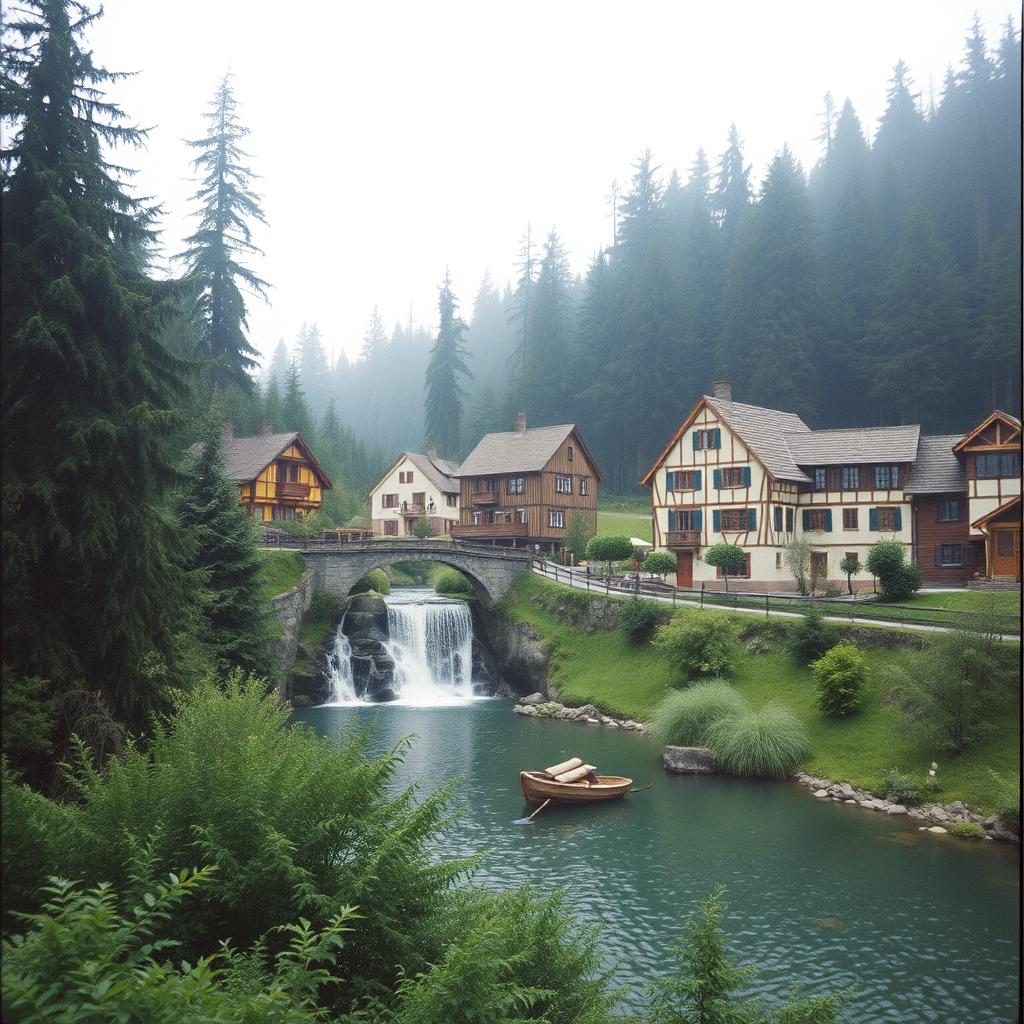
We begin our journey in Kaysersberg, birthplace of Albert Schweitzer. The half-timbered houses, colorful and painted, form a living picture. Sloping roofs, cobblestone streets, and the medieval castle overlooking the valley immerse us in history and the gentle Alsatian way of life. We continue at the edge of the Black Forest toward Baden-Baden, an iconic spa town. Classical facades, historic casino, verdant parks, whispering fountains in the soft light. The wooded hills announce the dense, mysterious Black Forest. Painted buildings, adorned with refined details, add charm and sophistication to our stroll. Heading north, we discover Freudenstadt and its large central square, one of Germany’s largest. Half-timbered buildings, beautifully painted, create a colorful, picturesque spectacle. Arcades and cobblestone streets invite us to wander, urban life and nature blending harmoniously. Not far away, the Burgbach Falls gush, water rushing over rocks, surrounded by deep forests. The setting is peaceful, perfect for hiking and wonder. We cross Schiltach and Wolfach, typical villages of the Black Forest. Schiltach enchants with houses painted in charming patterns, Wolfach immerses us in the authenticity of ancient streets and picturesque bridges. In Haslach, the historic town hall dominates the main square. Painted houses around it add beauty and warmth to our inner stroll. Nearby, Hornberg Castle stands on its rocky spur. Its imposing silhouette dominates the valley and surrounding forests, a spectacular panorama of the deep Black Forest. Going south, the Triberg Falls amaze us. They splash upon our souls, the fresh, humid air fills our senses, and in Furtwangen, the Clock Museum and cuckoo shops bear witness to artisanal tradition and mastery of timekeeping. The Wutach Gorge, wild and majestic, speaks to us of the purity of the forest. Steep cliffs, deep woods, rushing river. The trails offer spectacular panoramas, a mysterious and adventurous atmosphere imprinted on our inner landscape. From the summit of Feldberg, nearly one thousand five hundred meters, the panorama takes our breath away: mountains stretch endlessly. To the west and northwest, hills and ridges extend to the horizon. To the southeast, the Swiss and Austrian Alps. To the east, the valleys of the Breg and Brigach meander, and at the valley’s bottom, a very blue stream glimmers — the Breg, as blue as the Danube it will give birth to. Beneath our feet, Lake Titisee shines like a sheet of azure, surrounded by forests and traditional painted houses. In Donaueschingen, the fountain of the Princes of Fürstenberg Castle lies calm in a circular basin, like the eye of the water, from which gardens and statues rise. The young Danube is discernible symbolically among the trees, in a ceremonial setting. Nearby, the Breg Spring reveals the true source of the Danube. Blue-green water flows among mosses and rocks, in a wild, intimate site, contrasting with the symbolic source. Sigmaringen and its castle dominate the young Danube. Massive walls and towers reflect in the river, the narrow, wooded valley winding before our eyes, an alliance of historical majesty and natural beauty. Heading toward Lake Constance, we discover the Rhine Falls, near Schaffhausen. The river plunges over the rocks with force. Trails and viewpoints allow us to contemplate this power, and the painted houses nearby add a picturesque contrast. Lake Constance and Swiss villages: Stein am Rhein, a medieval village on the Rhine, painted houses decorated with frescoes, picturesque streets. Meersburg, a sloping village on the lake, medieval castle overlooking the sparkling water. Rorschach, a typical Swiss village, sloped painted houses, streets lined with terraces and gardens. The panoramas are wide and bright, the Alps in the background add depth and grandeur. We cross Bavaria to reach Louis II’s Castle: Neuschwanstein. Perched on a rocky spur, Neuschwanstein rises like a stone dream. White towers and turrets float above the Alpine forests. Ornate balconies, decorated facades, and sculpted windows echo Louis II’s medieval romantic imagination. Inside, each room tells a story: the Singer’s Hall celebrates Wagner’s Rhinegold mythology. Shimmering Rhine, dwarves and treasures of gold, gods and heroes in struggle, all painted with vivid colors and refined details. Carved woodwork and stained glass filter the light.
