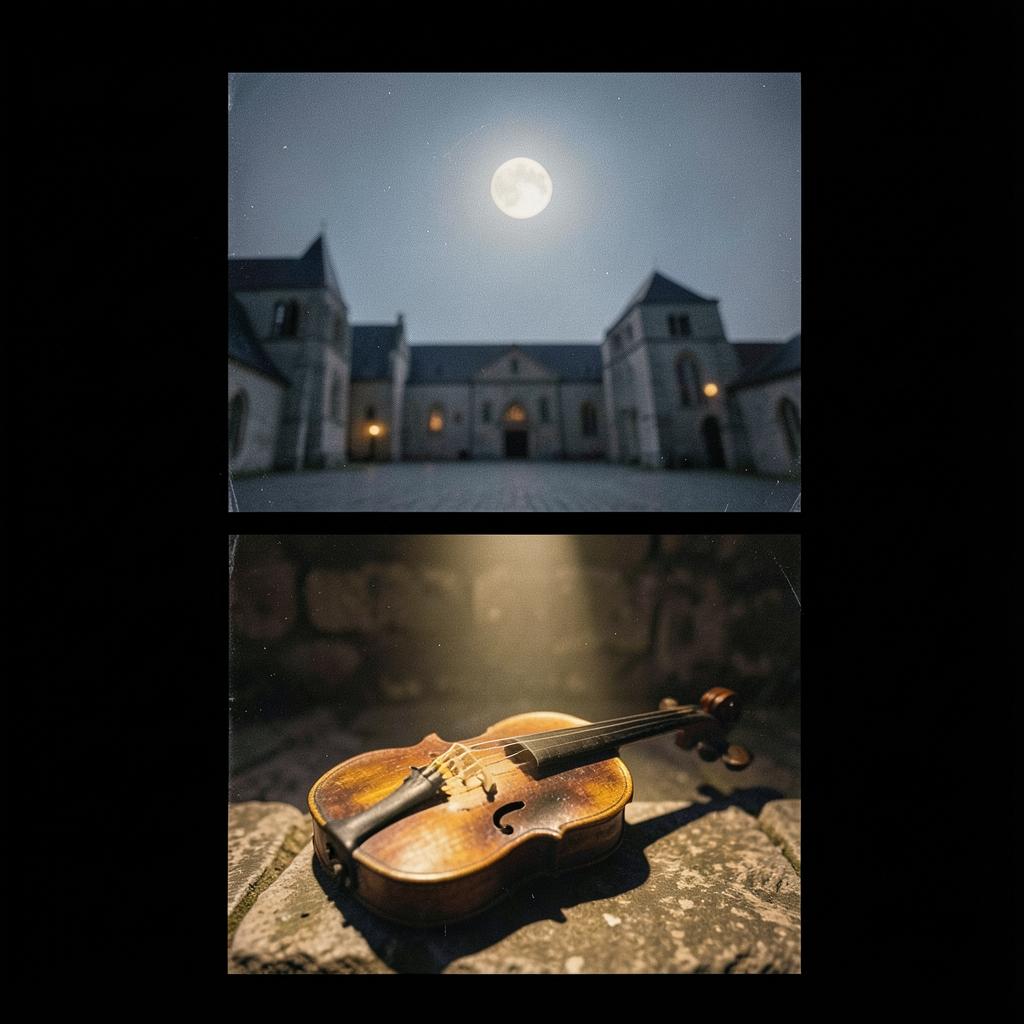
Луна, которая возвращается // La lune en son cours
[Hyper-Realistic] [Song with vocals: solo male voice, Old French langue d'oïl, ars nova ballade. No choir, no humming. THE BODY: ballade; tenor is the moon, returning with new light] [Percussion wanted: none; pulse is the breath of isorhythm] [Intro — the tenor states its pattern, slow and inevitable, vielle alone] [Strophe I — voice and vielle ornament long lines above; Moon law: the upper voice is free, like a cloud; the tenor keeps its phase; they meet at points no one explained] La lune est en son cours mue, Comme li tans qui va tournant ; Chascune nuit renouvelé La clarté qui va revenant. Li tenors est en son tour lent, Comme la lune en son chemin ; Et li chans est, faus et friant, Qui revient, mais ce n'est pas fin. [Flute Filigree — quick upper decoration, much softer, moonlight on water] [Strophe II — harp punctuation; the tenor holds its pattern] La vielle chante, et si atrait La douce flour de son archet ; La flestote, qui se trait Par desus, en son cler jet. Li harpe fait son douz jet, Qui les estoiles va sivant ; Et li chans est, faus et friant, Qui revient, mais ce n'est pas fin. [Breathing physiology — continuous slow swell and fade, about two measures each, ppp to mp and back; transitions on very fine notes; sound as a morphing texture, not discrete notes; inner voices much softer, one breathing section] [Envoi — the voice addresses the princes; the tenor completes its final turn] Princes, la lune est repairant, Chascun mois son chief remirant ; Li tenors est, et va querant Ce que li chans va declinant. Qui revient, mais ce n'est pas fin. [One Wide Phase — ONE f: full moon in one chord, wide, then immediate ppp] [Outro — tenor completes its last turn; the moon goes behind the spire; the courtyard sleeps in canon]
