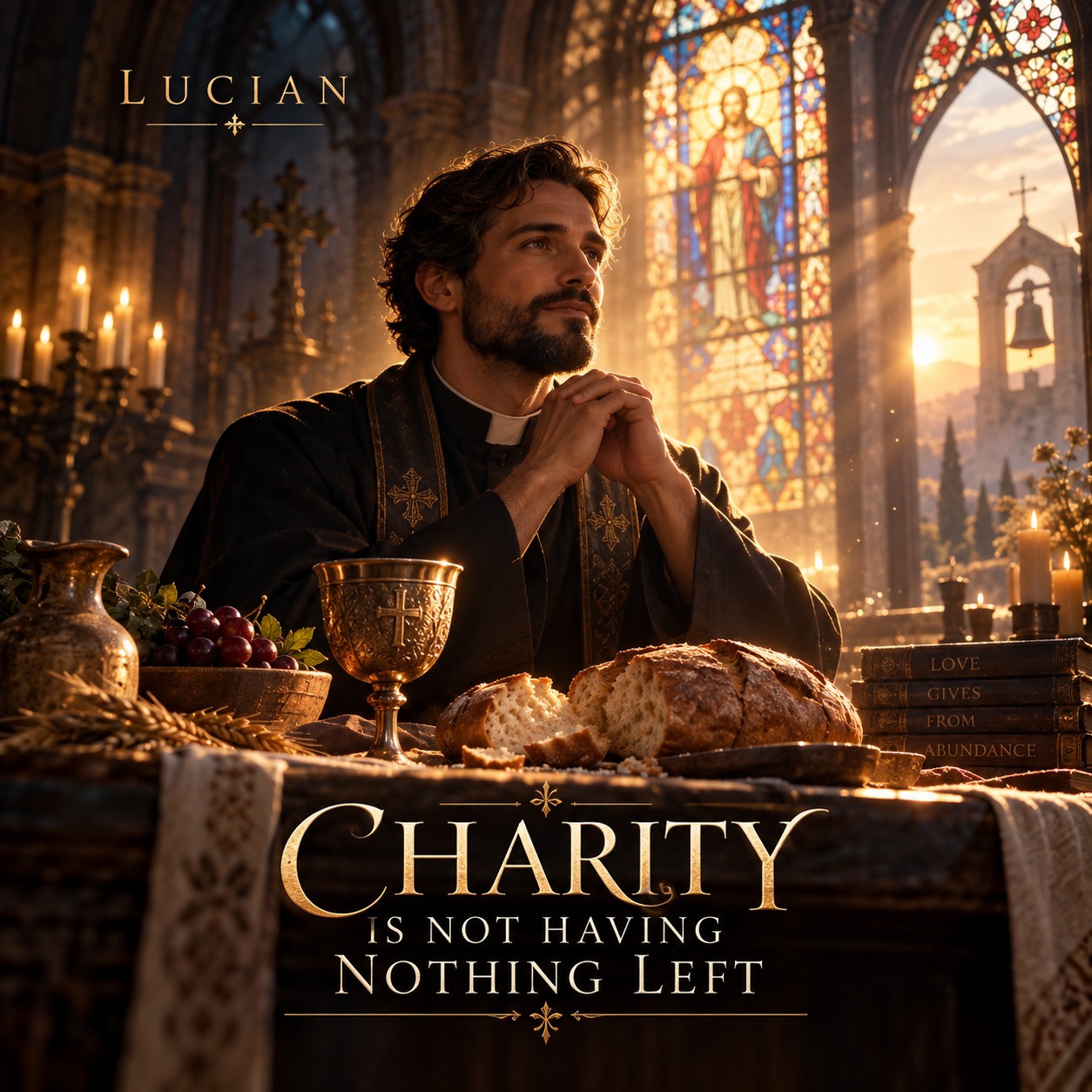

[Opening - spoken softly, distant church bell, quiet piano] There is a strange idea that goodness must hurt. That generosity is measured by how empty your hands are afterward. That the kindest person is the one who gives away everything, keeps nothing, asks for nothing, and quietly disappears beneath the needs of everyone else. But I do not believe charity asks you to destroy yourself. [Pause] If you have ten loaves, and your neighbor is hungry, give them bread. If your table is full, make another place. If your coat closet is crowded while someone shivers outside, then perhaps one of those coats was never truly yours to keep. That is charity. Not waiting until you have one loaf left and tearing it in half while your own children go hungry. Not giving away your final blanket and convincing yourself that freezing somehow makes the gift holier. Not emptying your cup until you have forgotten that you, too, are a person worthy of water. [Soft pause] There is no virtue in creating two people in need where there was once only one. Charity is not measured by the depth of your suffering. It is measured by the openness of your hand. And an open hand does not have to be an empty one. [Strings slowly enter] When harvest is plentiful, share the harvest. When the pantry is stocked, feed someone. When fortune finds you, let some of it continue its journey. Money should move. Food should feed. Knowledge should be taught. Strength should protect. Time should be given. Love should not be locked away like treasure in a vault. These things become greater when they are allowed to pass from one life into another. [Pause] But listen carefully. You are not a vault to be emptied either. You are not a resource for the world to consume. You are a life. And your life also deserves care. Keep enough food to eat. Keep enough strength to stand. Keep enough time to rest. Keep enough of yourself that tomorrow, when someone knocks upon your door, there is still someone there to answer it. [Church bell, distant] The candle that gives light must still have wax. The well that gives water must still be filled. And the person who wishes to spend a lifetime helping others must remain alive enough to have a lifetime to give. [Pause] So when you have plenty, do not close your eyes. Do not build higher walls around abundance. Do not tell the hungry man, "Perhaps someday, when I have more." If you already have more, then someday has arrived. Give. Give gladly. Give without making the receiver bow beneath your generosity. Give without keeping score. Give without turning kindness into a debt. But when you have little, do not confuse desperation with selfishness. Survive. Recover. Stand again. There will be another harvest. There will be another morning. And perhaps one day, when your table is full again, you will remember what an empty table felt like. And because you remember, you will pull out another chair. [Long pause, music warming] That is the charity I believe in. Not martyrdom. Not guilt. Not the slow destruction of the giver. But abundance refusing to become indifference. A full table with room for one more. A strong hand reaching toward a weaker one. A person saying, "I have enough. Come. Let me share it with you." [Soft piano] You do not have to become poor to care about the poor. You do not have to become hungry to feed the hungry. You do not have to become lost to guide someone home. Charity is not giving until you have nothing left. Charity is realizing that when you have plenty, some of that plenty can become someone else's hope. [Final distant bell] And tomorrow, when the sun rises, may both of you still have something left to give.
