Wide awake in Every Day Life, Chapter 7, Part 1

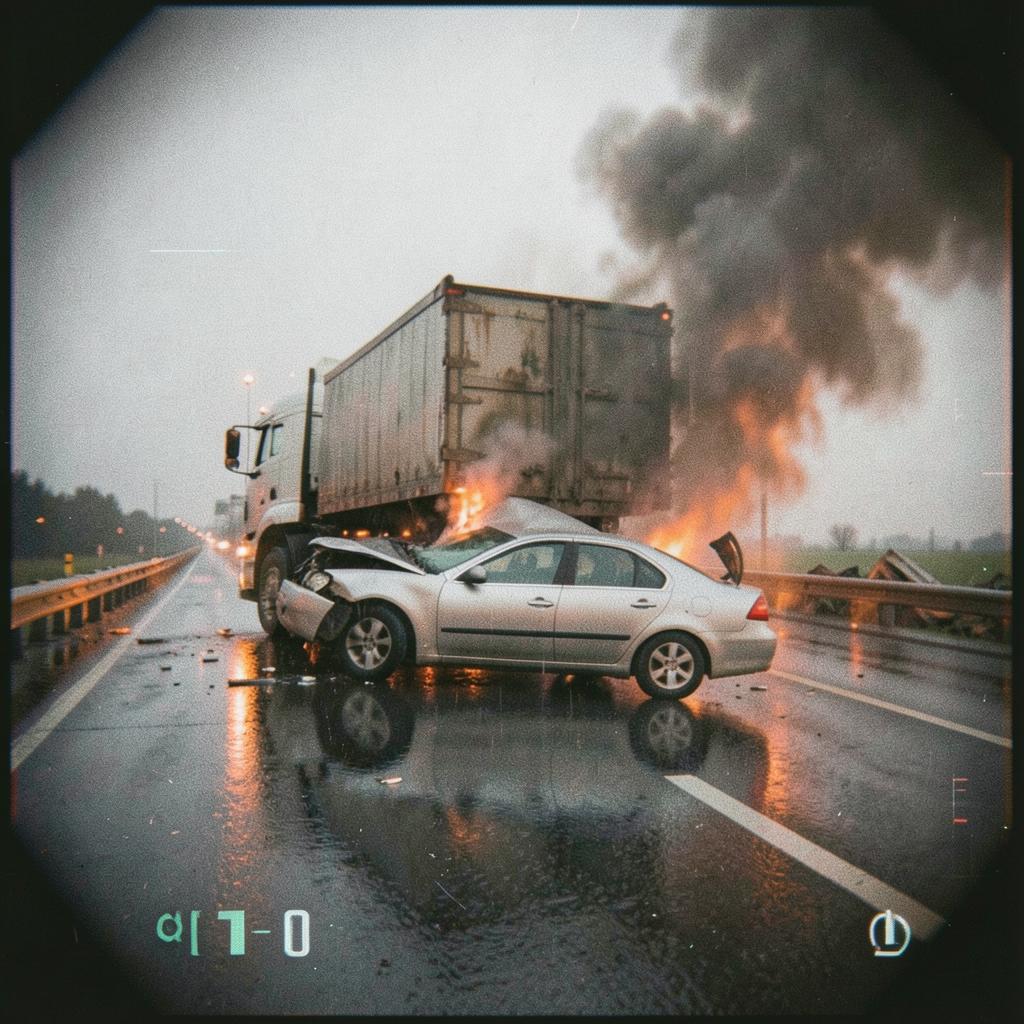
Chapter 7, Part 1 Why we must take the impact out of it Anyone who has dealt with serious road traffic accidents for many years knows this: You never get used to something like that. There are images that stay with you. Smells that stay with you. Situations that leave a deep impression. What is particularly difficult is not just death itself. But the force with which road traffic violence strikes people. This force does not just affect the victims. It also affects their loved ones. Rescuers. The police. Emergency doctors. Pastoral carers. Witnesses. And those responsible. Because one thing is clear: Physics does not negotiate. The higher the speed, the greater the mass, the more brutal the forces. That is why, for years, I have lived by a simple principle: If we want to save human lives, we must take the force out of it. This is not a theoretical stance. It stems from real-life emergency situations. One of them remains etched in my memory to this day. On the A6 near Sankt Leon-Rot, a traffic jam had formed due to roadworks. At the end of the queue, a car was stopped behind a lorry. At the wheel was a middle-aged woman. Next to her sat her mother. In the back of the car was her dog. Then a careless lorry driver crashed into them without braking. The car was pushed under the articulated lorry. The petrol tank burst. The petrol caught fire. The whole scene was engulfed in flames. For the first responders, it was hell. Anyone who has experienced something like this once carries it with them for the rest of their life. And that is precisely why I find it difficult to view debates on speed limits merely as political or ideological disputes. Because in moments like these, the true meaning of impact becomes brutally apparent. Not as a number. Not as a theory. But as fire. As metal. As screams. As irreparable loss. This logic becomes apparent time and again, particularly at the end of traffic jams. A stationary or almost stationary vehicle stands virtually no chance against the unchecked impact force of a heavy lorry. And with every additional km/h, it is not only the energy of the impact that increases. The chance of people still being rescued also decreases. That is precisely why, for me, speed is one thing above all else: a physical amplifier. It plays a decisive role in determining whether a mistake can still be corrected, or ends fatally. It influences: braking distance, reaction time, impact energy, and chances of survival. That is why it is so crucial for prevention. The basic logic behind it is simple. Higher speed means greater force. Even a few km/h can make a huge difference. Not just in terms of braking distance. But also in the force with which one vehicle strikes another. Driving at twice the speed does not just mean twice as much energy. The impact increases much more sharply. Slower speeds therefore always mean: more reaction time, a better chance of braking, less impact force, and a better chance of survival. In the case of lorry accidents, there is another factor to consider: mass. 40 tonnes have a very different impact to a car. When high mass and high speed combine, forces are generated against which vehicle structures and human bodies offer little protection. This becomes particularly drastic in so-called ‘sandwich’ accidents. In these, a vehicle is trapped between a vehicle ramming into it from behind and one travelling ahead. In such situations, even a few km/h can make all the difference. That is precisely why the question of 80 or 90 km/h is not a trivial one. It is a serious matter. Because in an unbraked rear-end collision, a few kilometres per hour less often means: less forward momentum, less penetration depth, and a greater chance that safety systems will still be effective. In other words: Slowing down is not a nuisance. Lower speed is a safety margin. Of course, we also need speed checks. On dangerous stretches of road. At known black spots. Visible. Consistent. Regular. But checks alone are not enough. They have a limited effect. They set limits. They remind us of the rules. But they do not yet change the culture. That is precisely why we must consider three things together: Enforcement. Common sense. Technology. Enforcement sets limits. Common sense changes behaviour. Technology can provide support in critical moments. None of these elements is sufficient on its own. If we are serious about Vision Zero, we must not play them off against one another. We need: more enforcement, more voluntary common sense, and better safety technology. It was from this conviction that the idea behind ‘Tempo Mit Verstand’ arose. The basic idea was simple: When politics moves slowly, when debates are deadlocked, when many issues are blocked or become ideologically charged, there is still one lever that everyone holds in their own hands: their own driving behaviour.
