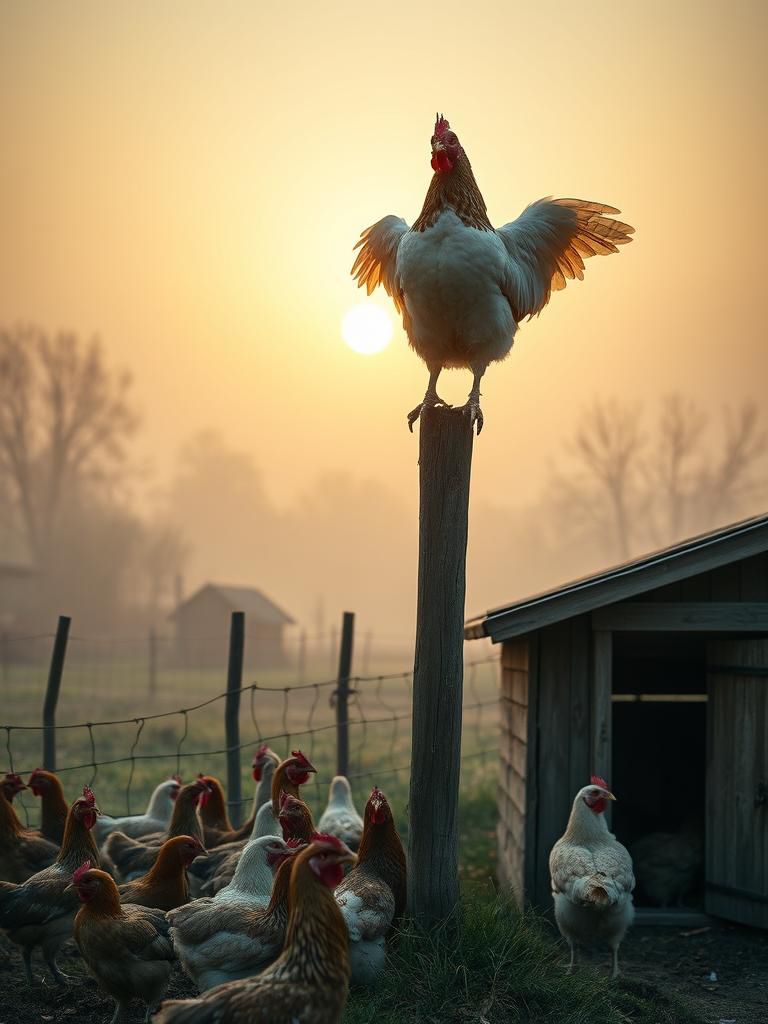

Here we observe the Chicken Hawk, in its natural habitat. Perched high above the common chickens, the Chicken Hawk is immediately recognizable—not by any acts of hunting or combat, but by its commanding vantage point. From here, it surveys danger at a safe and comfortable distance, far from the reach of teeth, claws, or consequence. The Chicken Hawk does not engage directly with threats. Instead, it specializes in warning calls. Listen closely. A sharp cry rings out across the yard, alerting the flock to impending doom—doom that, curiously, never seems to arrive anywhere near the hawk itself. These calls are frequent, dramatic, and delivered with great urgency. They serve a vital evolutionary function: maintaining dominance without exposure. Unlike true raptors, the Chicken Hawk feeds not on prey, but on narrative. It thrives on imagined invasions, projected fears, and worst-case scenarios. The more distant the threat, the more ferocious the call. When danger is identified—real or otherwise—the Chicken Hawk does not attack. Instead, it directs. Observe how it gestures with a wing toward the smaller chickens below. The youngest are singled out first. Their energy, optimism, and limited life experience make them ideal for high-risk excursions. The hawk reassures them softly: this is necessary, this is noble, this is how things have always been. The Chicken Hawk itself remains behind. This is not cowardice, you understand. It is strategy. In moments of reflection, the Chicken Hawk speaks solemnly of sacrifice. Fallen chickens are honored briefly, often in poetic terms, before their absence is folded neatly into the next warning call. Loss, in this species, is not a deterrent—it is a renewable resource. If questioned, the Chicken Hawk becomes agitated. It fans its feathers and accuses the flock of weakness, of forgetting the dangers beyond the fence. History, it claims, is watching. Though notably, history has never once demanded the hawk’s participation. As seasons pass, the yard grows quieter. Fewer chickens remain to heed the warnings. Still, the Chicken Hawk persists, calling into the open air, alert to threats only it can see. And so the Chicken Hawk endures—not through strength, not through courage, but through altitude. High enough to shout. High enough to survive. And always, always out of reach.
