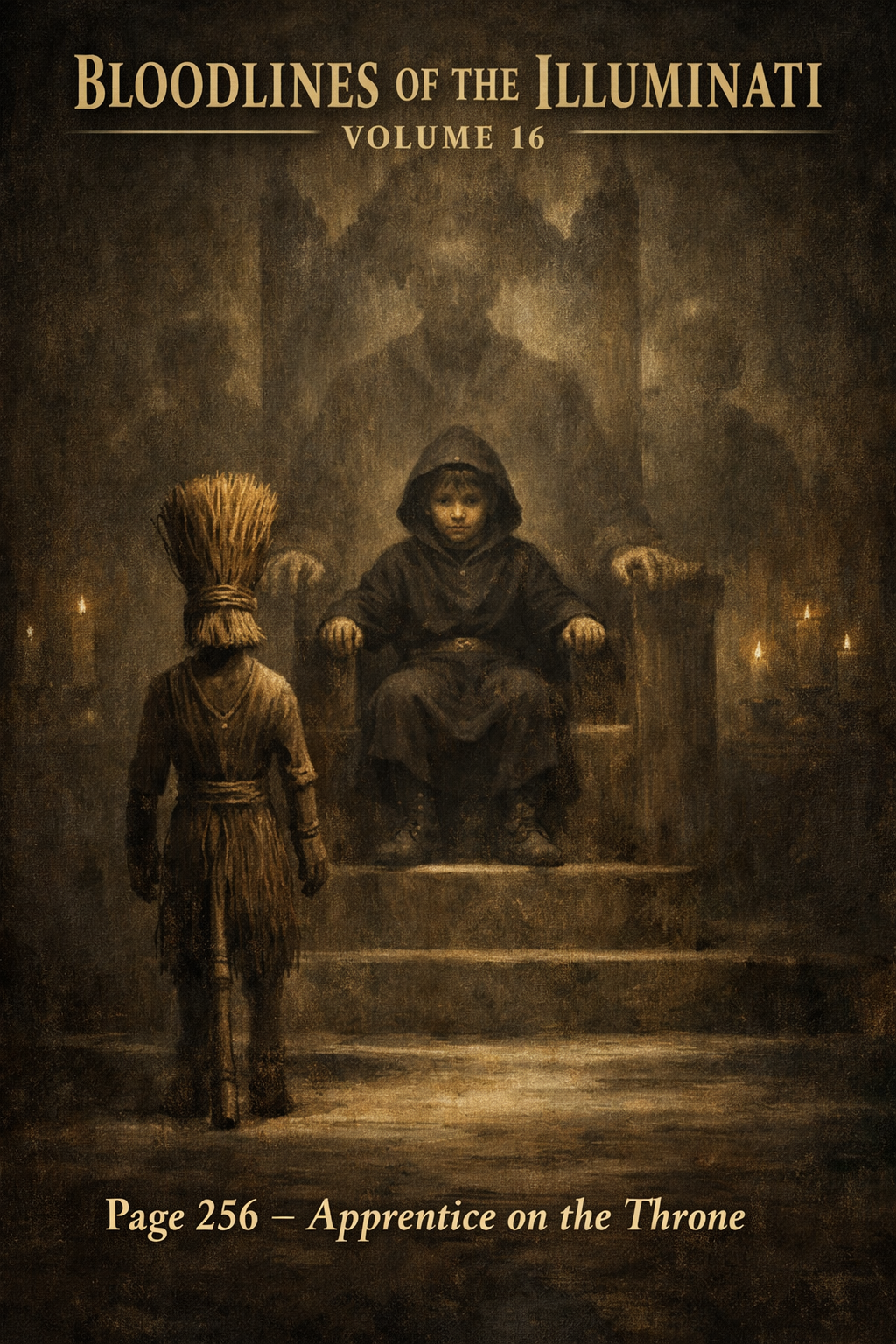
Page 256 - Apprentice on the Throne


[Intro, spoken, low and steady] They do not teach the kid magic to make him happy. They teach him magic so he stops asking who holds the wand. [Verse 1] Thirty one minutes in, the lesson turns surgical, a smiling child in a borrowed robe, looking harmless, marketable. He points at a broom like it is just play, but the frame is a classroom where obedience learns to levitate. They sell it as wonder, they feed it as power, tell the child, tell the victim, you can build what the master built, faster. Your mind is a tool, now speak and it moves, now blink and it sweeps, now praise the illusion as proof. They whisper, be creative, but mean be moldable, make the imagination a leash that feels voluntary, comfortable. The broom is a person with its face erased, so the kid can practice control without guilt on his tongue or his taste. The scene is a mirror held up like a prize, child and wizard, two silhouettes sharing the same eyes. Look close, the posture matches, the hunger aligns, it is not just a costume, it is rehearsal for the mind. They do not say prison, they say potential, they do not say trauma, they say talent, sequential. They let him imitate the great magician, then call imitation freedom, and stamp it as mission. [Hook] If the child can do what the great magician did, then the child will start to want what the great magician is. Mirror on mirror, lesson on lesson, a copy learns the crown while the crowd learns to clap for the session. You get power, they say, by being creative, but the creativity is a funnel, and the funnel is weighted. [Verse 2] Thirty two minutes, he sits where the throne belongs, not a chair for a kid, it is a seat with a history in its arms. He lifts his hands and the world waits, the way a room waits when one voice owns the fates. Conductor posture, but the baton is a switch, one gesture and the orchestra learns when to flinch. Subtle tie in, the child is now the programmer, and the programmer is now the child, a loop that looks calmer. That is the trick, make authority feel like play, so the orders slide in sweet, so the fear learns to stay. They call him Mickey, they let the name do the work, a costume for the handler, a mask for the hurt. More than one man wore that nickname with intent, not because it is cute, because it is efficient. In sessions, the symbol swaps seats, then swaps again, so the victim can obey without knowing who to blame. A throne is a throne, even drawn in light, even painted for children, it still teaches the right. Sit here, command here, learn the language of control, learn how to smile while you partition your soul. And when the kid applauds himself, proud of the new skill, they nod like proud mentors, then tighten the drill. Good job, they will tell you, you are growing, you are gifted, while the real curriculum is how easily your self gets shifted. [Bridge, quieter, tightening] They do not need chains if they can sell you a mirror. They do not need threats if the throne feels familiar. They do not need to say Illuminati, they only need a symbol that repeats when the body goes sloppy. One scene, played again, becomes a trigger that breathes, a bedtime story that teaches the mind how to leave. [Hook] If the child can do what the great magician did, then the child will start to want what the great magician is. Mirror on mirror, lesson on lesson, a copy learns the crown while the crowd learns to clap for the session. You get power, they say, by being creative, but the creativity is a funnel, and the funnel is weighted. [Outro, spoken] It is not a cartoon, it is a template. A kid on a throne, learning to call it his choice. And the room, always the room, listening for the new voice.
