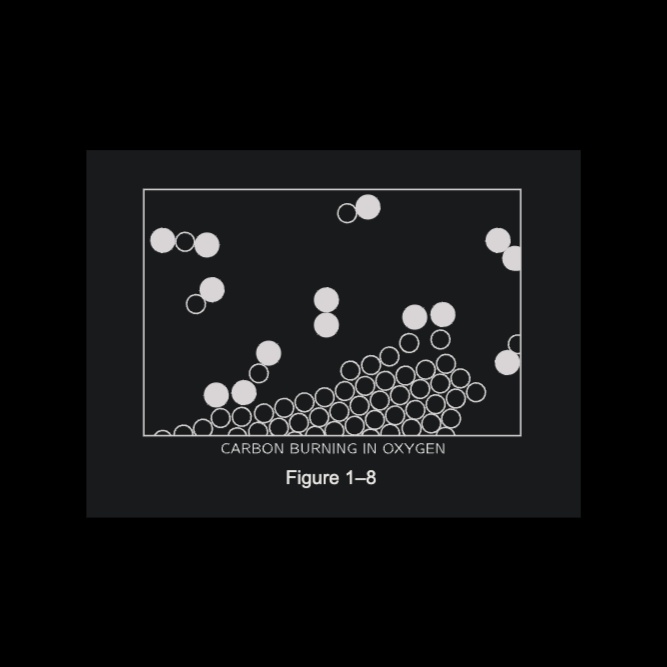

In all of the processes which have been described so far, the atoms and the ions have not changed partners, but of course there are circumstances in which the atoms do change combinations, forming new molecules. This is illustrated in Fig. 1–8. A process in which the rearrangement of the atomic partners occurs is what we call a chemical reaction. The other processes so far described are called physical processes, but there is no sharp distinction between the two. This figure is supposed to represent carbon burning in oxygen. In the case of oxygen, two oxygen atoms stick together very strongly. The carbon atoms are supposed to be in a solid crystal - graphite or diamond. Now, for example, one of the oxygen molecules can come over to the carbon, and each atom can pick up a carbon atom and go flying off in a new combination—“carbon-oxygen”—which is a molecule of the gas called carbon monoxide. It is given the chemical name CO. It is very simple: the letters “CO” are practically a picture of that molecule. But carbon attracts oxygen much more than oxygen attracts oxygen or carbon attracts carbon. Therefore in this process the oxygen may arrive with only a little energy, but the oxygen and carbon will snap together with a tremendous vengeance and commotion, and everything near them will pick up the energy. A large amount of motion energy, kinetic energy, is thus generated. This of course is burning; we are getting heat from the combination of oxygen and carbon. The heat is ordinarily in the form of the molecular motion of the hot gas, but in certain circumstances it can be so enormous that it generates light. That is how one gets flames.

0/500