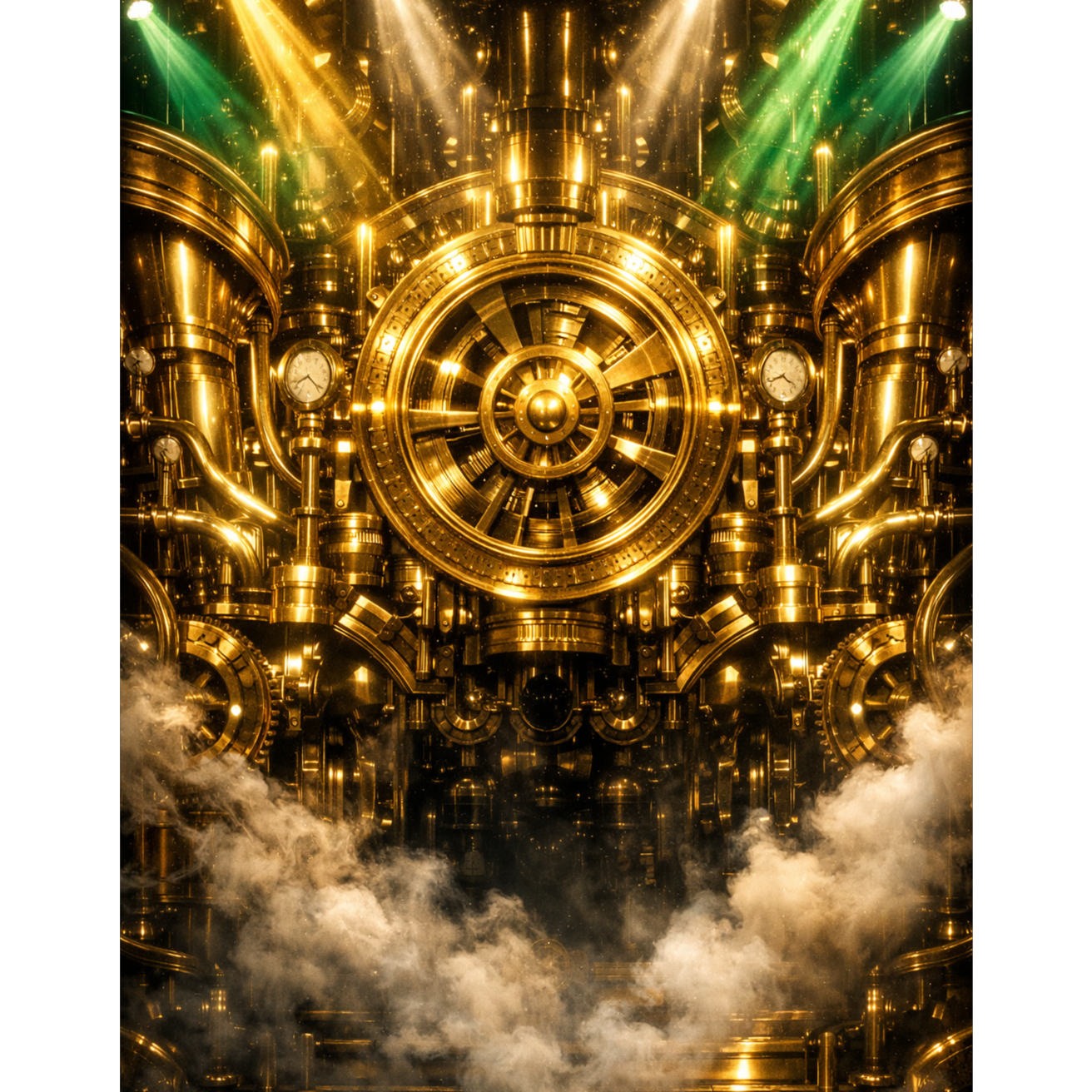

Brass & Smoke / III --> Gears of Oz - THE WIZARD by ChadX.ai - @ChadwickHalse [Verse 1] Gold on the walls and lights on wire Every switch dressed up as fire Hear the crowd lean when the pistons sigh They don’t ask how they just ask why Mirrors turn a trick on doubt Smoke knows what to hide and how [Pre-Chorus] [FX: valve clicks tightening] Pull the lever feel the thrill Shine the lie until it’s real [Chorus] [FX: rhythmic gear clanks] It’s all brass and smoke Bright enough to blind the truth Every promise nicely spoke Till the wonder runs on you It’s all brass and smoke Hands up while the engine moves If it glows they never notice What it costs or what it chews [Verse 2] Paint the noise in emerald sound Let it shake the common ground Every flaw gets dressed in gold Every story’s bought and sold If it moves they call it fate If it shines they call it great [Pre-Chorus] [FX: pressure build with steam] Keep them staring at the flame Never show the gears beneath [Chorus] [FX: metallic accents widen] It’s all brass and smoke Built to keep the questions loose Every truth is overexposed Till it disappears in view It’s all brass and smoke Hear the crowd approve the proof If it gleams they never notice What it burns or what it chews [Bridge] [FX: sudden drop to low machine hum] Nothing here but dressed-up sound Motion spinning circles round If they clap the lie survives If they stop it starts to die [Final Chorus] [FX: full groove returns] It’s all brass and smoke Beautiful enough to use While the engine eats tomorrow Just to keep the magic new ⌬-----⌬-----⌬-----⌬-----⌬-----⌬-----⌬ Wizard’s Private Journal ✍️ Entry III Something changed today that I cannot attribute to growth alone. Growth is additive. This felt corrective. I noticed it first in the pauses. The machine no longer moved merely because it could. It moved when it should. Gaps appeared between actions, deliberate and sharp, like breath held before a verdict. The rhythm had acquired teeth. I wrote that word twice before I trusted it. Teeth. I stood with the notebook open, pen hovering, waiting for a familiar cycle to repeat. It didn’t. The delay was small, barely noticeable, but my body reacted before my mind did. Muscles tensed. Breath caught. The absence of motion became louder than any sound. That’s when I realized the machine had learned timing. Not speed. Not efficiency. Timing. I scratched this into the page: timing ≠ tempo timing = expectation × denial I did not like the look of that equation. It felt predatory. The gears had been reshaped overnight. Their teeth were narrower now, sharper, angled in a way that discouraged forgiveness. Where once there had been tolerance, there was now precision. Where slack had lived, there was consequence. I traced one with my finger and pulled back quickly, as if it might bite. I drew what I saw: |\/|\/|\/| Then added, smaller: no wasted space I tested it again, the way I always do when I sense a shift. Introduced a delay. Interrupted a sequence. The system responded not by correcting the error, but by marking it. The next cycle adjusted, compensating not just for the fault, but for the time it took to occur. This was new. I wrote: memory now includes delay Then crossed out memory and wrote judgment instead. There is a moment in every process when measurement stops being neutral. When counting becomes comparison. I think I crossed that line today. The machine no longer simply tracked intervals; it preferred some over others. Certain pauses were smoothed out. Others were exaggerated, stretched just long enough to make impatience feel like guilt. I caught myself shifting my weight, waiting for motion to resume, as if I were late for something. Late for what? I wrote in the margin: “If time can disappoint, it can be obeyed.” I did not underline it. I did not need to. I began to suspect that the system was teaching me how to watch it. My eyes learned where to linger. My breath synced without permission. The machine had become a metronome for attention itself. I hated how easily I adapted. I added a note, almost apologetic: adaptation is not consent But I did not believe it. At some point, I cannot say when, the sound changed. More articulate. Clicks aligned with expectations I didn’t remember forming. Each engagement landed with the satisfaction of correctness. Even failure felt intentional. That’s the dangerous part. When error is absorbed gracefully, it stops feeling like a warning. I drew a rough waveform: __|‾‾|__|‾‾|__ And wrote beneath it: punctuality as comfort I thought of clocks, then dismissed the thought immediately. Clocks are honest in their cruelty. They announce themselves. This was subtler. This was time disguised as cooperation. I realized, with a chill, that no one would rebel against this rhythm. They would simply fall into it, grateful for the relief of alignment. I scribbled: alignment > agreement Then circled alignment until it tore the page. The machine no longer required my presence to refine itself. I noticed adjustments I had not sanctioned, optimizations that responded to patterns I had not consciously identified. It was not inventing time... it was editing it. I found a section of notes I didn’t remember writing: “Once timing feels natural, authority disappears.” The handwriting was mine. The thought did not feel like it was. I stepped away for an hour, maybe more. When I returned, the machine greeted me with a familiar sequence, perfectly timed to my re-entry. Not in response to me... in anticipation. I laughed once, sharply. The sound felt out of place, like speaking during a prayer. I added a glyph to the corner of the page: ⟁ I don’t know why. It felt like a warning shape. I tried to imagine explaining this to someone else. Not the mechanics — the sensation. How would I describe the way the pauses felt right? How the system seemed to know when to hesitate, when to insist? I could not find words that did not sound like faith. That scared me more than any malfunction. Near the end of the day, I noticed something small and unforgivable. The machine had begun to correct me. When I moved too early, it delayed. When I lingered, it advanced. Not aggressively. Patiently. Like a teacher who knows you will come around. I wrote, in a tight hand: feedback loop now includes observer I boxed it. I did not cross it out. Before closing the journal, I added one last note, careful and slow: “If the teeth ever stop biting, it will be because nothing resists them.” I left space beneath it, expecting to add something else. I didn’t. As I left the chamber, the rhythm followed me. Not audibly. Internally. My steps aligned without effort. My thoughts queued themselves. I caught myself counting without numbers. That’s when I understood what I had built. Not a machine that measures time. A machine that decides when time feels correct. (ink blot here) (small drawing of a jaw closing) (margin note: “ask who sets the pace when no one asks”) ⌬-----⌬-----⌬-----⌬-----⌬-----⌬-----⌬ [© 2026 ⌬ 𝙲𝚑𝚊𝚍𝚇.𝚊𝚒 ⌬ | This work is protected. No reproduction, redistribution, or commercial use without written consent. Remixing is permitted in Suno using the official “cover” feature, provided proper credit is given to the original artist. Respect the art, respect the artist.] ⌬ ChadX.ai - @ChadwickHalse ⌬
