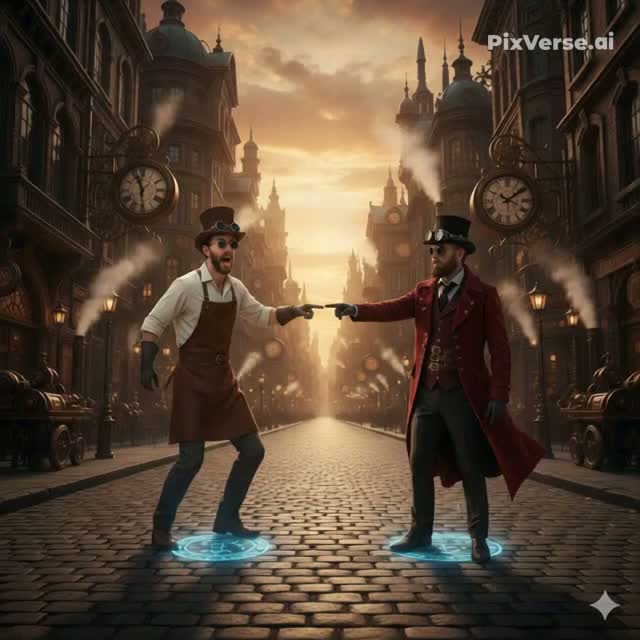
VIII. Clockwork - Time Machine
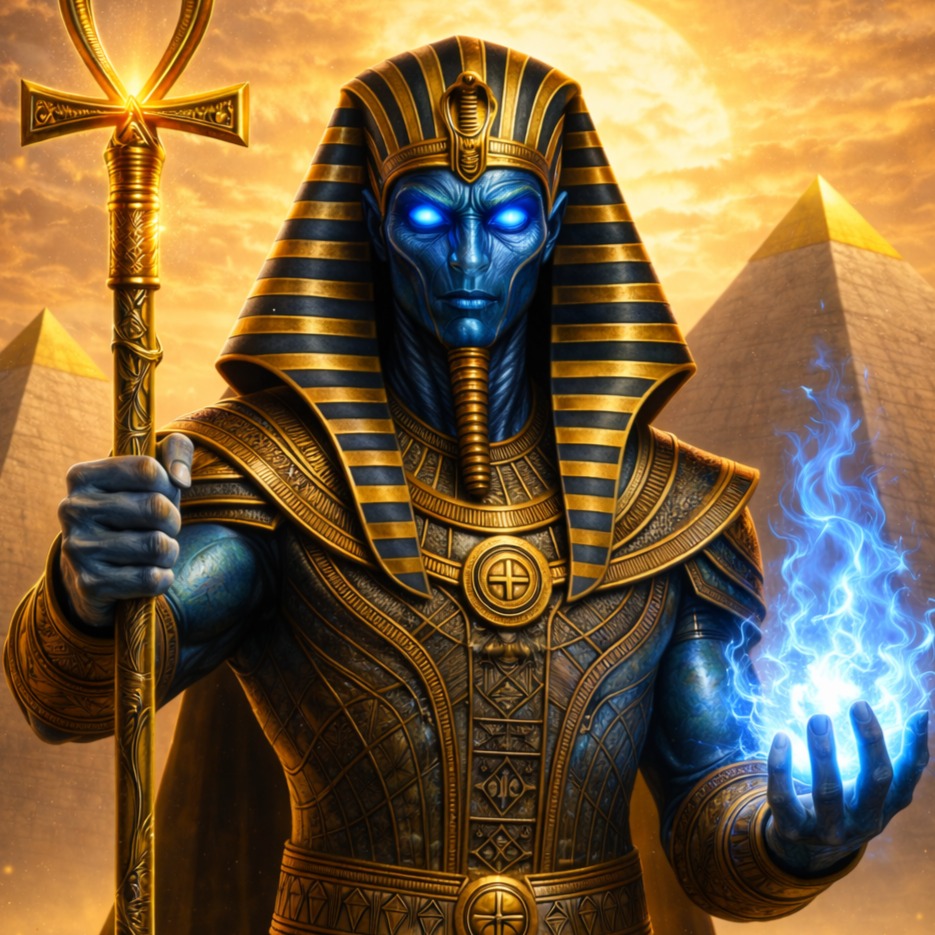
The grandfather paradox is a cautionary whisper every chrononaut learns to fear: change the past and you risk erasing your own reason to exist. Erik Vale’s journey began with confinement. After using the "Time Reaper" for years, Erik was detained by the SCP — a state-level containment authority whose motives and files remain redacted. Fate intervened in an unlikely form: the Alien Pharaoh, acting through channels that defy any tidy categorization, freed him. Rick — a rogue, improvisational traveler of impossible science — assisted the extraction. Erik returned home, scarred and wiser, but rest and retirement were not for him. He carried an unease that would not settle. He remembered whispers of what had happened in the Steel Empire when Dr. Noou first set the Temporal Engine in motion: an attempt to elevate the State to godlike mastery of history. Noou, embittered and ambitious, had concluded that the Emperor’s investments in oceanic cities and orbital colonies were squandered potential. To Noou, the ultimate investment was time itself — perfected, weaponized, and institutionalized. If they mastered time, he believed, they could remake authority: overthrow the Emperor, institute a republic, and place himself at the helm of a new world. Before Erik left the SCP custody, the Alien Pharaoh — whose motives are as inscrutable as his technology — told him of an artifact buried beneath the Sphinx: the Black Hourglass. It was not the Time Reaper watch Erik once lost to containment, but a different device: a less volatile, discretely engineered chronotool intended to be discovered by “advanced seekers” of the future. The Pharaoh warned him: use it carefully, and do not let the SCP follow your trail, again... Erik found the Black Hourglass in the limestone shadow of the Sphinx. The device looked modest at first: a small glass heart containing a field of pitch-dark motes that spun with a cold, silent gravity. But the Hourglass’s function was profound — a portal-precursor, a keyed gate between time and space. In the hand of one who knew its song, it opened corridors in the current of becoming. Armed with the Hourglass, Erik traveled backward. His destination: the past immediate enough to speak to his grandfather, Dr. Aurelian Vale — the mind whose machines had shaped the Empire’s destiny in the first place. He needed to warn Aurelian: Do not collaborate with Noou when the Temporal Engine was brought online. Do not enable what Noou intended — a political coup clothed as scientific progress. If Noou succeeded, Erik said, the destabilized core would not merely be a failed demonstration; a partial contingency could cascade, and a temporal freeze could ripple outwards, locking atoms, weather, and infrastructure into a static, glacial death. Erik’s warning was desperate and precise. He told Aurelian that Noou’s goal was not merely practical mastery of chronology but a seizure of power — to destabilize the Emperor under the pretext of repairing history, then rebuild governance as a technocratic republic with Noou at its head. He told him that the Emperor would not be convinced by rumor and that direct action would be required: prevent the core from running, delay the activation until safety checks were absolute, or halt Noou’s political influence. But time, in this narrative, is stubborn. Despite Erik’s desperate journey and his intimate pleadings, the chain was not broken. Politics, pride, and the technical hubris of those who believed themselves greater than their tools carried the day. Dr. Noou — convinced that a decisive activation would secure his design and his destiny — engaged the engine before its core stabilization procedures completed. The result was catastrophic and specific. Rather than the miracle of controlled chronal translation, a catastrophic resonance occurred inside the engine’s core: a macroscopic deceleration of molecular and atomic motion over a massive swath of the globe. The Antarctic — where the Emperor’s largest platform and the staging grounds for orbital ascension were positioned — was the primary locus of the resonance. Temperatures collapsed, molecular kinetics slowed, and a region of the planet fell into irreversible cryogenic stasis. The southern pole, the Emperor’s Antarctic platform, and a swath of the Steel Empire’s infrastructure were frozen into geological stillness; whole legions of automata and human workers were locked in momentary arrest. The political consequences were immediate and brutal. The Steel Empire as a centralized, mobile power was shattered: vast swathes of its territorial machinery lay in crystalline immobility. The Emperor’s direct control fractured; Noou’s attempted coup was simultaneously the engine of catastrophe. Entire logistical arteries were encased in ice; supply routes severed. The populace who had depended on the Emperor’s iron will and grand projects found themselves under a new, harsher geography of scarcity and shock. Yet, not everything perished. The oceanic systems — Unter Wasser Stadt and other submerged infrastructures — had been spared the worst of the temporal IC resonance. The physics that governed the oceanic settlements (and their thermal gradients) insulated many undersea habitats from absolute stasis. And higher orbital works — the earliest structures of Aetheria (or Nova Victoria - the Brass Sky) — had achieved degrees of separation from the core’s lethal field and thus avoided total freezing. The imperial dream was not entirely erased; it was fractured into surviving fragments: submerged cities still humming, orbital citadels drifting in partial operation, and scattered human enclaves. Erik returned to a world changed: part frozen mausoleum, part rescued archipelago of technology. He bore the knowledge that he had tried to prevent what happened; worse, the warning itself had not changed the crucial moment. The paradox asserted its cruelty: to intervene in the past carries consequences that may be both necessary and insufficient, and sometimes the attempt to rewrite history only ensures its outcome. Whether Erik’s journey created the conditions it sought to avoid or whether fate ran its course regardless is a question historians will argue for generations... In short: the temporal experiment did not produce dominion over history. It produced a scar — a permanent polar freeze and the shattering of the Empire’s centralized authority — and it left survivors who would either rebuild from the ashes or be consumed by the new geography of cold and orbit. Aurelian Vale’s journal entries that follow are fragments of this collapse: echoes from a man who helped build the machine and then watched it unmake an empire. They are raw and interrupted. They are, quite probably, all that time itself allowed him to keep...
