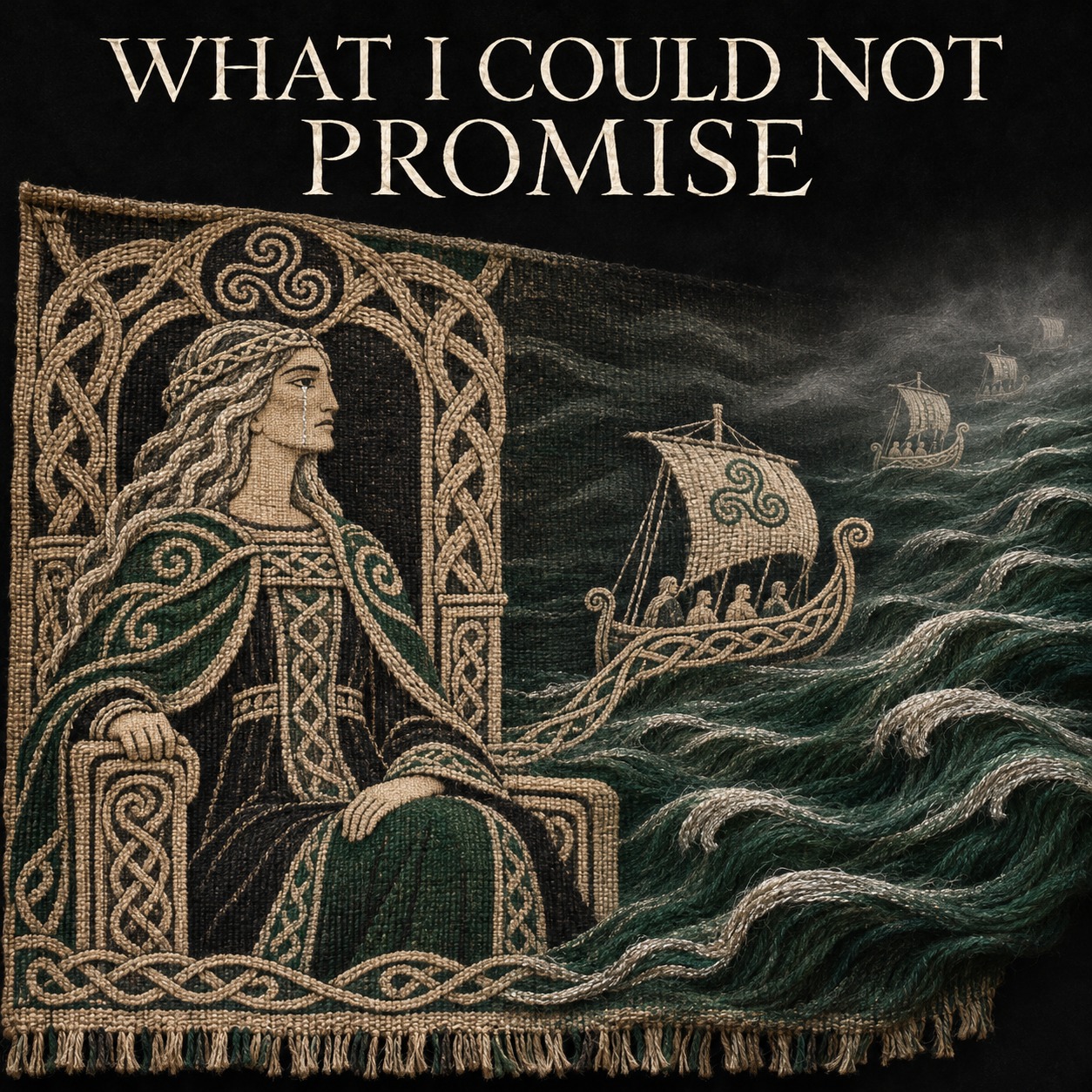
What I Could Not Promise

[Short instrumental intro — steady pulse, restrained; no extended opening] [Verse 1 — intimate mature female lead, clear English, measured storytelling] The western road came back undone. Our healers could not tell me why. A woman woke from her renewal And wept beneath a familiar sky. Then Beran came without his banners. I knew his step across the floor. He laid our charts beside his own. The breaks continued past our shore. [Verse 2 — quiet urgency, pulse strengthens] He showed an island, far from home, Where we could hold the crossing fast. “Your people know what mine must guard. Without them, neither wall will last.” “And who lives there?” I asked him twice. He named the folk who worked that ground. I left their names upon the table. We talked until the lamps burned down. [Chorus — fictional Tuatha language; pronounce as Old Irish, NOT English; distinct vowels, restrained female harmonies] Ar bitu, ar tegos. Mo briatra libu. Ní tairngu tóud. Bituega, bí biwu. [Verse 3 — firm, conversational, no triumphal delivery] I asked for ships to bring the wounded, For signals tested, stores supplied. For Nuada to command our people. For Beran's place beside the tide. I asked what happened if none answered. His hand lay still upon the chart. We named the risks we understood. At dawn I called our people in. [Verse 4 — warmer human detail, flowing phrasing] Some came too quickly, bright with wanting. Some asked how long. I could not say. One would not leave his wife behind. She came herself the following day. Three sisters stood beside their parents, Each with a different question ready. A scholar brought too many books. The shipwright said the hull was steady. [Chorus — fictional Tuatha language; pronounce as Old Irish, NOT English; distinct vowels, restrained female harmonies] Ar bitu, ar tegos. Mo briatra libu. Ní tairngu tóud. Bituega, bí biwu. [Bridge — sparse accompaniment, close unadorned vocal] I knew the hand that signed the orders. I watched it shake above my cup. By noon they needed my decision. I set it down. I looked them up. “You go so home may still be here. I cannot promise your return. My word goes with you past our waters. Your absence will remain my concern.” [Final verse — arrangement opens, controlled emotional lift] They checked the ropes and sang the soundings. The green sea took the loaded keels. Nuada counted every sail. A child leaned out to watch the seals. Then mist moved slowly through the rigging. The harbour song grew thin and strange. I held their names against the silence Until the last light slipped from range. [Final chorus — fictional Tuatha language; pronounce as Old Irish, NOT English; softer, personal rather than grand] Ar bitu, ar tegos. Mo briatra libu. Ní tairngu tóud. Bituega, bí biwu. [Outro — English, almost spoken; brief instrumental decay] I promised them a tended harbour. I kept a light above the bay. And what I could not promise Went with them anyway.
