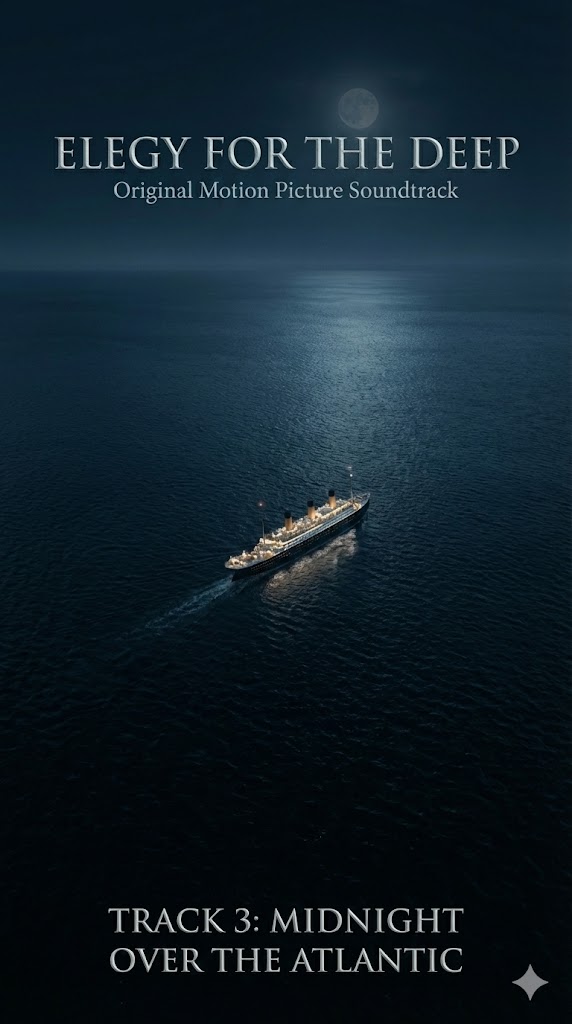
Midnight Over the Atlantic - Elegy for the Deep / Track 3

Night arrives with a quiet so vast it feels like another world. The sun has long slipped beneath the horizon, leaving the ship wrapped in a cool, moonlit glow. The sea stretches outward in all directions, a dark mirrored plain touched only by the faintest ripples. Track 3 begins with a soft, trembling tone, an otherworldly shimmer that seems to rise from the water itself. We open on the Atlantic at midnight, seen from high above. The ship glides like a silent cathedral, its lights small and delicate against the grand emptiness. Stars litter the sky, impossibly bright, as though the heavens have lowered themselves just to witness this night. A gentle wind passes over the deck, carrying the soft scent of salt and polished wood. The passengers have thinned, many are asleep in their cabins, unaware that the ship’s most hauntingly beautiful hours are unfolding. The camera descends to the forward observation deck, where six or seven passengers linger. Some are wrapped in shawls, others stand with hands clasped behind their backs, staring at the ocean as if waiting for it to reveal a secret. Among them is Elara Mare, still holding her journal, though she doesn’t write now. Instead, she is listening, to the wind, to the waves, to the elusive melodies that seem to live only in the quietest of moments. The ship hums softly. It is a sound that feels alive, the deep mechanical pulse of the engines, the rhythmic vibration of metal passing through water, the occasional whistle of wind curling around the railings. Everything blends into a nocturnal symphony. The scene is hypnotic. A young officer crosses the deck carrying a small lantern. He slows when he sees Elara, offering a polite nod before continuing his rounds. His footsteps fade quickly, swallowed by the vastness around them. The English horn motif emerges in the score, gentle and haunting, like a question whispered at the edge of sleep. As it plays, the camera glides past the passengers and over the ship’s bow. The sea ahead is eerily still, reflecting the moon in perfect symmetry. The water’s surface is so smooth that the stars seem painted directly upon it. Elara closes her eyes. For a moment, the audience hears what she hears, the layered textures of night, wind weaving through cables, distant machinery breathing, the faint resonance of footsteps on steel. These sounds, subtle as they are, carry emotional weight. They imply life, movement, connection. Then something draws her attention. Her gaze shifts slightly upward, toward the star fields. She tilts her head, fascinated by a particular arrangement of lights. The camera follows her line of sight, revealing a cluster of stars that, in their shifting glimmer, resemble the shape of the ship below them. It is a fleeting impression, but it imprints itself on the audience as something symbolic, a reflection of destiny written across the sky. Cut to the modern timeline. Aurelius stands alone at the stern of his small vessel, leaning against the rail. The same star formation hangs above him, shimmering like a memory returning. The water below is darker here, colder, but the stillness mirrors the past. He studies the sky as though it carries the answers he’s spent a lifetime searching for. Aurelius speaks softly. “She always said the night sea was a mirror... showing us what we hide from ourselves.” His voice carries into the darkness, and for a moment it seems to echo faintly, as if the ocean itself is responding. We transition again to the past, returning to the ship. Elara moves toward the bow, where the air is crisp and sharp. She places her hands on the cold railing and leans forward slightly, allowing the wind to brush her face. Her journal lies open beside her, pages fluttering in the breeze. Her hair glows faintly in the moonlight. The sound design shifts, the ambient noise fades, replaced by a deep, resonant quiet. Not silence, but something deeper, a stillness that feels aware. Elara’s expression changes. Not fear, curiosity. In the distance, a small, faint glow appears on the horizon. It could be a star, a far off vessel, or simply light catching the edge of a wave. She narrows her eyes, watching intently, as though the light holds meaning she cannot yet understand. The English horn returns, joined now by delicate harp harmonics and bowed metallic textures. The atmosphere thins, almost dreamlike. We cut to a below-deck interior, where the engines churn steadily. Crew members move with practiced efficiency. Lamps sway slightly. A clock ticks with quiet certainty. Everything feels stable, but the music suggests otherwise, not danger, but inevitability. Back on deck, a sudden gust of wind snaps Elara’s journal pages. Startled, she presses her hand atop the book, holding it in place. Her eyes drift again to the strange glow. For a second, she looks almost unsettled, though she could not articulate why. The camera pulls back slowly. The ship continues forward, slicing an invisible path through the vast Atlantic. The music swells, oboe, glass harmonica, strings trembling like distant starlight, and the world feels suspended between serenity and an unseen turning point. The final shot returns to Aurelius. He lifts his locket, holding it up to the stars. The wind stirs his coat. The same soft glow flickers at the horizon, mirroring the one Elara saw all those years ago. The scene fades as he whispers: “She knew the sea was speaking. I only wish she’d told me what it said.” Cut to darkness. ⌬-----⌬-----⌬-----⌬-----⌬-----⌬-----⌬ [© 2025 ⌬ 𝙲𝚑𝚊𝚍𝚇.𝚊𝚒 ⌬ | This work is protected. No reproduction, redistribution, or commercial use without written consent. Remixing is permitted in Suno using the official “cover” feature, provided proper credit is given to the original artist. Respect the art, respect the artist.] ⌬ ChadX.ai - @ChadwickHalse ⌬
