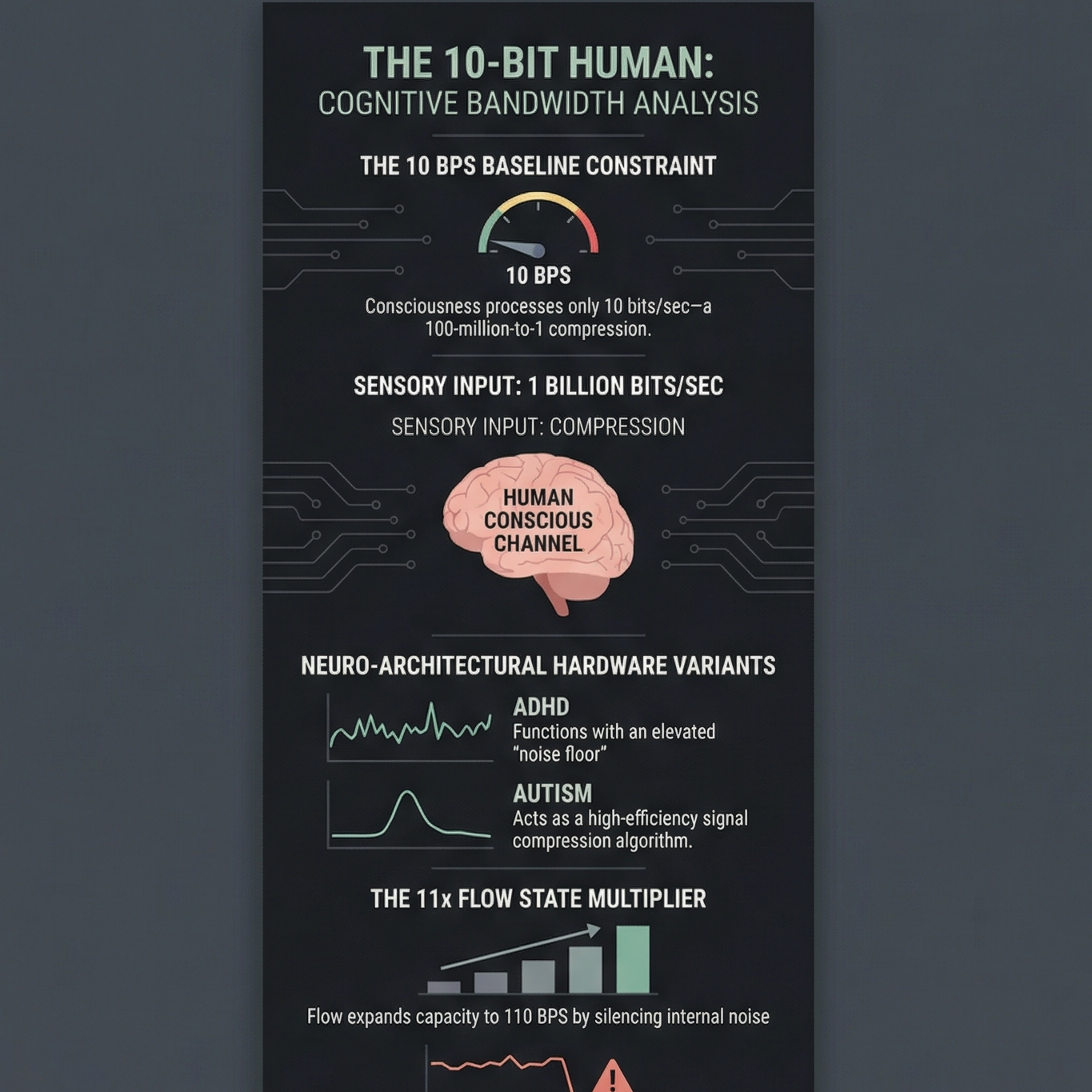

[Dialogue] So, um, I want to start with a really specific and honestly a very painful moment that I think pretty much everyone listening has experienced at least once. You're sitting at your desk, you've got Slack open on one monitor, maybe a half-written email on the other, and a podcast humming in your earbuds. Right, just the standard setup. Exactly, standard modern work. You are being productive. And then someone just walks up to your desk and asks a super simple question, just, "Hey, where do we keep the printer paper?" And you just snap. Well, you don't just snap, you freeze. It's like your brain physically hits a brick wall. You stare at them, and for a solid three seconds, you cannot even process the English language. You just feel this absolute static. It's the modern condition, really. We usually call it burnout or information overload. Or worse, we blame ourselves for not having enough willpower to just focus. Right, we tell ourselves, "I need to hustle harder," or "I need a better to-do list app." But we've been reading through this huge stack of research on information architecture and this thing called the bit calculator. And the sources for today's deep dive are suggesting something radically different. They really are. They're saying that freeze feeling you get, it's not psychological. It's not a mood. See, that's the part I had a really hard time wrapping my head around initially. Because physics, it sounds like a metaphor. Like when you say "I'm under a ton of pressure," you don't literally mean two thousand pounds. Right, but in this case, the sources are being quite literal about the thermodynamics of the brain. We are diving into the hard science today of why you feel overwhelmed. We're going to look at the ten-bit bottleneck, the concept of bit debt, and why your brain is basically writing checks its biology simply cannot cash. And if I'm understanding the paradigm shift here correctly, this completely changes the blame game. Completely. It moves the whole conversation from "try to work harder" to "you are fighting against hardwired biological hardware limitations." And these aren't limitations you can just mindset your way out of. You cannot hustle your way out of the laws of physics. So let's actually look at the hardware. Because the numbers in this research, honestly, when I first read them, I genuinely thought there was a typo. I had to go back and check the citation. You mean the input numbers? Yeah, exactly. We have this culturally ingrained idea that we're these infinite sponges for information, right? That we can just soak it all up forever. But the research gives a hard number for how much data actually hits our body, and it is astronomical. It's a staggering discrepancy. Let's look at the raw input. If you take the human sensor system, so your eyes reading text, your ears hearing our voices, your skin feeling the temperature of the room, your vestibular system keeping you from falling off your chair, you are ingesting data constantly. And the number is roughly one billion bits of information every single second. Right, one billion bits. That sounds so abstract, though. A billion is just a word to most of us. What does that actually look like in terms of data? Think of it this way. Imagine you are sitting there and someone plugs a fiber optic cable directly into the base of your skull. That cable is blasting the equivalent of one hundred high-definition movies into your system every second. That is honestly terrifying. It's a firehose. A literal firehose of reality hitting your nervous system all at once. Okay, so we are drowning in data. But here's the paradox, and this is the part that I really need you to explain because it just doesn't feel right intuitively. If I am taking in a billion bits, why do I struggle to remember a
