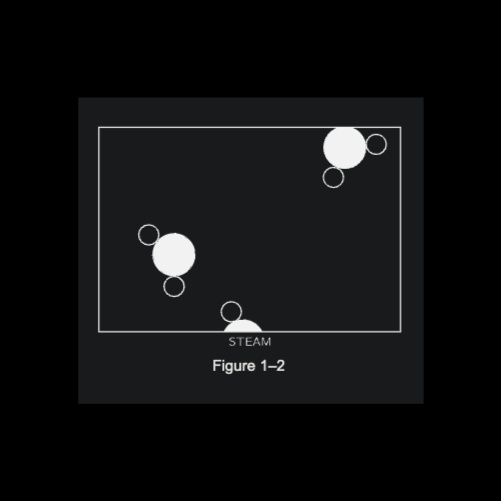

The atoms are one or two times ten to the minus eight centimeters in radius. Now, ten to the minus eight centimeters is called an angstrom, so we say they are one or two angstroms in radius. Another way to remember their size is this: if an apple is magnified to the size of the Earth, then the atoms in the apple are approximately the size of the original apple. Now imagine this great drop of water with all of these jiggling particles stuck together and tagging along with each other. The water keeps its volume; it does not fall apart, because of the attraction of the molecules for each other. If the drop is on a slope, where it can move from one place to another, the water will flow, but it does not just disappear—things do not just fly apart—because of the molecular attraction. Now the jiggling motion is what we represent as heat: when we increase the temperature, we increase the motion. If we heat the water, the jiggling increases and the volume between the atoms increases, and if the heating continues there comes a time when the pull between the molecules is not enough to hold them together and they do fly apart and become separated from one another. Of course, this is how we manufacture steam out of water—by increasing the temperature; the particles fly apart because of the increased motion. In Figure One Dash Two we have a picture of steam. This picture of steam fails in one respect: at ordinary atmospheric pressure there certainly would not be as many as three water molecules in this figure. Most squares this size would contain none—but we accidentally have two and a half or three in the picture just so it would not be completely blank. Now in the case of steam we see the characteristic molecules more clearly than in the case of water. For simplicity, the molecules are drawn so that there is a one hundred twenty degree angle between the hydrogen atoms. In actual fact the angle is one hundred five degrees and three minutes, and the distance between the center of a hydrogen and the center of the oxygen is zero point nine five seven angstroms, so we know this molecule very well.
