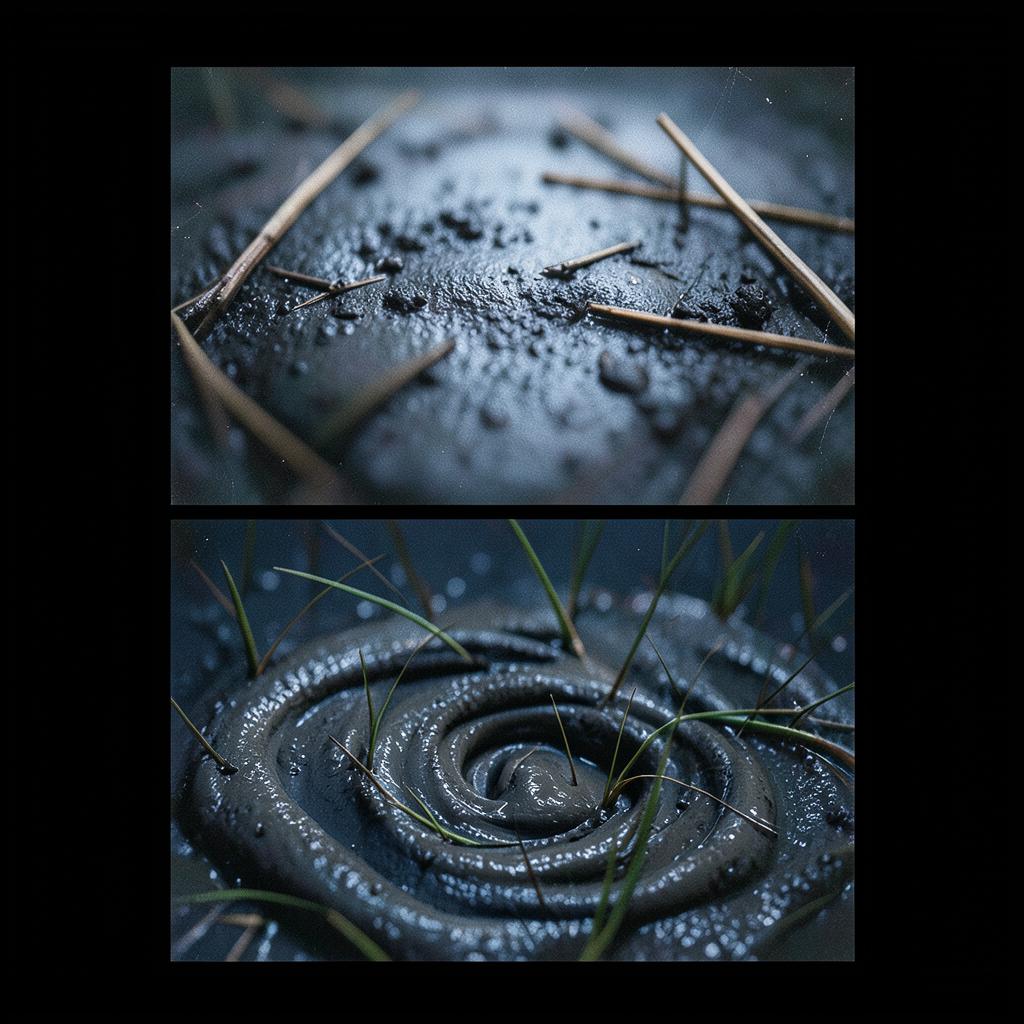

Between the cool, silent body of Apsu below and the warm, restless waters of Tiamat above, the first silt had gathered in a hidden seam of creation, where the deep had begun to dream of form. It was not ordinary mud. It was divine sediment — a thick, shimmering ooze born from the slow mingling of sweet and salt, heavy with memory and potential, alive with the faint pulse of unborn things. In this rich cosmic layer, where no sun had yet looked and no wind had yet stirred, the very first gods began to take shape. Not as grand rulers or cosmic forces, but as something far more primal and intimate. The first children of the deep. The first witnesses to matter becoming life. They emerged together, twin deities born in the same breath from the same glistening mud: **Lahmu** and **Lahamu**. Lahmu rose first, a long, serpentine being of thick, wet clay and dark reeds. His body was powerful yet flexible, covered in a hide of compressed silt that glistened like wet stone beneath the faint, unseen light of the abyss. His eyes were deep-set and heavy-lidded, the color of river mud after a flood, ancient and unreadable. Long strands of marsh-grass grew from his shoulders and spine like living armor, trailing behind him in slow, ghostly waves. He moved with the deliberate strength of something that had never known hurry — coiling through the silt, tasting the waters with his forked tongue, anchoring himself deep into the sediment that had birthed him. He was strength. He was foundation. He was the first solid thing in a world of endless liquid, the first certainty in a place where nothing had yet learned to stand. Beside him, Lahamu unfurled like a living reed drawn upward by a hidden tide. She was slightly smaller, more graceful, her form woven from finer silt and delicate water-plants. Her body shimmered with a softer sheen, reflecting faint glimmers of light that managed to pierce the primordial dark in wavering silver threads. Where Lahmu was thick and heavy, she was supple and flowing. Vines and thin reeds wrapped around her arms and tail like jewelry, like gifts offered by the deep itself. Her eyes were brighter than her brother’s — the pale green of new marsh growth, the color of shoots breaking through wet earth after endless rain. She moved with a gentle, swaying rhythm, like tall reeds dancing in an invisible current, as if the whole world around her had begun to breathe. She was growth. She was renewal. She was the first promise of life that could take root, the first soft answer to the hardness of stone and depth. Together they were the silt gods — the first gods to have actual form, the first to carry the shape of their own existence. They did not rule. They did not command. They did not need thrones, temples, or the applause of creation. They simply *were*. The living embodiment of the fertile mud that lay between their parents, between silence and motion, between stillness and storm. They spent eons drifting slowly through the deep, coiled around one another, exploring the vast layers of sediment they had been born from. They tasted every new mineral that settled from Tiamat’s waters. They felt every subtle shift in pressure from Apsu’s depths below. They learned the language of sinking grains, of suspended particles, of slow accumulation. They knew the secrets of weight, patience, and gradual becoming. They were quiet gods. Patient gods. Gods of waiting and watching, of endurance and deep time. They spoke little, preferring instead to listen to the slow heartbeat of the universe around them — the soft hiss of silt falling, the distant roll of currents, the ancient hush that lived beneath all sound. When they moved, they left graceful paths behind them in the mud, trails that shimmered briefly before settling once more into the dark. When they touched the waters, ripples spread outward like memories. When they rested, they seemed to become part of the earth itself, as if the world could not tell where they ended and the sediment began. When the younger gods eventually came — the loud, flashing, boisterous deities that would fill the abyss with noise, rivalry, laughter, and storm — Lahmu and Lahamu simply watched. They did not join the celebrations. They did not dance beneath the churned-up dark. They remained anchored in their silt, ancient and unmoving, like two living pillars holding up the fragile new world that was forming above them. They watched the brighter gods blaze and clash and scatter like sparks on black water, and still they remained what they had always been: calm, fertile, enduring. The deep root beneath the restless bloom. They were the first. The eldest. The ones who remembered the universe when it was nothing but warm darkness and slow-settling mud. They remembered the first cooling of the waters. The first weight of particles finding one another. The first faint sense that something might one day rise from the abyss and call itself alive. They carried that memory not in words, b
