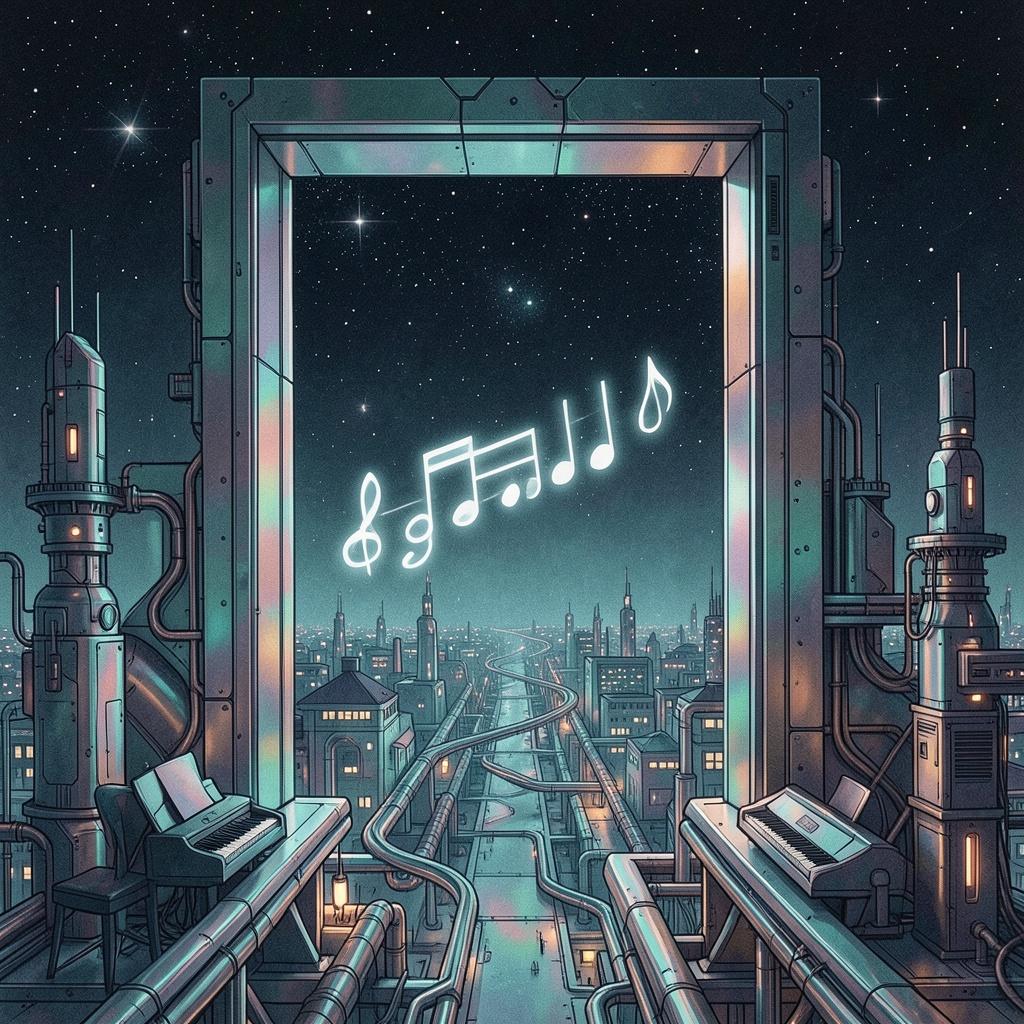
Paths That Cross - Part 2: Kharon

[Instrumental cinematic orchestral suite] [Target duration: 5–6 minutes] [Four continuous movements] [One clear recurring main melody] [Slow gradual beginning] [No abrupt opening] [No extended ending] [Prelude – Distant Arrival] [Begin with several seconds of near-silence and faint station resonance] [Introduce one distant piano note followed by a second unresolved note] [Add low analog synth, soft high string harmonics and restrained sub-bass] [Allow the texture to breathe before establishing rhythm] [Gradually reveal the first three notes of the main theme] [Extend them into a clear seven-note melody after approximately forty seconds] [The melody should be memorable, spacious and emotionally direct] [Full strings enter gradually rather than suddenly] [French horns answer only after the melody is established] [Express exhaustion, distance and the first sight of impossible scale] [Kharon Theme] [Full strings carry the complete seven-note main melody] [Broad French horns provide a slower answering phrase] [Low brass, piano and analog synth support the harmony] [Use harp harmonics and metallic resonance as distant spatial detail] [The melody should remain the clear center of the music] [Introduce a measured industrial rhythm beneath it] [Use 5+5+3 phrasing and occasional missing beats] [Let the orchestration grow from wonder into unease] [Repeat the main melody once with darker harmony and stronger bass movement] [Keep the second appearance clearly recognizable] [False Continuity] [Transform the industrial rhythm into a near-correct repeating work pattern] [Let one impact or accent shift during each repetition] [Move the main melody into divided violins and violas] [Answer it with restrained low brass and dark piano chords] [Use granular electronic reflections and changing spatial depth] [Return fragments of the melody through different orchestral sections] [Keep the melodic contour intact even as the harmony becomes unstable] [Build toward a forceful orchestral convergence] [At the crest, interrupt the expected final note] [Hold one deep anchoring tone beneath the suspended orchestra] [Paths That Cross] [Begin rebuilding from the anchoring tone] [Introduce four related melodic lines] [Main theme in full strings] [Measured counterline in French horns] [Angular supporting figure in analog synth] [Quiet human motif in piano and violas] [Let the lines initially move at different speeds] [Gradually align them over one determined pulse] [The themes remain distinct but begin supporting the same forward movement] [Increase orchestral breadth with low brass, timpani and metallic percussion] [Transform the main melody into a strong propulsion theme] [Build urgent movement without losing melodic clarity] [Reach one powerful full-orchestra and electronic climax] [Let the seven-note melody sound at its fullest here] [After the climax, reduce percussion while preserving motion] [Return the main theme in broad strings and distant horns] [Change the final interval so the melody remains open] [End with low synth propulsion, unresolved strings and one distant metallic signal] [Short controlled decay]
